Colorado: Sharing the road — Part 4 Practice Test
Questions in this part include: “What does the handbook say about violating school bus traffic laws?” · “Where should you check for laws that may apply differently to bicyclists, such as riding on sidewalks and in crosswalks?”
Independent educational site · not affiliated with any government agency or DMV
Ready? Test yourself
- Instant feedback with an explanation
- Every answer cites its source in the manual
- Your best score is saved on this device
Questions are original and based on the official manual "Colorado Driver Handbook" (DR 2337, January 2025), Colorado Division of Motor Vehicles (DMV).
All 17 questions in this practice test
Take the test above first, then use this list to study. Tap “Show answer” to see the correct answer and explanation.
Show the questions and answersHide the questions
-
On a divided highway with four or more lanes and a median separating the traffic, which vehicles must stop for a school bus that is stopped with its red lights flashing?
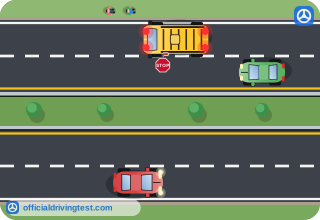
- Vehicles traveling in both directions
- Only vehicles in the lane next to the bus
- Only vehicles in the right lane behind it
- Only vehicles in both lanes behind the bus
Show answer
Correct answer: Only vehicles in both lanes behind the bus
With a median separating the traffic, only the vehicles in both lanes behind the school bus must stop, not the opposite traffic.
Source: Colorado Driver Handbook (DR 2337, January 2025), page 20 · Open this page in the manual (Manual page 20)
-
On a two-lane roadway, which traffic must stop for a school bus that is stopped with its red lights flashing?
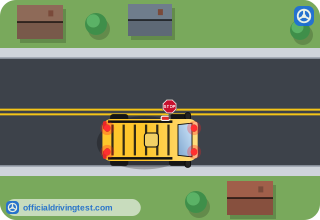
- Traffic in both directions
- Only traffic behind the bus
- Only traffic in the bus's lane
- Only traffic in the opposite direction
Show answer
Correct answer: Traffic in both directions
On a two-lane roadway, traffic in both directions is required to stop.
Source: Colorado Driver Handbook (DR 2337, January 2025), page 20 · Open this page in the manual (Manual page 20)
-
On a four-lane road without a median, which traffic must stop for a school bus that is stopped with its red lights flashing?
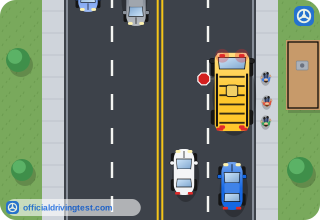
- Only vehicles behind the bus
- Only vehicles in the bus's lane
- Vehicles in both directions
- Only vehicles in the opposite direction
Show answer
Correct answer: Vehicles in both directions
On a four-lane road without a median, traffic in both directions must stop.
Source: Colorado Driver Handbook (DR 2337, January 2025), page 20 · Open this page in the manual (Manual page 20)
-
On a highway with five or more lanes and a shared center turn lane, which vehicles must come to a complete stop for a stopped school bus with its red lights flashing?
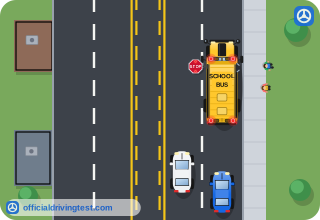
- Vehicles in all lanes, in both directions
- Only vehicles in both lanes behind the bus
- Only vehicles in the lane next to the bus
- Only vehicles in the center turn lane
Show answer
Correct answer: Only vehicles in both lanes behind the bus
With a shared center turn lane, only the vehicles in both lanes behind the school bus must stop, and opposite traffic is not required to.
Source: Colorado Driver Handbook (DR 2337, January 2025), page 20 · Open this page in the manual (Manual page 20)
-
What does the handbook say about violating school bus traffic laws?
- It results in a written warning only
- It is a minor offense for a first violation
- It applies only to vehicles behind the bus
- It has serious legal consequences
Show answer
Correct answer: It has serious legal consequences
The handbook states that violating school bus traffic laws has serious legal consequences.
Source: Colorado Driver Handbook (DR 2337, January 2025), page 21 · Open this page in the manual (Manual page 21)
-
How does the handbook classify bicycles on the roadway?
- As vehicles
- As pedestrians
- As a separate class with no duty to follow the rules of the road
- As equipment that may use only sidewalks
Show answer
Correct answer: As vehicles
The handbook states that bicycles are considered vehicles on the roadway, with many of the same rights and responsibilities as motorists.
Source: Colorado Driver Handbook (DR 2337, January 2025), page 22 · Open this page in the manual (Manual page 22)
-
Where should you check for laws that may apply differently to bicyclists, such as riding on sidewalks and in crosswalks?
- Your vehicle owner’s manual
- The license plate registration rules
- Your local ordinances
- The lane markings on the road
Show answer
Correct answer: Your local ordinances
The manual says to check local ordinances, because in some communities bicyclists may ride on sidewalks and in crosswalks.
Source: Colorado Driver Handbook (DR 2337, January 2025), page 22 · Open this page in the manual (Manual page 22)
-
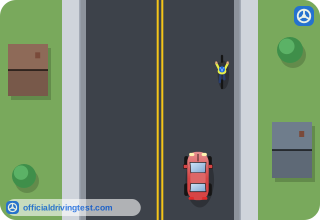
Why must drivers be especially alert and cautious when approaching or passing bicyclists?
- Bicyclists are not allowed to use any road with a posted speed limit
- Bicycles are smaller and bicyclists are more vulnerable than people in vehicles
- Bicyclists always have the same level of experience and skill as drivers
- Bicyclists are required to stop and yield to every motor vehicle
Show answer
Correct answer: Bicycles are smaller and bicyclists are more vulnerable than people in vehicles
The manual says bicycles are smaller and bicyclists are more vulnerable than people inside of motor vehicles.
Source: Colorado Driver Handbook (DR 2337, January 2025), page 22 · Open this page in the manual (Manual page 22)
-
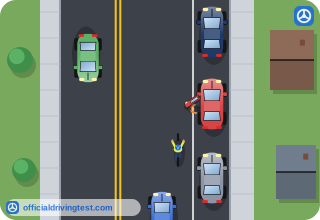
Colorado law says bicyclists should ride as far to the right as judged safe. Where may bicyclists ride on a narrow road or to avoid obstacles such as the door zone of parked cars?
- Only on the left shoulder
- Only on the sidewalk
- Only in the farthest right part of the lane, with no exceptions
- In the center of the travel lane
Show answer
Correct answer: In the center of the travel lane
The manual says bicyclists may ride in the center of the travel lane on narrow roads or to avoid obstacles such as the door zone of parked cars, broken glass or drainage grates.
Source: Colorado Driver Handbook (DR 2337, January 2025), page 22 · Open this page in the manual (Manual page 22)
-
What is the minimum distance a motorist must give when passing a bicyclist, including one in a bike lane?
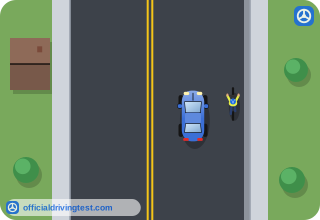
- Three feet from the outermost part of the vehicle or any attachments
- Two feet from the center line of the road or any attachments
- Four feet from the bicyclist's handlebars on roads with a bike lane
- Five feet from the outermost part of the vehicle, but only in town
Show answer
Correct answer: Three feet from the outermost part of the vehicle or any attachments
The manual requires a minimum of three feet from the outermost part of the vehicle or any attachments.
Source: Colorado Driver Handbook (DR 2337, January 2025), page 22 · Open this page in the manual (Manual page 22)
-
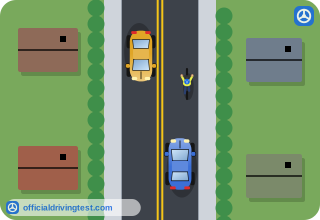
If you are unable to give a bicyclist three feet of passing distance, what should you do?
- Sound your horn and pass as closely as needed
- Slow down and remain behind the bicyclist until it is safe to pass
- Pass on the right side of the bicyclist
- Pass at the same speed, staying as far left as possible
Show answer
Correct answer: Slow down and remain behind the bicyclist until it is safe to pass
The manual says to slow down and stay behind the bicyclist until it is safe to pass.
Source: Colorado Driver Handbook (DR 2337, January 2025), page 22 · Open this page in the manual (Manual page 22)
-
When may bicyclists ride side by side?
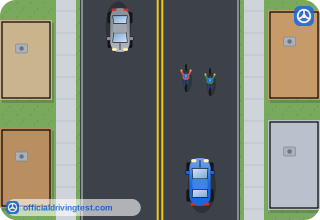
- Never, because they must always ride in single file on every road
- Only on roads with a posted speed limit under 25 miles per hour
- Only when they are riding in a designated bike lane or on a path
- If they are not impeding the normal and reasonable movement of traffic
Show answer
Correct answer: If they are not impeding the normal and reasonable movement of traffic
The manual allows side-by-side riding if bicyclists are not impeding the normal and reasonable movement of traffic.
Source: Colorado Driver Handbook (DR 2337, January 2025), page 22 · Open this page in the manual (Manual page 22)
-
How must you treat bicyclists in intersections?

- Yield to them as you would for pedestrians and other vehicles
- Expect them to yield to you because they are slower
- Pass them first, then turn
- Ignore them unless they use hand signals
Show answer
Correct answer: Yield to them as you would for pedestrians and other vehicles
The manual says to yield to bicyclists in intersections as you would for pedestrians and other vehicles.
Source: Colorado Driver Handbook (DR 2337, January 2025), page 22 · Open this page in the manual (Manual page 22)
-
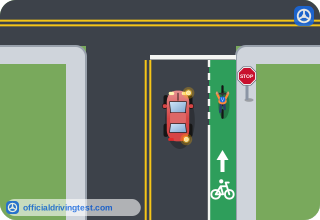
What is true of bike lanes at intersections?
- They end at the edge of every intersection, even where paint continues
- They continue only where paint extends through the intersection
- They continue through intersections, with or without paint across them
- They continue only at intersections that have traffic signals
Show answer
Correct answer: They continue through intersections, with or without paint across them
The manual says people on bikes have the right-of-way in a bike lane, and bike lanes continue through intersections regardless of paint.
Source: Colorado Driver Handbook (DR 2337, January 2025), page 22 · Open this page in the manual (Manual page 22)
-
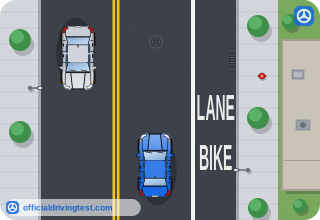
Why should you not stop, park or drive in a designated bicycle path or lane?
- It is allowed, but only when no bicyclist is present in the lane
- It forces bicyclists into the main travel lane and can put them in danger
- It makes the bicycle lane markings wear out faster than other markings
- It blocks the view of other drivers who are behind you on the road
Show answer
Correct answer: It forces bicyclists into the main travel lane and can put them in danger
The manual says impeding bicycle traffic in a bike lane forces bicyclists into the main travel lane and can put them in an unsafe situation.
Source: Colorado Driver Handbook (DR 2337, January 2025), page 22 · Open this page in the manual (Manual page 22)
-
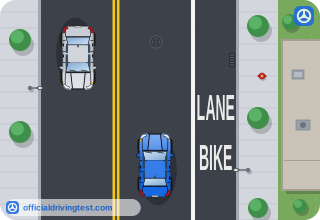
When may a driver cross a bike lane?
- Never, under any circumstances, even when turning at an intersection
- Only when passing a bicyclist who is riding in the bike lane
- Only when the bike lane is empty and the road surface is wet
- When turning, or entering or leaving a road, driveway or alley
Show answer
Correct answer: When turning, or entering or leaving a road, driveway or alley
The manual says you may cross a bike lane when turning, entering or leaving another road, driveway or alley.
Source: Colorado Driver Handbook (DR 2337, January 2025), page 23 · Open this page in the manual (Manual page 23)
-
Are people on bikes required to stay in a bike lane when one is present?
- No, people on bikes may ride outside of a bike lane
- Yes, they must always use the bike lane when there is one
- Yes, unless they are riding side by side with others
- Yes, but only during daylight hours on weekdays
Show answer
Correct answer: No, people on bikes may ride outside of a bike lane
The manual states that people on bikes may ride outside of a bike lane.
Source: Colorado Driver Handbook (DR 2337, January 2025), page 23 · Open this page in the manual (Manual page 23)