Colorado: Sharing the road — Part 3 Practice Test
Questions in this part include: “What is one sign of a runaway truck or bus?” · “What activates when a school bus driver opens the bus door?”
Independent educational site · not affiliated with any government agency or DMV
Ready? Test yourself
- Instant feedback with an explanation
- Every answer cites its source in the manual
- Your best score is saved on this device
Questions are original and based on the official manual "Colorado Driver Handbook" (DR 2337, January 2025), Colorado Division of Motor Vehicles (DMV).
All 17 questions in this practice test
Take the test above first, then use this list to study. Tap “Show answer” to see the correct answer and explanation.
Show the questions and answersHide the questions
-
What is one sign of a runaway truck or bus?
- Hazard lights flashing continuously
- Smoke coming from the brakes
- A loud horn blowing in short bursts
- Brake lights staying off on a downgrade
Show answer
Correct answer: Smoke coming from the brakes
The handbook lists smoke coming from the brakes as one sign of a runaway truck or bus.
Source: Colorado Driver Handbook (DR 2337, January 2025), page 20 · Open this page in the manual (Manual page 20)
-
If you see a runaway truck or bus, what should you do?
- Follow closely to stay out of its blind spots
- Pass it quickly on the left to get in front
- Brake hard in front of it to slow it down
- Get out of the way and do not get in front of it
Show answer
Correct answer: Get out of the way and do not get in front of it
The handbook says to get out of the way and not to get in front of the truck or bus.
Source: Colorado Driver Handbook (DR 2337, January 2025), page 20 · Open this page in the manual (Manual page 20)
-
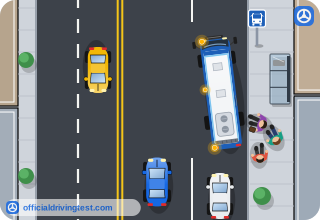
What should you do when driving behind a bus, since buses frequently stop?
- Stay alert so you can stop smoothly and safely
- Pass it at the first chance to avoid delay
- Follow closely so other drivers cannot cut in
- Flash your lights each time it slows down
Show answer
Correct answer: Stay alert so you can stop smoothly and safely
Buses frequently stop, so you must stay alert to allow for smooth and safe stopping of your vehicle.
Source: Colorado Driver Handbook (DR 2337, January 2025), page 20 · Open this page in the manual (Manual page 20)
-
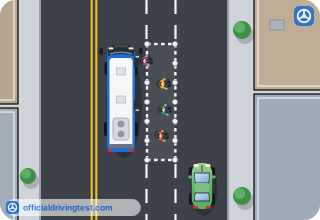
Why should you use care when passing a stopped bus?
- Buses are required to pull to the right when you pass
- The bus is required to wait until you finish passing
- The bus may start to move out into your lane of traffic
- The bus lights show it will turn left across your path
Show answer
Correct answer: The bus may start to move out into your lane of traffic
The handbook says a stopped bus may start to move out into your lane of traffic.
Source: Colorado Driver Handbook (DR 2337, January 2025), page 20 · Open this page in the manual (Manual page 20)
-
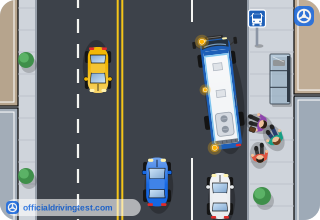
Who has the right-of-way when a bus is leaving a drop-off location and merging into traffic?
- The vehicle already in the lane
- The bus
- The vehicle that is going faster
- The vehicle that signals first
Show answer
Correct answer: The bus
The handbook says buses have the right-of-way when leaving a drop-off location and merging into traffic; for transit buses it adds that you must yield when the bus is signaling to enter a traffic lane and the yield sign on its rear is lit.
Source: Colorado Driver Handbook (DR 2337, January 2025), page 20 · Open this page in the manual (Manual page 20)
-
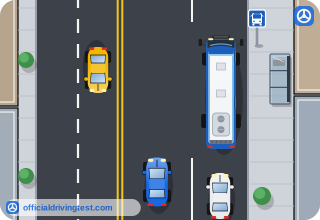
Which people should you look for when driving near a bus?
- Only pedestrians already crossing the road
- Motorcyclists passing on the right of the bus
- Bus drivers waving other vehicles through
- Pedestrians exiting or waiting to board the bus
Show answer
Correct answer: Pedestrians exiting or waiting to board the bus
The handbook tells you to look for pedestrians who might be exiting or waiting to board the bus.
Source: Colorado Driver Handbook (DR 2337, January 2025), page 20 · Open this page in the manual (Manual page 20)
-
Where should you watch for people walking and loading bikes around a bus?
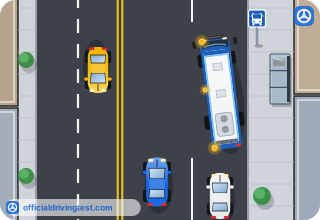
- In front of the bus
- Behind the bus
- Beside the rear doors
- On the far shoulder
Show answer
Correct answer: In front of the bus
The handbook says to watch for people walking and loading bikes in front of the bus.
Source: Colorado Driver Handbook (DR 2337, January 2025), page 20 · Open this page in the manual (Manual page 20)
-
Why should you use extra caution near school buses, especially in neighborhoods and school zones?
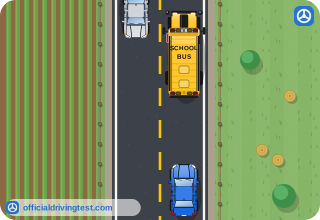
- School buses there may ignore traffic signals
- Bus drivers in those areas cannot see vehicles behind them
- Students are likely to be getting on and off and crossing roads
- School buses in those areas always travel faster than traffic
Show answer
Correct answer: Students are likely to be getting on and off and crossing roads
These areas are likely to have students getting on and off the bus as well as crossing roads.
Source: Colorado Driver Handbook (DR 2337, January 2025), page 20 · Open this page in the manual (Manual page 20)
-
When does a school bus driver activate the overhead amber (yellow) warning lights?
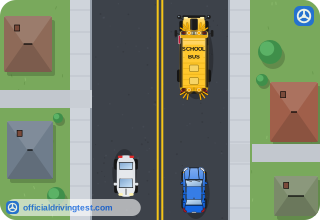
- Only after the bus has come to a complete stop
- When the bus is about to stop to load or unload children
- Whenever the bus is traveling slower than traffic
- When the bus is stopped and children are crossing
Show answer
Correct answer: When the bus is about to stop to load or unload children
The driver activates the amber warning lights when the bus is about to stop and load or unload children.
Source: Colorado Driver Handbook (DR 2337, January 2025), page 20 · Open this page in the manual (Manual page 20)
-
How long do a school bus's overhead yellow warning lights stay on?
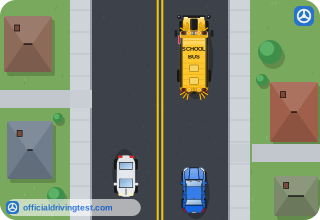
- Until the bus stops moving
- Until the last child has boarded
- Until the bus driver turns on the hazard lights
- Until the bus door opens
Show answer
Correct answer: Until the bus door opens
The handbook says the yellow warning lights stay on until the bus door opens.
Source: Colorado Driver Handbook (DR 2337, January 2025), page 20 · Open this page in the manual (Manual page 20)
-
What activates when a school bus driver opens the bus door?
- The red STOP lights and STOP arm
- The amber warning lights only
- The yellow hazard flashers and a horn
- Only the bus's brake lights
Show answer
Correct answer: The red STOP lights and STOP arm
When the bus driver opens the bus door, the red STOP lights and STOP arm activate.
Source: Colorado Driver Handbook (DR 2337, January 2025), page 20 · Open this page in the manual (Manual page 20)
-
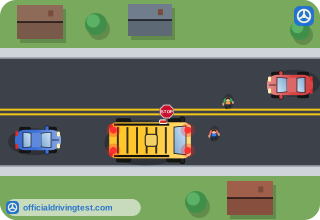
When must you stay stopped for a school bus that has its red STOP lights and STOP arm activated?
- Until the first child has crossed the road in front of you
- Until the bus begins to move and children are inside
- Until the driver retracts the stop arm and turns off the red lights
- Until the amber warning lights start flashing again
Show answer
Correct answer: Until the driver retracts the stop arm and turns off the red lights
You must remain stopped until the bus driver retracts the stop arm and deactivates the red warning lights.
Source: Colorado Driver Handbook (DR 2337, January 2025), page 20 · Open this page in the manual (Manual page 20)
-
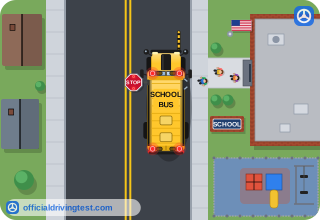
What is the minimum distance from the front or rear bumper of a school bus at which vehicles must stop?
- 5 feet
- 20 feet
- 10 feet
- 15 feet
Show answer
Correct answer: 20 feet
Vehicles must stop no less than 20 feet from the front or rear bumper of the school bus.
Source: Colorado Driver Handbook (DR 2337, January 2025), page 20 · Open this page in the manual (Manual page 20)
-
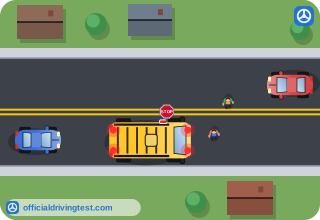
What does the handbook say about not stopping when a school bus has its stop lights on and stop arm extended?
- It is allowed if you slow down and proceed carefully
- It is only a violation if a child is in the road
- It is allowed if no children are visible
- It is illegal and dangerous
Show answer
Correct answer: It is illegal and dangerous
The handbook says it is illegal and dangerous not to stop in this situation.
Source: Colorado Driver Handbook (DR 2337, January 2025), page 20 · Open this page in the manual (Manual page 20)
-
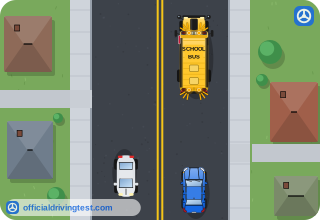
On a school bus with overhead red and yellow lights, what should you do when the yellow lights are flashing?
- Prepare to stop
- Stop at least 20 feet away
- Proceed at normal speed
- Pass the bus on the left
Show answer
Correct answer: Prepare to stop
The school bus diagram says that when the yellow lights are flashing you should prepare to stop.
Source: Colorado Driver Handbook (DR 2337, January 2025), page 20 · Open this page in the manual (Manual page 20)
-
The school bus diagram says that when yellow hazard warning lights are flashing on any school bus, what should you do?
- Stop at least 20 feet away
- Stop until the lights go off
- Proceed with caution
- Pass the bus quickly on the left
Show answer
Correct answer: Proceed with caution
The diagram for all school buses says to proceed with caution when the yellow hazard warning lights are flashing.
Source: Colorado Driver Handbook (DR 2337, January 2025), page 20 · Open this page in the manual (Manual page 20)
-
After the flashing red lights of a stopped school bus turn off, how should you proceed?
- At normal speed
- With caution
- After honking once
- Only after the bus moves
Show answer
Correct answer: With caution
The handbook says not to proceed until the flashing red lights stop, and then to proceed with caution.
Source: Colorado Driver Handbook (DR 2337, January 2025), page 20 · Open this page in the manual (Manual page 20)