Colorado: Sharing the road — Part 2 Practice Test
Questions in this part include: “What may not be visible on rural roads because of trees, crops and bushes?” · “A two-wheeled motorcycle may pass stopped vehicles in the same lane, if there is enough room, at what maximum speed?”
Independent educational site · not affiliated with any government agency or DMV
Ready? Test yourself
- Instant feedback with an explanation
- Every answer cites its source in the manual
- Your best score is saved on this device
Questions are original and based on the official manual "Colorado Driver Handbook" (DR 2337, January 2025), Colorado Division of Motor Vehicles (DMV).
All 17 questions in this practice test
Take the test above first, then use this list to study. Tap “Show answer” to see the correct answer and explanation.
Show the questions and answersHide the questions
-
What may not be visible on rural roads because of trees, crops and bushes?
- Speed limit signs on freeways
- Blind driveways and T-intersections
- Street lights along the shoulder
- Center lines on straight roads
Show answer
Correct answer: Blind driveways and T-intersections
Rural roads can have blind driveways, T-intersections and side streets hidden by trees, crops and bushes.
Source: Colorado Driver Handbook (DR 2337, January 2025), page 17 · Open this page in the manual (Manual page 17)
-
Which of these obstacles may be on a rural road?
- Toll plazas, weigh stations and rest areas
- Parking meters, bus lanes and bike boxes
- Roundabouts, traffic signals and crosswalks
- Farm vehicle and unmarked railroad crossings
Show answer
Correct answer: Farm vehicle and unmarked railroad crossings
Rural roads may have obstacles such as rocks, debris, animals, farm vehicle crossings and unmarked railroad crossings.
Source: Colorado Driver Handbook (DR 2337, January 2025), page 17 · Open this page in the manual (Manual page 17)
-
Where might bicyclists ride on a rural road that has no shoulder or a shoulder with debris?
- Only on the sidewalk
- On the center line
- In the oncoming lane
- In the travel lane
Show answer
Correct answer: In the travel lane
Watch for bicyclists riding on the shoulder, or in the travel lane if there is no shoulder or it has debris.
Source: Colorado Driver Handbook (DR 2337, January 2025), page 17 · Open this page in the manual (Manual page 17)
-
Which smaller road users should you look for as you scan?
- Only large trucks, buses and recreational vehicles
- Only passenger vehicles traveling in your own lane
- Pedestrians, bicyclists and motorcyclists
- Only pedestrians who are using marked crosswalks
Show answer
Correct answer: Pedestrians, bicyclists and motorcyclists
Be sure to look for smaller road users, including pedestrians, bicyclists and motorcyclists.
Source: Colorado Driver Handbook (DR 2337, January 2025), page 18 · Open this page in the manual (Manual page 18)
-
A two-wheeled motorcycle may pass stopped vehicles in the same lane, if there is enough room, at what maximum speed?
- 5 miles per hour
- 10 miles per hour
- 15 miles per hour
- 25 miles per hour
Show answer
Correct answer: 15 miles per hour
The handbook allows this only at a speed no greater than 15 miles per hour.
Source: Colorado Driver Handbook (DR 2337, January 2025), page 19 · Open this page in the manual (Manual page 19)
-
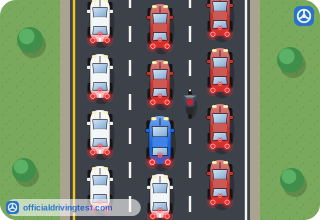
What does the handbook call it when a two-wheeled motorcycle passes stopped vehicles in the same lane because the vehicles in the next lanes are also stopped and there is room?
- Zipper passing
- Lane filtering
- Lane sharing
- Shoulder riding
Show answer
Correct answer: Lane filtering
The handbook names this maneuver lane filtering.
Source: Colorado Driver Handbook (DR 2337, January 2025), page 19 · Open this page in the manual (Manual page 19)
-
Why should you stay behind the white-painted stop bars at stop signs and traffic lights, according to the handbook?
- They show where school buses must stop to load children
- They mark the exact spot where cameras photograph vehicles
- They are set where drivers can best see approaching bikes
- Many are carefully measured to give trucks room to turn
Show answer
Correct answer: Many are carefully measured to give trucks room to turn
The handbook says many stop bars are carefully measured to give trucks the room they need for turns.
Source: Colorado Driver Handbook (DR 2337, January 2025), page 20 · Open this page in the manual (Manual page 20)
-
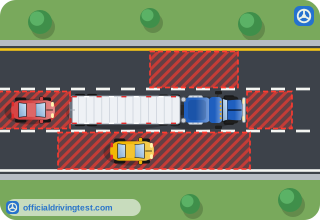
What are the blind spots around trucks and buses called?
- No Zones
- Stop Zones
- Truck Pockets
- Dead Zones
Show answer
Correct answer: No Zones
The handbook calls the blind spots around trucks and buses “No Zones.”
Source: Colorado Driver Handbook (DR 2337, January 2025), page 20 · Open this page in the manual (Manual page 20)
-
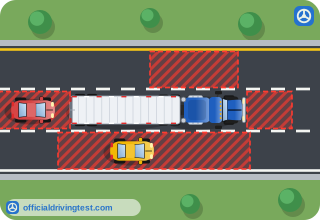
What happens when your vehicle is traveling in a truck or bus No Zone?
- You are protected because the truck driver slows down
- The driver sees you in the mirrors but may not signal
- The driver cannot see you, which greatly raises crash potential
- You can see the driver, so the driver can see you
Show answer
Correct answer: The driver cannot see you, which greatly raises crash potential
Vehicles in No Zones cannot be seen and greatly increase the potential for a crash.
Source: Colorado Driver Handbook (DR 2337, January 2025), page 20 · Open this page in the manual (Manual page 20)
-
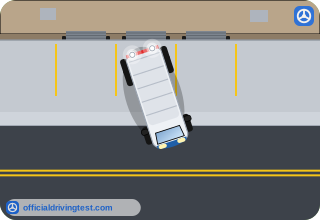
What should you do around a truck or bus that is preparing to back up?
- Pass quickly on the right side
- Do not pass or stop close to it
- Stop close behind it to show where you are
- Honk to warn the driver and stay behind it
Show answer
Correct answer: Do not pass or stop close to it
The trailer will obstruct objects in the No Zone, so you should not pass or stop close to a truck or bus that is backing up.
Source: Colorado Driver Handbook (DR 2337, January 2025), page 20 · Open this page in the manual (Manual page 20)
-
How does the handbook say you should pass a truck?
- Slowly and on the right to stay out of its blind spot
- Slowly, staying beside it to let the driver see you
- On the right, staying beside it until traffic clears
- Quickly and on the left when possible
Show answer
Correct answer: Quickly and on the left when possible
The handbook says to pass trucks quickly and on the left when possible.
Source: Colorado Driver Handbook (DR 2337, January 2025), page 20 · Open this page in the manual (Manual page 20)
-
After passing a truck or bus, when can you pull in front of it?
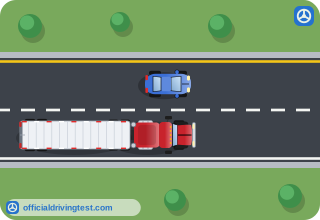
- When you can see both of its headlights in your rear view mirror
- When you can see one headlight in your rear view mirror
- As soon as your rear bumper is past its front bumper
- As soon as you have passed it and signaled briefly
Show answer
Correct answer: When you can see both of its headlights in your rear view mirror
Trucks need longer distances to slow down, so wait until you can see both headlights on the front of the vehicle in your mirror.
Source: Colorado Driver Handbook (DR 2337, January 2025), page 20 · Open this page in the manual (Manual page 20)
-
Why should you not tailgate a truck or bus?
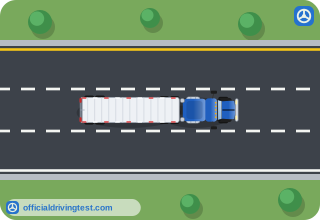
- The truck's exhaust can damage your vehicle's engine
- The driver will think you want to pass and speed up
- The driver cannot see you and it cuts off your view of traffic
- Tailgating a large vehicle is allowed only on freeways
Show answer
Correct answer: The driver cannot see you and it cuts off your view of traffic
Trucks and buses have large rear blind spots, so the driver cannot see you and your own view of traffic is cut off.
Source: Colorado Driver Handbook (DR 2337, January 2025), page 20 · Open this page in the manual (Manual page 20)
-
How do the side blind spots of trucks and buses compare with those of cars?
- About the same size as a car's
- Much larger on both sides
- Larger only on the right side
- Larger only on the driver's side
Show answer
Correct answer: Much larger on both sides
Trucks and buses have much larger blind spots on both sides than cars.
Source: Colorado Driver Handbook (DR 2337, January 2025), page 20 · Open this page in the manual (Manual page 20)
-
What increases the possibility of a collision when a large truck or bus makes a right turn?
- Staying well behind it until it completes the turn
- Slowing down to let it complete the turn
- Stopping behind the stop bar until it turns
- Cutting in between it and the curb or shoulder
Show answer
Correct answer: Cutting in between it and the curb or shoulder
Trucks and buses often move to the left lane to make right turns, and cutting in between them and the curb increases the possibility of a collision.
Source: Colorado Driver Handbook (DR 2337, January 2025), page 20 · Open this page in the manual (Manual page 20)
-
What were runaway truck ramps built to prevent?
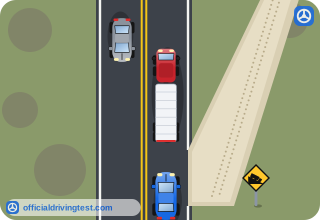
- Serious crashes from out of control vehicles
- Trucks from exceeding the speed limit downhill
- Slow trucks from blocking mountain highways
- Trucks from using the shoulder in snow
Show answer
Correct answer: Serious crashes from out of control vehicles
The handbook says runaway truck ramps were built to prevent serious crashes from out of control vehicles.
Source: Colorado Driver Handbook (DR 2337, January 2025), page 20 · Open this page in the manual (Manual page 20)
-
According to the handbook, which action on a runaway truck ramp or its entrance is both illegal and unsafe?
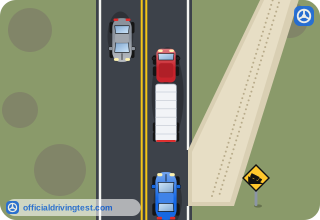
- Passing a slower vehicle near it
- Signaling a lane change near it
- Changing a tire
- Driving past it in the right lane
Show answer
Correct answer: Changing a tire
The handbook says never to chain up, change a tire or park on the ramp or the entrance.
Source: Colorado Driver Handbook (DR 2337, January 2025), page 20 · Open this page in the manual (Manual page 20)