Colorado: Railroad crossings and light rail — Part 2 Practice Test
Questions in this part include: “By how much do trains overhang the tracks?” · “Which vehicles must stop at most railroad crossings?”
Independent educational site · not affiliated with any government agency or DMV
Ready? Test yourself
- Instant feedback with an explanation
- Every answer cites its source in the manual
- Your best score is saved on this device
Questions are original and based on the official manual "Colorado Driver Handbook" (DR 2337, January 2025), Colorado Division of Motor Vehicles (DMV).
All 22 questions in this practice test
Take the test above first, then use this list to study. Tap “Show answer” to see the correct answer and explanation.
Show the questions and answersHide the questions
-
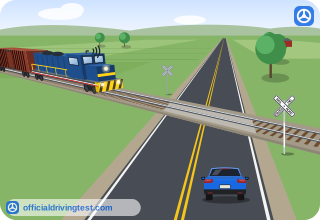
If no stop line is visible at a railroad crossing, how far from the tracks must you be?
- At least 3 feet
- At least 5 feet
- At least 6 feet
- At least 10 feet
Show answer
Correct answer: At least 10 feet
The handbook says that if no line is visible, you must be at least 10 feet from the tracks.
Source: Colorado Driver Handbook (DR 2337, January 2025), page 21 · Open this page in the manual (Manual page 21)
-
By how much do trains overhang the tracks?
- 3 feet
- 1 foot
- 6 feet
- 8 feet
Show answer
Correct answer: 3 feet
The handbook says trains overhang the tracks by 3 feet.
Source: Colorado Driver Handbook (DR 2337, January 2025), page 21 · Open this page in the manual (Manual page 21)
-
What sign is posted below the Advance Warning sign at crossings in designated quiet zones?
- A “Stop Here” sign
- A “Yield to Trains” sign
- A “No Train Horn” sign
- A “Stop on Red” sign
Show answer
Correct answer: A “No Train Horn” sign
Crossings in designated quiet zones have a “No Train Horn” sign posted below the Advance Warning signs.
Source: Colorado Driver Handbook (DR 2337, January 2025), page 21 · Open this page in the manual (Manual page 21)
-
At a crossing in a designated quiet zone, what warns you of an approaching train?
- A train horn
- The flashing lights and gates
- A railroad worker with a flag
- A bell on the crossbuck
Show answer
Correct answer: The flashing lights and gates
Train horns do not blow in quiet zones, so the flashing lights and gates warn you of an approaching train.
Source: Colorado Driver Handbook (DR 2337, January 2025), page 21 · Open this page in the manual (Manual page 21)
-
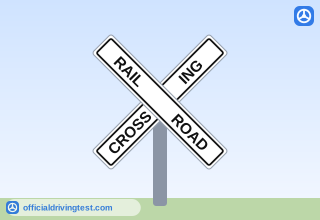
How should you treat a crossbuck sign?
- The same as a stop sign
- As a marker for trains only
- As a speed limit sign
- The same as a yield sign
Show answer
Correct answer: The same as a yield sign
The handbook says crossbuck signs should be treated the same as a yield sign.
Source: Colorado Driver Handbook (DR 2337, January 2025), page 21 · Open this page in the manual (Manual page 21)
-
At a crossing with more than one track, what does the sign below the crossbuck indicate?
- The number of tracks at the crossing
- The maximum train speed
- The distance to the next crossing
- Whether train horns are allowed
Show answer
Correct answer: The number of tracks at the crossing
If there is more than one track, a sign below the crossbuck indicates the number of tracks.
Source: Colorado Driver Handbook (DR 2337, January 2025), page 21 · Open this page in the manual (Manual page 21)
-
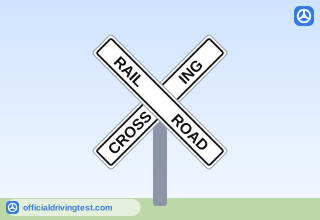
Crossbuck signs normally serve as caution signs. When do they become regulatory?
- At night only
- When the gates are up
- When a train approaches
- During rush hour
Show answer
Correct answer: When a train approaches
They normally serve as caution signs but become regulatory when a train approaches.
Source: Colorado Driver Handbook (DR 2337, January 2025), page 21 · Open this page in the manual (Manual page 21)
-
Which vehicles must stop at most railroad crossings?
- Commercial buses and all trucks carrying any load
- Commercial buses and trucks carrying hazardous materials
- All passenger vehicles towing a trailer
- Commercial vans and every truck over 10,000 pounds
Show answer
Correct answer: Commercial buses and trucks carrying hazardous materials
The handbook says commercial buses and trucks carrying hazardous materials must stop at most railroad crossings.
Source: Colorado Driver Handbook (DR 2337, January 2025), page 21 · Open this page in the manual (Manual page 21)
-
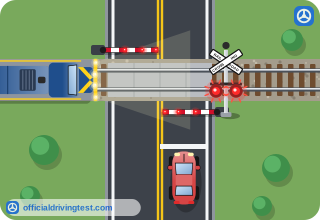
What should you do when railroad crossing lights are flashing?
- Stop only if you can see a train approaching
- Slow down and cross if no train is in sight
- Cross quickly if you are already close to the tracks
- Always stop, and do not cross until they stop flashing
Show answer
Correct answer: Always stop, and do not cross until they stop flashing
The handbook says to always stop when the lights flash and not to cross until they have stopped flashing.
Source: Colorado Driver Handbook (DR 2337, January 2025), page 21 · Open this page in the manual (Manual page 21)
-
When may you cross a railroad crossing that has gates and flashing lights?
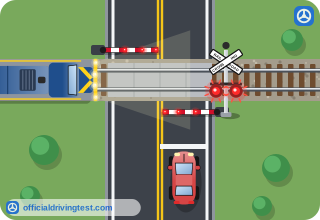
- Only after the gates are raised and the lights stop flashing
- As soon as the gates begin to rise, if no train is visible
- After the train has passed, even if the lights still flash
- When the gates are down, if there is no train in sight
Show answer
Correct answer: Only after the gates are raised and the lights stop flashing
The handbook says not to cross until the gates are raised and the lights have stopped flashing.
Source: Colorado Driver Handbook (DR 2337, January 2025), page 21 · Open this page in the manual (Manual page 21)
-
While the gates are down at a railroad crossing, what is the status of the road?
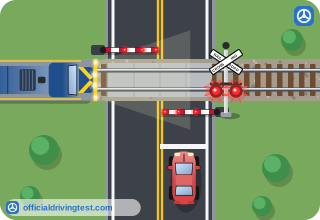
- It is open to turning vehicles
- It is open only to pedestrians
- The road is closed
- It is open to vehicles that can cross safely
Show answer
Correct answer: The road is closed
The handbook says that while the gates are down, the road is closed.
Source: Colorado Driver Handbook (DR 2337, January 2025), page 21 · Open this page in the manual (Manual page 21)
-
How are light rail vehicles (LRVs) governed when they operate on streets?
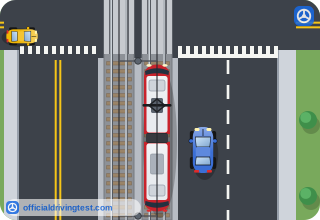
- By their own signals only, not by street signs
- By all traffic signals and signs, like other motorists
- By railroad rules only, since they run on tracks
- By transit-district rules that override traffic signals
Show answer
Correct answer: By all traffic signals and signs, like other motorists
LRVs are governed by all traffic signals and signs and have the same rights and responsibilities as other motorists on the streets.
Source: Colorado Driver Handbook (DR 2337, January 2025), page 21 · Open this page in the manual (Manual page 21)
-
In which direction do light rail vehicles operate on streets compared with other traffic?
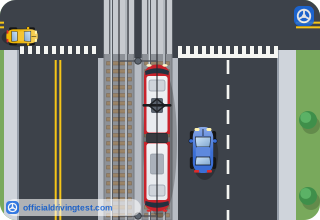
- Only in the same direction as other vehicles
- Only in the opposite direction from other traffic
- Only in the center lane of the street
- In the same direction in some areas, opposite in others
Show answer
Correct answer: In the same direction in some areas, opposite in others
In some areas LRVs operate in the same direction as other motor vehicles, and in other areas in the opposite direction.
Source: Colorado Driver Handbook (DR 2337, January 2025), page 21 · Open this page in the manual (Manual page 21)
-
How much can each light rail car weigh?
- Up to 40 tons
- Up to 10 tons
- Up to 20 tons
- Up to 100 tons
Show answer
Correct answer: Up to 40 tons
The handbook says each light rail car weighs up to 40 tons and cannot stop quickly.
Source: Colorado Driver Handbook (DR 2337, January 2025), page 21 · Open this page in the manual (Manual page 21)
-
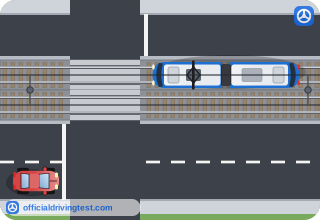
What should you never do when a light rail vehicle (LRV) is approaching?
- Stop beside the tracks
- Let it pass
- Turn in front of it
- Wait for it at a red light
Show answer
Correct answer: Turn in front of it
The handbook's first light rail tip is never to turn in front of an approaching LRV.
Source: Colorado Driver Handbook (DR 2337, January 2025), page 21 · Open this page in the manual (Manual page 21)
-
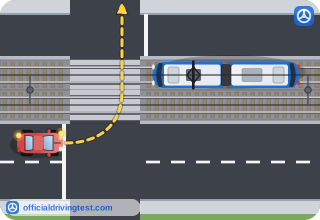
What should you do before turning across a set of light rail tracks?
- Check only for traffic ahead
- Check in all directions
- Check only to the right
- Sound your horn
Show answer
Correct answer: Check in all directions
The handbook says never to turn across a set of light rail tracks without checking in all directions.
Source: Colorado Driver Handbook (DR 2337, January 2025), page 21 · Open this page in the manual (Manual page 21)
-
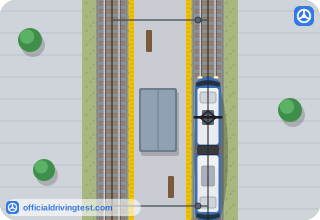
Which people should you watch for in a light rail area?
- Only people already crossing the tracks
- LRV drivers leaving the vehicle unattended
- Cyclists riding on the LRV platform
- People getting on and off a stopped LRV
Show answer
Correct answer: People getting on and off a stopped LRV
The handbook says to watch for people getting on and off a stopped LRV.
Source: Colorado Driver Handbook (DR 2337, January 2025), page 21 · Open this page in the manual (Manual page 21)
-
Why should you be especially alert in light rail areas?
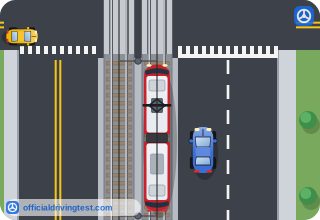
- Buildings and foliage can make it hard to see LRVs
- Light rail signals are hard to tell from traffic signals
- LRVs can stop faster than any other vehicle
- LRVs do not use lights when approaching
Show answer
Correct answer: Buildings and foliage can make it hard to see LRVs
Nearby buildings and foliage can make it difficult for motorists to see LRVs.
Source: Colorado Driver Handbook (DR 2337, January 2025), page 21 · Open this page in the manual (Manual page 21)
-
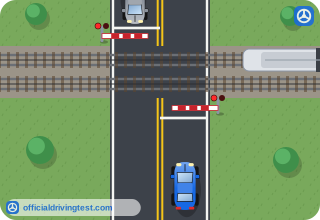
At a light rail crossing, regular traffic lights, warning lights and gates with railroad-type arms all mean the same thing. What is it?
- Stop and do not cross the tracks
- Slow down and cross when the train is far away
- Proceed with caution if no vehicle is visible
- Stop only if you see a light rail vehicle
Show answer
Correct answer: Stop and do not cross the tracks
The manual says all these light rail signals mean the same thing: stop and do not cross the tracks.
Source: Colorado Driver Handbook (DR 2337, January 2025), page 22 · Open this page in the manual (Manual page 22)
-
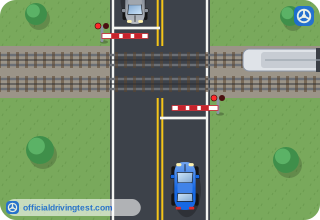
Why must you never drive around traffic gates at a light rail crossing, even if a light rail vehicle (LRV) has just passed?
- The gates stay down for at least ten minutes after a vehicle passes
- The overhead wires lose power after the vehicle passes
- Another vehicle might be coming from the other direction
- Light rail vehicles always run in pairs
Show answer
Correct answer: Another vehicle might be coming from the other direction
The handbook warns that another vehicle might be coming from the other direction.
Source: Colorado Driver Handbook (DR 2337, January 2025), page 22 · Open this page in the manual (Manual page 22)
-
What is the standard height of the overhead wires above the center of light rail tracks?
- 12 feet, 6 inches
- 18 feet, 6 inches
- 15 feet, 9 inches
- 22 feet, 3 inches
Show answer
Correct answer: 18 feet, 6 inches
The manual states overhead wires are a standard height of 18 feet, 6 inches above the center of the tracks.
Source: Colorado Driver Handbook (DR 2337, January 2025), page 22 · Open this page in the manual (Manual page 22)
-
What should you assume about a wire hanging from the overhead catenary above light rail tracks?
- It is dead once the light rail vehicle has passed
- It is safe to touch if it is hanging on the ground
- It is electrified only when a light rail vehicle is nearby
- It is electrified, so never touch it or anything it is touching
Show answer
Correct answer: It is electrified, so never touch it or anything it is touching
The manual says to always assume a hanging overhead wire is electrified and never touch the wire or anything it is touching.
Source: Colorado Driver Handbook (DR 2337, January 2025), page 22 · Open this page in the manual (Manual page 22)