Colorado: Parking rules Practice Test
Where you may not park, parallel parking, parking on hills with and without a curb, and accessible parking spaces.
Independent educational site · not affiliated with any government agency or DMV
Ready? Test yourself
- Instant feedback with an explanation
- Every answer cites its source in the manual
- Your best score is saved on this device
Questions are original and based on the official manual "Colorado Driver Handbook" (DR 2337, January 2025), Colorado Division of Motor Vehicles (DMV).
All 24 questions in this practice test
Take the test above first, then use this list to study. Tap “Show answer” to see the correct answer and explanation.
Show the questions and answersHide the questions
-
Crosshatched sections next to disabled parking spaces are for what use?
- Loading and unloading for up to five minutes
- Van access only, with no parking at any time
- Motorcycle parking only
- Overflow parking when the other spaces are full
Show answer
Correct answer: Van access only, with no parking at any time
Crosshatched sections are for van access only and parking is not allowed at any time.
Source: Colorado Driver Handbook (DR 2337, January 2025), page 9 · Open this page in the manual (Manual page 9)
-
Who must be entering or exiting the vehicle in order to park in a disabled parking space?
- Any passenger riding in the vehicle
- Any licensed driver of the vehicle
- A person carrying a note from a doctor
- The person who owns the disabled placard
Show answer
Correct answer: The person who owns the disabled placard
The person who owns the disabled placard must be entering or exiting the vehicle.
Source: Colorado Driver Handbook (DR 2337, January 2025), page 9 · Open this page in the manual (Manual page 9)
-
Parking illegally in a designated disabled spot without a placard or plate could result in what charge?
- A misdemeanor
- A felony
- A written warning
- A civil infraction
Show answer
Correct answer: A misdemeanor
You could be charged with a misdemeanor.
Source: Colorado Driver Handbook (DR 2337, January 2025), page 9 · Open this page in the manual (Manual page 9)
-
If convicted of parking illegally in a designated disabled spot without a placard or plate, what fine range applies?
- $100-$1,000
- $250-$2,500
- $350-$5,000
- $500-$10,000
Show answer
Correct answer: $350-$5,000
The manual states a fine of $350-$5,000 on conviction, along with possible jail time, loss of driving privileges and/or impoundment.
Source: Colorado Driver Handbook (DR 2337, January 2025), page 9 · Open this page in the manual (Manual page 9)
-
How do the fines compare if you park in a disabled space using someone else's placard or plate?
- They are the same as for parking without a placard
- They are double those for parking without a placard
- They are half of those for parking without a placard
- There is no fine, only towing of the vehicle
Show answer
Correct answer: They are double those for parking without a placard
Using someone else's placard brings jail time, loss of driving privileges and towing, plus fines double those for parking without a placard.
Source: Colorado Driver Handbook (DR 2337, January 2025), page 9 · Open this page in the manual (Manual page 9)
-
If your vehicle has an automatic transmission, what should you do when parking?
- Leave the vehicle in neutral
- Leave the vehicle in low gear
- Leave the vehicle in park
- Leave the vehicle in reverse
Show answer
Correct answer: Leave the vehicle in park
With an automatic transmission, leave the vehicle in park.
Source: Colorado Driver Handbook (DR 2337, January 2025), page 13 · Open this page in the manual (Manual page 13)
-
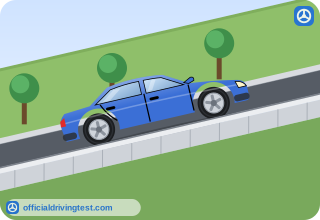
You park a vehicle with a standard transmission headed uphill. What gear should you leave it in?
- Reverse gear
- Low gear
- Neutral
- Second gear
Show answer
Correct answer: Low gear
A standard transmission is left in low gear when headed uphill and in reverse gear when headed downhill.
Source: Colorado Driver Handbook (DR 2337, January 2025), page 13 · Open this page in the manual (Manual page 13)
-
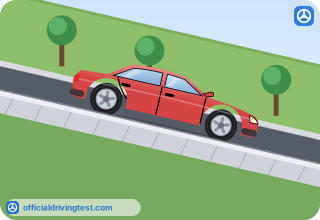
You park a vehicle with a standard transmission headed downhill. What gear should you leave it in?
- Low gear
- Neutral
- Third gear
- Reverse gear
Show answer
Correct answer: Reverse gear
A standard transmission is left in reverse gear when headed downhill.
Source: Colorado Driver Handbook (DR 2337, January 2025), page 13 · Open this page in the manual (Manual page 13)
-
When leaving your parked vehicle, what must you also remember to do?
- Set the emergency brake and remove the key
- Leave the vehicle in neutral so it can be pushed
- Leave the engine running
- Leave the key in the ignition
Show answer
Correct answer: Set the emergency brake and remove the key
The handbook says to set the emergency brake and remove the ignition key when leaving the vehicle.
Source: Colorado Driver Handbook (DR 2337, January 2025), page 13 · Open this page in the manual (Manual page 13)
-
Which of these is a place where you may not park?
- On the right side of a quiet residential street
- In front of a business that is closed for the night
- On a crosswalk, sidewalk, bridge or railroad tracks
- On a city street next to a public park or school
Show answer
Correct answer: On a crosswalk, sidewalk, bridge or railroad tracks
The handbook lists crosswalks, sidewalks, bridges, elevated structures, railroad tracks and controlled access highways.
Source: Colorado Driver Handbook (DR 2337, January 2025), page 13 · Open this page in the manual (Manual page 13)
-
How close to a traffic signal, stop sign or railroad crossing may you NOT park?
- Within 10 feet
- Within 30 feet
- Within 15 feet
- Within 50 feet
Show answer
Correct answer: Within 30 feet
You may not park within 30 feet of a traffic signal, stop sign or railroad crossing.
Source: Colorado Driver Handbook (DR 2337, January 2025), page 13 · Open this page in the manual (Manual page 13)
-
How close to a fire hydrant may you NOT park?
- Within 5 feet
- Within 10 feet
- Within 30 feet
- Within 15 feet
Show answer
Correct answer: Within 15 feet
You may not park within 15 feet of a fire hydrant.
Source: Colorado Driver Handbook (DR 2337, January 2025), page 13 · Open this page in the manual (Manual page 13)
-
Which of these is another place where you may not park?
- Within an intersection, tunnel or on/off ramp
- Beside a curb painted white
- Beside a city park
- On a residential street with no sidewalk
Show answer
Correct answer: Within an intersection, tunnel or on/off ramp
The handbook lists an intersection, tunnel, runaway truck ramp, on/off ramp and blocking a driveway.
Source: Colorado Driver Handbook (DR 2337, January 2025), page 13 · Open this page in the manual (Manual page 13)
-
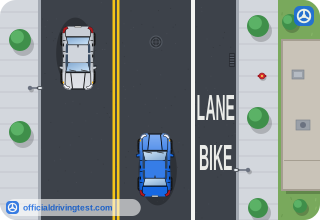
May you park in a bike lane?
- Yes, if you stay only a few minutes
- Yes, if there are no bicyclists in sight
- No, parking in a bike lane is not allowed
- Yes, if you set your hazard lights
Show answer
Correct answer: No, parking in a bike lane is not allowed
The handbook lists a bike lane among the places where you can not park.
Source: Colorado Driver Handbook (DR 2337, January 2025), page 13 · Open this page in the manual (Manual page 13)
-
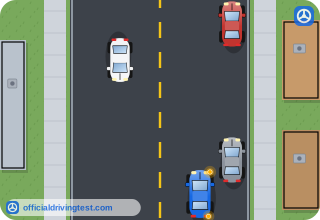
What is the first step of parallel parking?
- Stop one car length behind the vehicle ahead
- Stop even with the vehicle ahead
- Stop with your front bumper touching the vehicle ahead
- Back up from the curb at a high speed
Show answer
Correct answer: Stop even with the vehicle ahead
Parallel parking starts by stopping even with the vehicle ahead, then turning the wheel sharply right and backing slowly.
Source: Colorado Driver Handbook (DR 2337, January 2025), page 13 · Open this page in the manual (Manual page 13)
-
In parallel parking, what do you do when you are clear of the vehicle ahead?
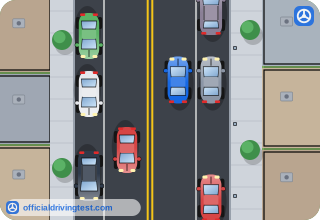
- Turn the wheel sharply to the right and pull forward at once
- Straighten the wheels and stop beside the vehicle ahead
- Turn the wheel sharply to the left and drive forward slowly
- Turn the wheel sharply left and back slowly toward the vehicle behind
Show answer
Correct answer: Turn the wheel sharply left and back slowly toward the vehicle behind
When clear of the vehicle ahead, turn the wheel sharply left and keep backing slowly toward the vehicle behind.
Source: Colorado Driver Handbook (DR 2337, January 2025), page 13 · Open this page in the manual (Manual page 13)
-
In parallel parking, how do you finish parking after backing toward the vehicle behind?
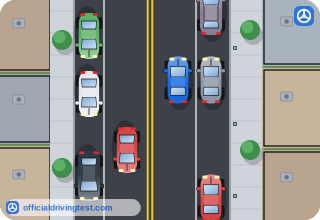
- Turn the wheel sharply right and pull toward the curb
- Turn the wheel sharply left and pull toward the curb
- Straighten the wheels and stop with the rear wheels at the curb
- Back up until you touch the vehicle behind
Show answer
Correct answer: Turn the wheel sharply right and pull toward the curb
You turn the wheel sharply right and pull toward the curb in the center of the parking space.
Source: Colorado Driver Handbook (DR 2337, January 2025), page 13 · Open this page in the manual (Manual page 13)
-
How should you pull away from a parallel parked position?
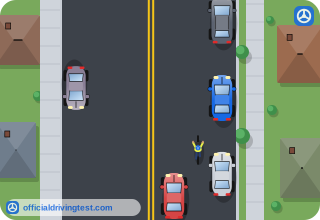
- Pull out quickly, since the signal is not needed when leaving a parking space
- Turn the wheel sharply left before checking your mirrors
- Activate your signal, check your mirrors and blind spots, and pull away when safe
- Shift to reverse and signal after you leave the space
Show answer
Correct answer: Activate your signal, check your mirrors and blind spots, and pull away when safe
To pull away you activate your signal, check mirrors and blind spots, and go when it is safe.
Source: Colorado Driver Handbook (DR 2337, January 2025), page 13 · Open this page in the manual (Manual page 13)
-
Where parallel parking is permitted, how close must your vehicle be to the curb?
- Within 12 inches of the curb
- Within 24 inches of the curb
- Within 36 inches of the curb
- Within 6 inches of the curb
Show answer
Correct answer: Within 12 inches of the curb
The handbook says a parallel parked vehicle must be within 12 inches of the curb (or as close as possible to the outside edge of the shoulder) so traffic is not blocked or slowed.
Source: Colorado Driver Handbook (DR 2337, January 2025), page 14 · Open this page in the manual (Manual page 14)
-
You stop your vehicle while headed downhill next to a curb. Which way should you turn your front wheels?
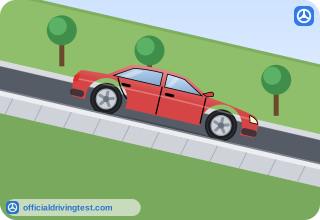
- Away from the curb
- Straight ahead
- Toward the curb
- To the left, toward the roadway
Show answer
Correct answer: Toward the curb
When headed downhill, the front wheels are turned toward the curb so the curb can act as a block.
Source: Colorado Driver Handbook (DR 2337, January 2025), page 14 · Open this page in the manual (Manual page 14)
-
You park headed uphill where there is a curb. Which way should you turn your front wheels?
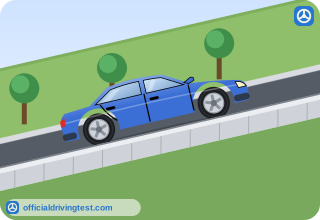
- Toward the curb
- Away from the curb
- Straight ahead
- Toward the curb, then roll forward
Show answer
Correct answer: Away from the curb
Headed uphill with a curb, the front wheels are turned away from the curb and the vehicle rolls back slowly against it.
Source: Colorado Driver Handbook (DR 2337, January 2025), page 14 · Open this page in the manual (Manual page 14)
-
When parking headed uphill next to a curb, what part of the vehicle should rest against the curb after it rolls backwards slowly?
- The front bumper of the car
- The rear bumper of the car
- The side of the rear tire
- The rear part of the front wheel
Show answer
Correct answer: The rear part of the front wheel
The vehicle rolls backwards slowly until the rear part of the front wheel rests against the curb, using it as a block.
Source: Colorado Driver Handbook (DR 2337, January 2025), page 14 · Open this page in the manual (Manual page 14)
-
When parking headed uphill without a curb, which way should you turn your front wheels?
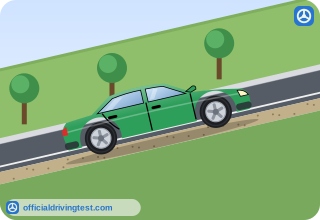
- To the right, so the vehicle rolls off the highway if it moves
- To the left, so the vehicle rolls into the lane if it moves
- Straight ahead, with the wheels centered in line
- To the left, toward the center of the roadway
Show answer
Correct answer: To the right, so the vehicle rolls off the highway if it moves
Without a curb, the front wheels turn to the right so that a rolling vehicle goes off the highway, not into the roadway.
Source: Colorado Driver Handbook (DR 2337, January 2025), page 14 · Open this page in the manual (Manual page 14)
-
When parking headed downhill with no curb, which way should you turn your wheels?
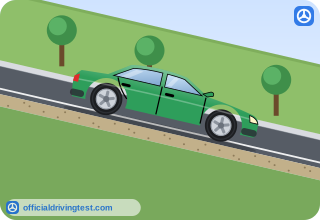
- To the left
- Straight ahead
- To the right
- Toward the center line
Show answer
Correct answer: To the right
On a downhill with no curb you also turn the wheels to the right.
Source: Colorado Driver Handbook (DR 2337, January 2025), page 14 · Open this page in the manual (Manual page 14)