Colorado: Freeway driving and lane changes Practice Test
Entering and leaving the freeway, acceleration and deceleration lanes, changing lanes and diverging diamond interchanges.
Independent educational site · not affiliated with any government agency or DMV
Ready? Test yourself
- Instant feedback with an explanation
- Every answer cites its source in the manual
- Your best score is saved on this device
Questions are original and based on the official manual "Colorado Driver Handbook" (DR 2337, January 2025), Colorado Division of Motor Vehicles (DMV).
All 21 questions in this practice test
Take the test above first, then use this list to study. Tap “Show answer” to see the correct answer and explanation.
Show the questions and answersHide the questions
-
When should you look over your shoulder on the drive test?
- Only when backing up
- Only when stopped at a signal
- Only when merging onto a freeway
- Before changing lanes
Show answer
Correct answer: Before changing lanes
Searching includes looking over your shoulder before changing lanes.
Source: Colorado Driver Handbook (DR 2337, January 2025), page 2 · Open this page in the manual (Manual page 2)
-
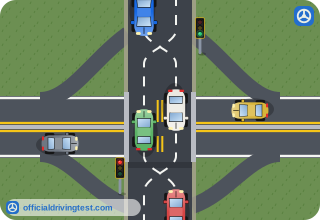
Which movements, a typical challenge at standard four-way interchanges, are eliminated with a diverging diamond interchange (DDI)?
- Right-turn movements
- Left-turn movements
- U-turn movements
- Through movements
Show answer
Correct answer: Left-turn movements
The handbook says left-turn movements, a typical challenge with standard four-way interchanges, are eliminated with a DDI, which allows for fewer conflicts with other vehicles.
Source: Colorado Driver Handbook (DR 2337, January 2025), page 11 · Open this page in the manual (Manual page 11)
-
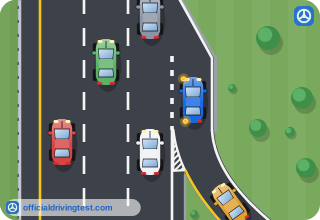
What is the purpose of an acceleration ramp on a high-speed roadway?
- To let you stop and wait for a gap in traffic
- To let you build up speed before entering
- To let you slow down before leaving the freeway
- To let you pass slower traffic on the right
Show answer
Correct answer: To let you build up speed before entering
High-speed roadways generally have acceleration ramps so you can build up speed.
Source: Colorado Driver Handbook (DR 2337, January 2025), page 14 · Open this page in the manual (Manual page 14)
-
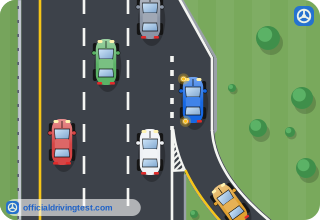
When entering a freeway from an on-ramp, what should you try to do with your speed?
- Keep it below freeway traffic until you are merged
- Hold it at the speed of the vehicle ahead on the ramp
- Reduce it until you see a gap in the lane
- Increase it to match freeway traffic
Show answer
Correct answer: Increase it to match freeway traffic
The handbook says to try to increase your speed to match freeway traffic when entering from an on-ramp.
Source: Colorado Driver Handbook (DR 2337, January 2025), page 14 · Open this page in the manual (Manual page 14)
-
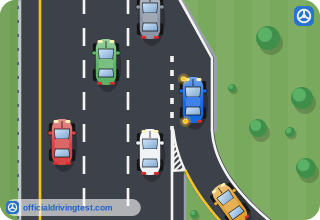
What should you do before entering a highway from a side entrance ramp?
- Signal, look for an opening, accelerate to traffic speed and merge when safe
- Stop at the end of the ramp, wait for traffic to slow and then merge in
- Merge at once, with your signal on, and let traffic adjust to you
- Flash your headlights, sound your horn and enter ahead of the nearest vehicle
Show answer
Correct answer: Signal, look for an opening, accelerate to traffic speed and merge when safe
The handbook lists these steps before entering a highway from a side entrance ramp.
Source: Colorado Driver Handbook (DR 2337, January 2025), page 14 · Open this page in the manual (Manual page 14)
-
On an entrance ramp, when may you merge into freeway traffic?
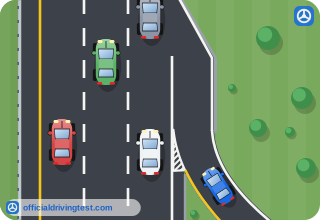
- As soon as you can see the freeway lanes
- At the start of the acceleration lane
- After the solid white line has ended
- Once you have reached 25 miles per hour
Show answer
Correct answer: After the solid white line has ended
You must not merge into traffic until the solid white line has ended.
Source: Colorado Driver Handbook (DR 2337, January 2025), page 14 · Open this page in the manual (Manual page 14)
-
When may you stop in the acceleration lane of a freeway entrance?
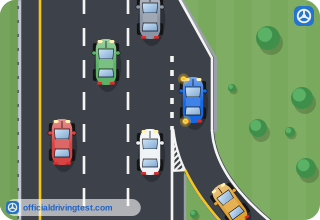
- Whenever traffic on the freeway is heavy
- Only if absolutely necessary
- Whenever you need to check for an opening
- Whenever the vehicle ahead stops
Show answer
Correct answer: Only if absolutely necessary
The handbook says not to stop in the acceleration lane unless absolutely necessary.
Source: Colorado Driver Handbook (DR 2337, January 2025), page 14 · Open this page in the manual (Manual page 14)
-
When you merge onto a freeway from an acceleration lane, who must yield the right-of-way?
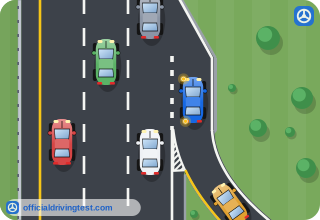
- Freeway traffic must yield to you
- The slower vehicle must yield
- The vehicle that arrives at the merge first must yield
- You must yield to freeway traffic
Show answer
Correct answer: You must yield to freeway traffic
The handbook says you must yield the right-of-way to freeway traffic when entering.
Source: Colorado Driver Handbook (DR 2337, January 2025), page 14 · Open this page in the manual (Manual page 14)
-
What must you do on a metered freeway entrance ramp?
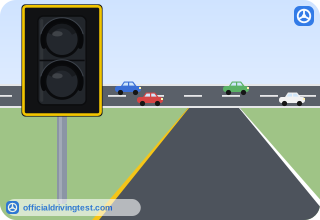
- Stop and wait to be released on a green light
- Slow down and merge if the freeway looks clear
- Enter on a red light when no vehicles are near
- Stay in the acceleration lane until traffic slows
Show answer
Correct answer: Stop and wait to be released on a green light
On metered ramps you must stop and wait to be released on a green light to enter the freeway.
Source: Colorado Driver Handbook (DR 2337, January 2025), page 14 · Open this page in the manual (Manual page 14)
-
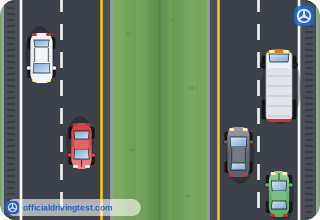
On a freeway, which lane should you drive in when you are driving slower than the normal speed?
- The leftmost lane
- The center lane
- The rightmost lane
- The passing lane
Show answer
Correct answer: The rightmost lane
The handbook says to drive in the rightmost lane when driving slower than the normal speed.
Source: Colorado Driver Handbook (DR 2337, January 2025), page 14 · Open this page in the manual (Manual page 14)
-
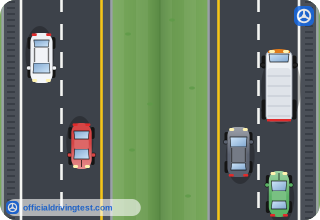
What is the freeway passing lane (the leftmost lane) reserved for?
- Vehicles driving faster than the posted speed limit, and emergency vehicles at all times
- Passing vehicles in other lanes, left turns, and heavy traffic that does not allow merging into other lanes
- Slow vehicles that are preparing to leave the freeway, and vehicles that are turning right
- Vehicles carrying several passengers, and vehicles that are hauling heavy loads on the freeway
Show answer
Correct answer: Passing vehicles in other lanes, left turns, and heavy traffic that does not allow merging into other lanes
The passing lane is reserved for passing, left turns and conditions where the traffic volume does not allow merging into non-passing lanes.
Source: Colorado Driver Handbook (DR 2337, January 2025), page 14 · Open this page in the manual (Manual page 14)
-
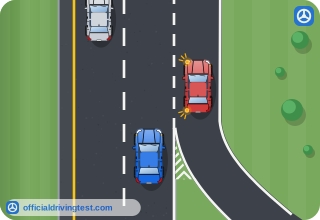
What should you do, if it is safe, when approaching a merge area on a freeway?
- Speed up to pass the merging vehicles first
- Brake to let merging vehicles go ahead of you in your lane
- Stay in your lane and keep a steady speed
- Move over to make room for vehicles entering the freeway
Show answer
Correct answer: Move over to make room for vehicles entering the freeway
The handbook says to move over, if safe, when approaching a merge area to make room for entering vehicles.
Source: Colorado Driver Handbook (DR 2337, January 2025), page 14 · Open this page in the manual (Manual page 14)
-
On a freeway, you observe traffic ahead of, around and behind you. Which vehicles does the handbook say to be aware of?
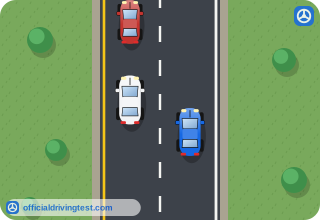
- Vehicles traveling in your blind spots
- Vehicles that are parked on the shoulder
- Vehicles that are using the passing lane
- Vehicles that are using the acceleration lane
Show answer
Correct answer: Vehicles traveling in your blind spots
The handbook says to observe traffic around you and be aware of vehicles traveling in your blind spots.
Source: Colorado Driver Handbook (DR 2337, January 2025), page 14 · Open this page in the manual (Manual page 14)
-
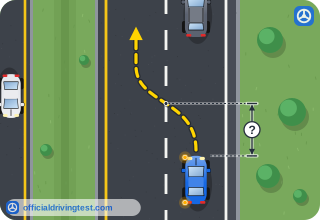
When driving on a freeway, how far before you change lanes should you signal, at least?
- 50 feet
- 300 feet
- 200 feet
- 20 feet
Show answer
Correct answer: 200 feet
The handbook says to signal at least 200 feet before you change lanes on a freeway and to avoid frequent lane changes.
Source: Colorado Driver Handbook (DR 2337, January 2025), page 14 · Open this page in the manual (Manual page 14)
-
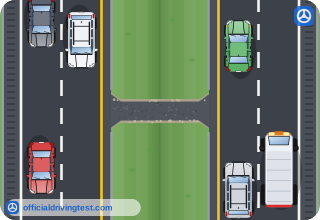
What does the handbook say about driving across, over or within a freeway median or island?
- Do it only to pass a slower vehicle
- Do not do it
- Do it only to avoid a hazard ahead
- Do it only when no other vehicle is near
Show answer
Correct answer: Do not do it
The handbook says not to drive across, over or within any median or island.
Source: Colorado Driver Handbook (DR 2337, January 2025), page 14 · Open this page in the manual (Manual page 14)
-
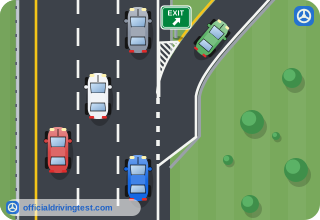
Which lane should you use when leaving the freeway to slow down before the exit ramp?
- The acceleration lane
- The passing lane
- The shoulder
- The deceleration lane
Show answer
Correct answer: The deceleration lane
The deceleration lane is designed to let you slow down before reaching the exit ramp.
Source: Colorado Driver Handbook (DR 2337, January 2025), page 15 · Open this page in the manual (Manual page 15)
-
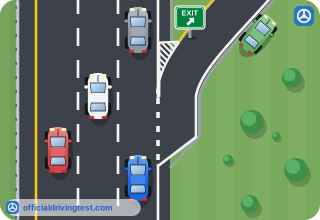
When leaving the freeway, how far before the beginning of the deceleration lane should you activate your turn signal?
- 200 feet
- 50 feet
- 300 feet
- 400 feet
Show answer
Correct answer: 200 feet
You activate your turn signal 200 feet before the beginning of the deceleration lane.
Source: Colorado Driver Handbook (DR 2337, January 2025), page 15 · Open this page in the manual (Manual page 15)
-
When leaving the freeway, when should you start slowing down for the exit ramp?
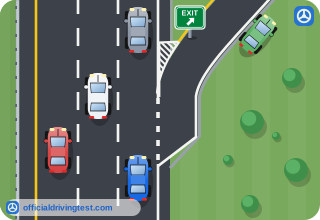
- Before you reach the deceleration lane, in the travel lane
- As soon as you have turned on your signal
- After you enter the deceleration lane
- Once you can see the exit sign
Show answer
Correct answer: After you enter the deceleration lane
You maintain your speed until you enter the deceleration lane, then slow down to the speed advised for the exit ramp.
Source: Colorado Driver Handbook (DR 2337, January 2025), page 15 · Open this page in the manual (Manual page 15)
-
What is one tip the handbook gives for exiting a freeway?
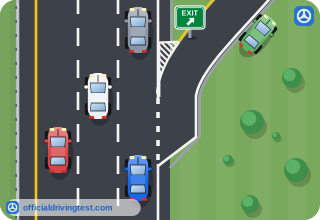
- Slow down in the travel lane well before the exit
- Do not exit at the last second
- Use the shoulder to reach the exit ramp
- Brake hard at the start of the exit ramp
Show answer
Correct answer: Do not exit at the last second
The handbook tells you not to exit at the last second.
Source: Colorado Driver Handbook (DR 2337, January 2025), page 15 · Open this page in the manual (Manual page 15)
-
After turning into a freeway deceleration lane, what speed limit must you not exceed?
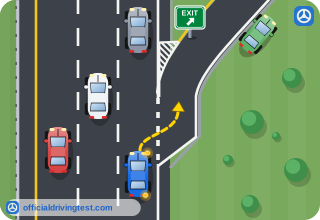
- The speed limit of the freeway itself
- The speed of the traffic you just left
- The minimum speed on the freeway
- The posted speed limit for the exit ramp
Show answer
Correct answer: The posted speed limit for the exit ramp
The handbook says to slow down in the deceleration lane and not exceed the posted speed limit for the exit ramp.
Source: Colorado Driver Handbook (DR 2337, January 2025), page 15 · Open this page in the manual (Manual page 15)
-
While you are on the freeway before your exit, how should you keep your speed?
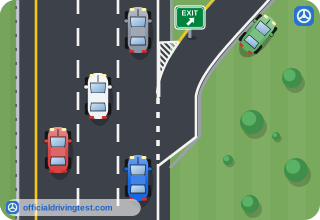
- Consistent with the flow of traffic
- Below the flow of traffic, to prepare for the exit
- Above the flow of traffic, to reach the exit sooner
- At the speed advised for the exit ramp
Show answer
Correct answer: Consistent with the flow of traffic
One of the handbook tips for exiting is to keep your speed consistent with the flow of traffic while on the freeway.
Source: Colorado Driver Handbook (DR 2337, January 2025), page 15 · Open this page in the manual (Manual page 15)