California: Emergencies and special situations — Part 1 Practice Test
Questions in this part include: “Which spots must you avoid when stopping a disabled vehicle?” · “What must the driver of a stopped vehicle produce for law enforcement?”
Independent educational site · not affiliated with any government agency or DMV
Ready? Test yourself
- Instant feedback with an explanation
- Every answer cites its source in the manual
- Your best score is saved on this device
Questions are original and based on the official manual "California Driver Handbook" (2025), California DMV.
All 17 questions in this practice test
Take the test above first, then use this list to study. Tap “Show answer” to see the correct answer and explanation.
Show the questions and answersHide the questions
-
You can see a collision or hazard ahead. How do you warn drivers behind you?
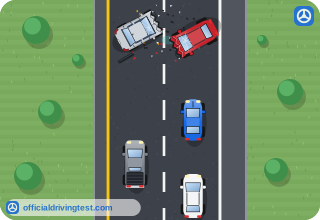
- Turn on your emergency flashers, lightly tap the brake pedal three or four times, and use a hand signal.
- Speed up and pull over to one side so that every driver behind you gets an unobstructed view of the problem.
- Hold the horn down until traffic slows.
- Flash your high beams at the oncoming lane.
Show answer
Correct answer: Turn on your emergency flashers, lightly tap the brake pedal three or four times, and use a hand signal.
Warn following traffic with your emergency flashers, three or four light taps on the brake pedal, and a hand signal as you slow or stop.
Source: California Driver Handbook (2025), page 12 · Open this page in the manual (Manual page 12)
-
Your car must stop for mechanical trouble but has no emergency flashers. What can you use?
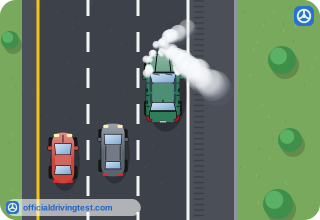
- Your turn signals.
- The parking brake warning light.
- Nothing; you simply wait.
- Short repeated bursts on the horn until someone stops to help you out.
Show answer
Correct answer: Your turn signals.
If your vehicle has no emergency flashers, use your turn signals to warn other drivers.
Source: California Driver Handbook (2025), page 12 · Open this page in the manual (Manual page 12)
-
Where should you stop when your vehicle has trouble?
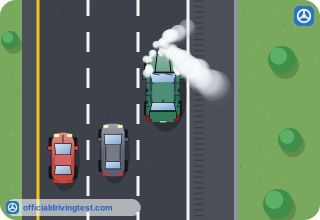
- In the lane closest to the center divider.
- Off the road away from traffic if you can; otherwise where drivers behind can see you.
- Anywhere at all, as long as your emergency flashers are working and you switch them on right away.
- Only where there is a streetlight overhead.
Show answer
Correct answer: Off the road away from traffic if you can; otherwise where drivers behind can see you.
Pull completely off the road away from traffic if possible; if you cannot, stop where you and your vehicle are visible to traffic coming from behind.
Source: California Driver Handbook (2025), page 12 · Open this page in the manual (Manual page 12)
-
Which spots must you avoid when stopping a disabled vehicle?
- Long, flat, open stretches of road.
- Wide shoulders close to an exit.
- Just over a hill or just around a curve.
- Any place within one mile of an intersection.
Show answer
Correct answer: Just over a hill or just around a curve.
Never stop just over a hill or just around a curve, because drivers may not see your vehicle in time to avoid it.
Source: California Driver Handbook (2025), page 12 · Open this page in the manual (Manual page 12)
-
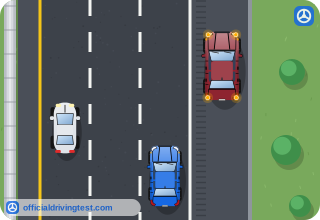
After calling for roadside assistance, what does the handbook tell you to do?
- Walk to the nearest exit to look for help.
- Stand behind the vehicle to warn traffic.
- Stay in your vehicle until help arrives.
- Wait on the center divider where approaching drivers can see you most clearly.
Show answer
Correct answer: Stay in your vehicle until help arrives.
Call for emergency roadside assistance and remain inside your vehicle until help arrives.
Source: California Driver Handbook (2025), page 12 · Open this page in the manual (Manual page 12)
-
If you must stop on a freeway, what should you do?
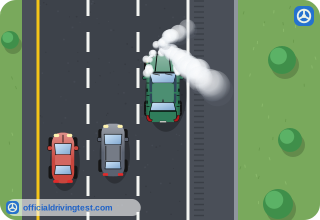
- Stand well behind the vehicle and wave your arms to warn approaching traffic
- Park with two wheels on the shoulder and walk along the roadway to find help
- Park completely off the pavement and stay inside with the doors locked
- Leave the vehicle and wait on the median
Show answer
Correct answer: Park completely off the pavement and stay inside with the doors locked
Get fully off the pavement, then remain inside the locked vehicle until help comes.
Source: California Driver Handbook (2025), page 29 · Open this page in the manual (Manual page 29)
-
An officer signals you to pull over. What should you do first to show you have seen them?
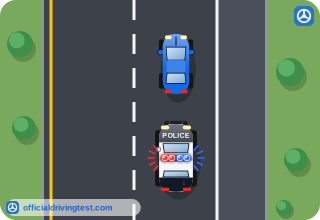
- Wave your arm out the window
- Flash your high beams twice
- Switch on your right turn signal
- Turn on your hazard lights and stop immediately
Show answer
Correct answer: Switch on your right turn signal
The right turn signal tells the officer that you have noticed them and are preparing to pull over.
Source: California Driver Handbook (2025), page 29 · Open this page in the manual (Manual page 29)
-
You are in the carpool/HOV lane when an officer pulls you over. Where should you stop?
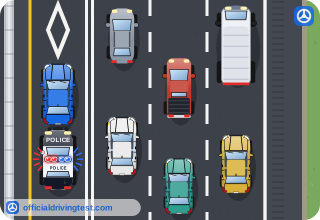
- On the left shoulder, since it is closer
- Completely onto the right shoulder, in a well-lit area when possible
- Wherever you are, stopping in the lane
- At the next exit ramp or off-ramp, no matter how far away it happens to be
Show answer
Correct answer: Completely onto the right shoulder, in a well-lit area when possible
Always move all the way onto the right shoulder, even from the carpool lane, and pick a well-lit spot if you can.
Source: California Driver Handbook (2025), page 29 · Open this page in the manual (Manual page 29)
-
During a law enforcement stop, what should you do with your radio?
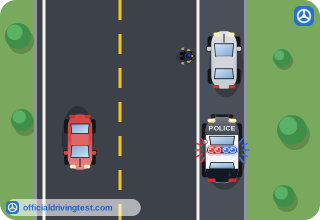
- Leave it playing so the officer knows you are calm
- Turn it off
- Turn it up so you can hear the officer over it
- Switch it to a traffic information station
Show answer
Correct answer: Turn it off
During a law enforcement stop, turn off your radio.
Source: California Driver Handbook (2025), page 29 · Open this page in the manual (Manual page 29)
-
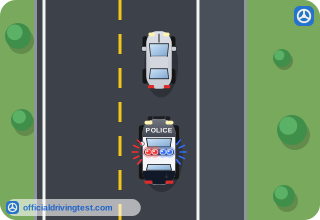
After stopping for an officer, should you get out of your vehicle?
- Yes, get out right away to show cooperation
- Yes, if the stop is at night
- Yes, so that you can retrieve your documents from the trunk
- No, stay inside unless the officer directs you to get out
Show answer
Correct answer: No, stay inside unless the officer directs you to get out
Remain in the vehicle unless the officer tells you otherwise.
Source: California Driver Handbook (2025), page 29 · Open this page in the manual (Manual page 29)
-
When should you roll down your window during a law enforcement stop?
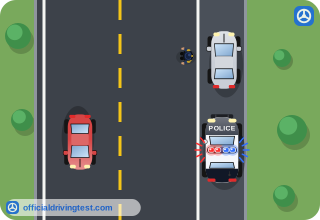
- After you stop and before the officer makes contact with you
- Only if the officer knocks on the glass and asks you to open it
- While you are still slowing down
- Only after you have been asked for your license
Show answer
Correct answer: After you stop and before the officer makes contact with you
Roll down your window after you stop your vehicle and before the officer makes contact with you.
Source: California Driver Handbook (2025), page 29 · Open this page in the manual (Manual page 29)
-
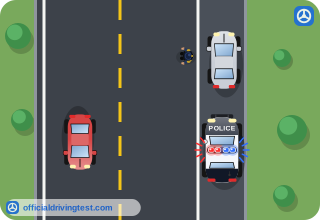
Where should the driver and passengers place their hands during a traffic stop?
- In their laps, under a coat or a bag, to stay comfortable
- In clear view before the officer makes contact
- Anywhere comfortable until asked
- Out of the windows
Show answer
Correct answer: In clear view before the officer makes contact
Everyone in the vehicle should have their hands visible before the officer reaches the car.
Source: California Driver Handbook (2025), page 29 · Open this page in the manual (Manual page 29)
-
Before questioning you about a traffic violation, a California officer must:
- Read you your rights
- Offer you a written warning
- State the reason for the stop
- Ask for the names of all passengers
Show answer
Correct answer: State the reason for the stop
Officers must give the reason for the stop before questioning, unless withholding it is needed to protect life or property from an imminent threat. The reason is also documented on the citation or report.
Source: California Driver Handbook (2025), page 29 · Open this page in the manual (Manual page 29)
-
An officer asks permission to search your vehicle. What are your rights?
- You must consent to any search request
- You may say no, but you may not resist if the officer searches anyway
- You may physically block the officer from opening the doors
- An officer can never search the vehicle unless you give written consent first
Show answer
Correct answer: You may say no, but you may not resist if the officer searches anyway
Clearly state that you do not give permission, but the officer may still have legal authority to search, and you must not interfere.
Source: California Driver Handbook (2025), page 30 · Open this page in the manual (Manual page 30)
-
What must the driver of a stopped vehicle produce for law enforcement?
- A driver's license only
- A driver license, plus either a Social Security card or a passport
- Driver's license, proof of insurance, and vehicle registration
- Nothing until a citation is written
Show answer
Correct answer: Driver's license, proof of insurance, and vehicle registration
All three documents must be produced. If they are not, officers may conduct a limited search to find them.
Source: California Driver Handbook (2025), page 30 · Open this page in the manual (Manual page 30)
-
During a traffic stop, can an officer order the driver and passengers to get out of or stay inside the vehicle?
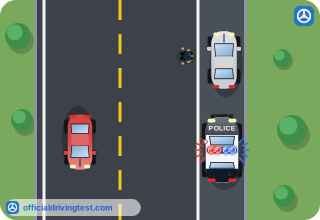
- Yes, and you must comply
- Only the driver can be ordered out
- No, that decision is always yours
- Only if a citation is being issued
Show answer
Correct answer: Yes, and you must comply
An officer can legally require the driver and every passenger to exit or remain in the vehicle, and those orders must be followed.
Source: California Driver Handbook (2025), page 30 · Open this page in the manual (Manual page 30)
-
In California, who may ask you about your immigration status during a traffic stop?
- Any peace officer
- City police officers only
- Only federal law enforcement officers
- County sheriffs and the Highway Patrol
Show answer
Correct answer: Only federal law enforcement officers
State and local officers are prohibited from asking about immigration status, and you may decline to answer if they do.
Source: California Driver Handbook (2025), page 30 · Open this page in the manual (Manual page 30)