Arkansas: Signals and vehicle controls — Part 4 Practice Test
Questions in this part include: “What does observing tire and vehicle load limits mean?” · “What should you always make sure of before starting the engine?”
Independent educational site · not affiliated with any government agency or DMV
Ready? Test yourself
- Instant feedback with an explanation
- Every answer cites its source in the manual
- Your best score is saved on this device
Questions are original and based on the official manual "Arkansas Driver License Study Guide" (Volume 1, Edition 10, October 2026), Arkansas State Police (ASP).
All 18 questions in this practice test
Take the test above first, then use this list to study. Tap “Show answer” to see the correct answer and explanation.
Show the questions and answersHide the questions
-
How often should wiper blades be replaced, according to the manual?
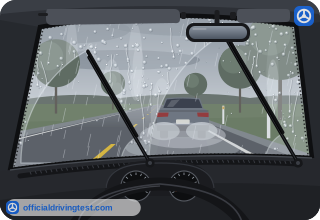
- Every two to three years, whatever the visibility
- Every five years, or when the wipers stop moving
- Every six months to a year, or when visibility changes
- Only after the wipers stop working completely
Show answer
Correct answer: Every six months to a year, or when visibility changes
The manual says to replace wiper blades every six months to a year or when visibility changes.
Source: Arkansas Driver License Study Guide (Volume 1, Edition 10, October 2026), page 83 · Open this page in the manual (Manual page 83)
-
Under the manual's windshield guide, a vehicle should be rejected if it lacks safety glass in all doors, windows and windshields after which date?
- January 1, 1951
- July 1, 1951
- July 1, 1971
- January 1, 1981
Show answer
Correct answer: July 1, 1951
The reject rule applies to a vehicle not equipped with safety glass in all doors, windows and windshields after July 1, 1951.
Source: Arkansas Driver License Study Guide (Volume 1, Edition 10, October 2026), page 83 · Open this page in the manual (Manual page 83)
-
Under the manual's windshield guide, a windshield should be rejected if how many cracks or visual impairments are present in an 8-inch-wide area through the center under the driver's side wiper area?
- More than three
- More than five
- Any chip, even a very small one
- More than one
Show answer
Correct answer: More than one
The guide rejects a windshield with more than one crack or other visual impairment in that eight-inch-wide area.
Source: Arkansas Driver License Study Guide (Volume 1, Edition 10, October 2026), page 83 · Open this page in the manual (Manual page 83)
-
Under the manual's inspection guide, when should glass in the windshield, side or rear windows be rejected?
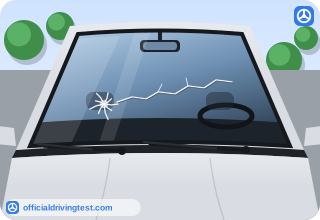
- When damage obscures the driver's view to the front left, right or rear
- When it has any scratch on its surface, however small or shallow
- When it has any tint at all, even if the driver's view is clear
- When it is more than five years old, whatever its condition
Show answer
Correct answer: When damage obscures the driver's view to the front left, right or rear
The guide rejects glass damaged to the extent that the driver's view to the front left, right or rear is obscured.
Source: Arkansas Driver License Study Guide (Volume 1, Edition 10, October 2026), page 83 · Open this page in the manual (Manual page 83)
-
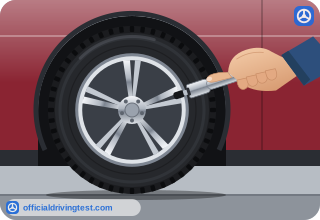
What does the manual mean by a "cold" tire when checking tire pressure?
- A tire that has been parked in below-freezing weather
- A tire that has not been driven on for at least 30 minutes
- A tire that has not been driven on for at least three hours
- A tire whose outside surface feels cool to the touch
Show answer
Correct answer: A tire that has not been driven on for at least three hours
The term cold does not relate to outside temperature; a cold tire has not been driven on for at least three hours.
Source: Arkansas Driver License Study Guide (Volume 1, Edition 10, October 2026), page 84 · Open this page in the manual (Manual page 84)
-
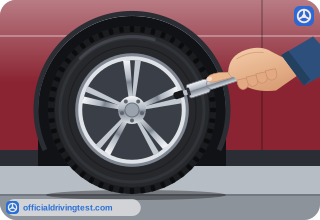
Why should you measure tire pressure when the tires are cold?
- Driving lowers the air pressure inside the tires
- Driving warms the tires and raises the pressure inside
- Cold tires hold more air than warm tires
- Warm tires cannot be measured with a gauge
Show answer
Correct answer: Driving warms the tires and raises the pressure inside
The manufacturer's recommended pressure reflects a cold tire, and driving makes the pressure increase, so you measure cold or compensate.
Source: Arkansas Driver License Study Guide (Volume 1, Edition 10, October 2026), page 84 · Open this page in the manual (Manual page 84)
-
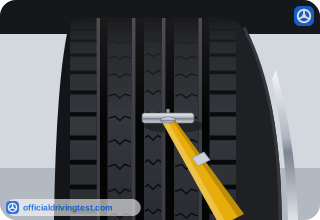
According to the manual, tires are in general not safe and should be replaced when the tread is worn down to how much?
- 1/4 of an inch
- 1/8 of an inch
- 1/2 of an inch
- 1/16 of an inch
Show answer
Correct answer: 1/16 of an inch
The manual states tires should be replaced when the tread is worn down to 1/16 of an inch.
Source: Arkansas Driver License Study Guide (Volume 1, Edition 10, October 2026), page 84 · Open this page in the manual (Manual page 84)
-
When you place a penny in the tread with Lincoln's head upside down and facing you, what does it mean if you can see the top of Lincoln's head?
- You are ready for new tires
- The tires are safe for another year
- The tire pressure is too low
- The tires are balanced correctly
Show answer
Correct answer: You are ready for new tires
The manual says that if you can see the top of Lincoln's head, you are ready for new tires.
Source: Arkansas Driver License Study Guide (Volume 1, Edition 10, October 2026), page 84 · Open this page in the manual (Manual page 84)
-
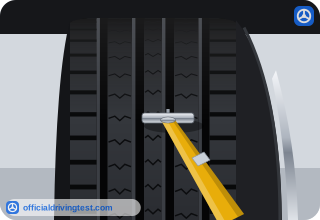
What does tire tread provide, especially when the road is wet or icy?
- A quieter ride and better fuel economy for the vehicle
- Extra air pressure for the tire
- Gripping action and traction that prevent slipping or sliding
- Protection from cuts and slashes
Show answer
Correct answer: Gripping action and traction that prevent slipping or sliding
The tread gives gripping action and traction that prevent slipping or sliding.
Source: Arkansas Driver License Study Guide (Volume 1, Edition 10, October 2026), page 84 · Open this page in the manual (Manual page 84)
-
What does observing tire and vehicle load limits mean?
- Not driving faster than the speed rating printed on the tires
- Not carrying more weight than the tires or vehicle can safely handle
- Not parking on soft ground
- Not filling the tires above 30 psi
Show answer
Correct answer: Not carrying more weight than the tires or vehicle can safely handle
The manual explains load limits as not carrying more weight than your tires or vehicle can safely handle.
Source: Arkansas Driver License Study Guide (Volume 1, Edition 10, October 2026), page 84 · Open this page in the manual (Manual page 84)
-
A steering system that does not move when the steering wheel is first turned may need what?
- To be driven for several miles to warm up
- To have the tire pressure lowered
- To be left alone until it gets worse
- To be checked by a mechanic
Show answer
Correct answer: To be checked by a mechanic
The manual says such a steering system may need to be checked by a mechanic.
Source: Arkansas Driver License Study Guide (Volume 1, Edition 10, October 2026), page 84 · Open this page in the manual (Manual page 84)
-
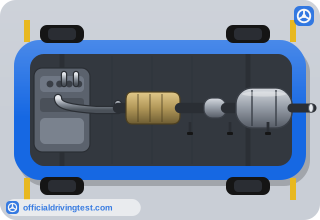
Which of these is a job of the exhaust system, according to the manual?
- Removing toxic gases from the engine
- Supplying fresh air to the cabin
- Charging the battery
- Cooling the brake fluid
Show answer
Correct answer: Removing toxic gases from the engine
The manual says the exhaust system removes toxic gases, aids in reducing engine noise and helps cool the hot gases.
Source: Arkansas Driver License Study Guide (Volume 1, Edition 10, October 2026), page 84 · Open this page in the manual (Manual page 84)
-
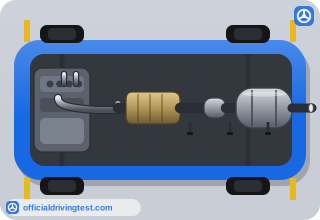
What can fumes from a leaky exhaust cause?
- Only a bad smell inside the vehicle
- Damage to the tires
- Death in a very short time
- A weaker horn
Show answer
Correct answer: Death in a very short time
The manual warns that fumes from a leaky exhaust can cause death in a very short time.
Source: Arkansas Driver License Study Guide (Volume 1, Edition 10, October 2026), page 84 · Open this page in the manual (Manual page 84)
-
What should you never allow the engine to do in your garage or an enclosed area without an open window?
- Cool down
- Idle
- Be turned off
- Be washed
Show answer
Correct answer: Idle
Fumes from a leaky exhaust can cause death in a very short time, so never let the engine idle in a garage or enclosed area without an open window.
Source: Arkansas Driver License Study Guide (Volume 1, Edition 10, October 2026), page 84 · Open this page in the manual (Manual page 84)
-
What does the manual suggest doing occasionally during the winter to reduce the risk of toxic exhaust fumes entering the moving vehicle?
- Keep all windows closed and the heater on high
- Idle the engine for several minutes before driving
- Turn off the heater
- Open a window to let fresh air fill the cabin
Show answer
Correct answer: Open a window to let fresh air fill the cabin
The manual says it is a good idea to occasionally open a window and allow fresh air into the cabin.
Source: Arkansas Driver License Study Guide (Volume 1, Edition 10, October 2026), page 84 · Open this page in the manual (Manual page 84)
-
What should you always make sure of before starting the engine?
- That your parking brake is set
- That your seat belt is unbuckled
- That your headlights are on
- That the radio is turned off
Show answer
Correct answer: That your parking brake is set
The manual says to always make sure the parking brake is set before starting the engine.
Source: Arkansas Driver License Study Guide (Volume 1, Edition 10, October 2026), page 84 · Open this page in the manual (Manual page 84)
-
What does the manual say you should use to become familiar with your vehicle's basic operations?
- A friend's advice
- An internet video
- The Owner's Manual
- The examiner's checklist
Show answer
Correct answer: The Owner's Manual
The manual says to use the Owner's Manual to become familiar with basic operations.
Source: Arkansas Driver License Study Guide (Volume 1, Edition 10, October 2026), page 84 · Open this page in the manual (Manual page 84)
-
Why is the horn described as an important safety device?
- It tells police where you are
- It warns other drivers and could save your life
- It shows other drivers your speed
- It lets you pass vehicles without signaling
Show answer
Correct answer: It warns other drivers and could save your life
The manual says the horn warns other drivers and should always be in working condition.
Source: Arkansas Driver License Study Guide (Volume 1, Edition 10, October 2026), page 84 · Open this page in the manual (Manual page 84)