Arkansas: Signals and vehicle controls — Part 2 Practice Test
Questions in this part include: “Is it legal in Arkansas to drive using only your parking lights?” · “You should use your low-beam headlights when following another vehicle closer than what distance?”
Independent educational site · not affiliated with any government agency or DMV
Ready? Test yourself
- Instant feedback with an explanation
- Every answer cites its source in the manual
- Your best score is saved on this device
Questions are original and based on the official manual "Arkansas Driver License Study Guide" (Volume 1, Edition 10, October 2026), Arkansas State Police (ASP).
All 19 questions in this practice test
Take the test above first, then use this list to study. Tap “Show answer” to see the correct answer and explanation.
Show the questions and answersHide the questions
-
Besides the time around sunset and sunrise, you should turn on your headlights anytime you cannot see a person or object clearly within what distance?
- 100 feet
- 500 feet
- 200 feet
- 1,000 feet
Show answer
Correct answer: 500 feet
The manual says to use headlights anytime you cannot see a person or object clearly within 500 feet.
Source: Arkansas Driver License Study Guide (Volume 1, Edition 10, October 2026), page 51 · Open this page in the manual (Manual page 51)
-
Is it legal in Arkansas to drive using only your parking lights?
- Yes, but only in rain, snow or fog
- Yes, but only between dusk and dawn
- Yes, but only on roads with low speed limits
- No, parking lights are for parked cars
Show answer
Correct answer: No, parking lights are for parked cars
Parking lights are for parked cars, and it is illegal in Arkansas to drive using only parking lights.
Source: Arkansas Driver License Study Guide (Volume 1, Edition 10, October 2026), page 51 · Open this page in the manual (Manual page 51)
-
When should you use your high-beam headlights?
- Whenever there are no oncoming vehicles
- Whenever you are following another vehicle closely
- When driving in fog, snow or heavy rain
- Only on roads that are well lit
Show answer
Correct answer: Whenever there are no oncoming vehicles
The manual says to use high beams whenever there are no oncoming vehicles.
Source: Arkansas Driver License Study Guide (Volume 1, Edition 10, October 2026), page 51 · Open this page in the manual (Manual page 51)
-
How far can you see with high beams compared with low beams?
- Half again as far
- Three times as far
- Twice as far
- The same distance
Show answer
Correct answer: Twice as far
The manual says high beams let you see twice as far as low beams.
Source: Arkansas Driver License Study Guide (Volume 1, Edition 10, October 2026), page 51 · Open this page in the manual (Manual page 51)
-
You should dim your high beams whenever you come within what distance of an oncoming vehicle?
- 100 feet
- 500 feet
- 200 feet
- 1,000 feet
Show answer
Correct answer: 500 feet
The manual says to dim high beams within 500 feet of an oncoming vehicle.
Source: Arkansas Driver License Study Guide (Volume 1, Edition 10, October 2026), page 51 · Open this page in the manual (Manual page 51)
-
You should use your low-beam headlights when following another vehicle closer than what distance?
- 100 feet
- 500 feet
- 1,000 feet
- 200 feet
Show answer
Correct answer: 200 feet
The manual says to use low beams when following another vehicle closer than 200 feet.
Source: Arkansas Driver License Study Guide (Volume 1, Edition 10, October 2026), page 51 · Open this page in the manual (Manual page 51)
-
Why should you use your low headlight beams when driving in fog, snow or heavy rain?
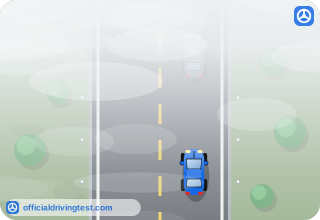
- Light from high beams reflects and causes glare, making it harder to see the road
- High beams use more fuel and wear out the bulbs when the road is wet
- High beams make other drivers think you are about to stop suddenly
- High beams cannot be seen by oncoming drivers in bad weather
Show answer
Correct answer: Light from high beams reflects and causes glare, making it harder to see the road
In fog, snow or heavy rain, high-beam light reflects and causes glare, which makes the road harder to see.
Source: Arkansas Driver License Study Guide (Volume 1, Edition 10, October 2026), page 51 · Open this page in the manual (Manual page 51)
-
What does the manual say you can do with your headlights to alert other drivers if needed?
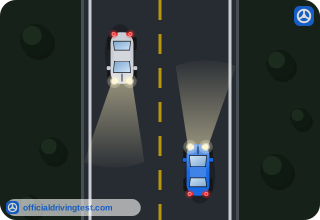
- Switch to your parking lights
- Leave your high beams on continuously
- Flick your headlight
- Turn your headlights off for a few seconds
Show answer
Correct answer: Flick your headlight
The manual says to flick your headlight to alert other drivers if needed.
Source: Arkansas Driver License Study Guide (Volume 1, Edition 10, October 2026), page 51 · Open this page in the manual (Manual page 51)
-
What should the horn be used to alert other drivers of?
- A mistake that another driver has made
- A dangerous situation, such as an accident
- A friend or acquaintance on the road
- A slow vehicle that is blocking traffic
Show answer
Correct answer: A dangerous situation, such as an accident
The horn should be used to alert other drivers of a dangerous situation such as an accident.
Source: Arkansas Driver License Study Guide (Volume 1, Edition 10, October 2026), page 52 · Open this page in the manual (Manual page 52)
-
In which situation should you sound your vehicle horn?
- You want to greet a friend you see on the road
- Another driver has made a mistake and you want to tell them
- Traffic ahead is slow to speed up when the light turns green
- A pedestrian or cyclist appears to be moving into your lane
Show answer
Correct answer: A pedestrian or cyclist appears to be moving into your lane
The manual says to sound the horn when a person on foot or on a bike appears to be moving into your lane of travel.
Source: Arkansas Driver License Study Guide (Volume 1, Edition 10, October 2026), page 52 · Open this page in the manual (Manual page 52)
-
In which situation should you sound your vehicle horn?
- Approaching a sharp curve where you cannot see ahead
- Following a vehicle that is traveling slower than you would like
- Approaching a pedestrian who is blind
- Stopped at a red light behind another vehicle
Show answer
Correct answer: Approaching a sharp curve where you cannot see ahead
The manual lists approaching a location where you cannot see what is ahead, such as a steep hill, a sharp curve or a narrow valley exit, as a time to sound the horn.
Source: Arkansas Driver License Study Guide (Volume 1, Edition 10, October 2026), page 52 · Open this page in the manual (Manual page 52)
-
When should you sound a sharp blast on your horn?
- When a driver ahead is slow to move at a green light
- When you want other drivers to know they made a mistake
- When a child or older person is about to walk into the street
- When you are passing a driver who is driving the speed limit
Show answer
Correct answer: When a child or older person is about to walk into the street
The manual says to sound a sharp blast when a child or older person is about to walk, run or ride into the street.
Source: Arkansas Driver License Study Guide (Volume 1, Edition 10, October 2026), page 52 · Open this page in the manual (Manual page 52)
-
When should you sound a sharp blast on your horn?
- When you are waiting for a pedestrian to cross
- When another car is in danger of hitting you
- When you need to tell a driver to speed up
- When you are parking in a crowded lot
Show answer
Correct answer: When another car is in danger of hitting you
The manual lists another car being in danger of hitting you as a time for a sharp blast of the horn.
Source: Arkansas Driver License Study Guide (Volume 1, Edition 10, October 2026), page 52 · Open this page in the manual (Manual page 52)
-
For which purpose should you NOT use your horn?
- To warn a driver who does not see you
- To warn a person moving into your lane of travel
- To warn a driver who starts to turn into your lane while you pass
- To encourage other vehicles to speed up
Show answer
Correct answer: To encourage other vehicles to speed up
The manual says not to use the horn to encourage other vehicles to speed up.
Source: Arkansas Driver License Study Guide (Volume 1, Edition 10, October 2026), page 52 · Open this page in the manual (Manual page 52)
-
For which purpose should you NOT use your horn?
- To greet a friend on the road
- To warn of danger when you cannot see around a sharp curve
- To alert a driver who is not paying attention
- To warn when you lose control and are moving toward oncoming traffic
Show answer
Correct answer: To greet a friend on the road
The manual lists greeting a friend on the road among the things you should not use the horn for.
Source: Arkansas Driver License Study Guide (Volume 1, Edition 10, October 2026), page 52 · Open this page in the manual (Manual page 52)
-
How far before a lane change, a right turn or a left turn should turn signals be used?
- 25 feet
- 300 feet
- 500 feet
- 100 feet
Show answer
Correct answer: 100 feet
The manual says turn signals should be used 100 feet before a lane change or turn.
Source: Arkansas Driver License Study Guide (Volume 1, Edition 10, October 2026), page 53 · Open this page in the manual (Manual page 53)
-
Besides lane changes and turns, when should turn signals be used?
- Each time you merge into traffic or park
- Only when another vehicle is close behind you
- Only on roads with more than two lanes
- Only when you are slowing down to stop at a red light
Show answer
Correct answer: Each time you merge into traffic or park
The manual says to use turn signals each time you merge into traffic or park.
Source: Arkansas Driver License Study Guide (Volume 1, Edition 10, October 2026), page 53 · Open this page in the manual (Manual page 53)
-
You plan to turn beyond an intersection. When should you start your turn signal?
- Before you reach the intersection
- Right at the middle of the intersection
- Just after you pass through the intersection
- Only after you have started the turn
Show answer
Correct answer: Just after you pass through the intersection
If you signal earlier, another driver may think you are turning at the intersection.
Source: Arkansas Driver License Study Guide (Volume 1, Edition 10, October 2026), page 53 · Open this page in the manual (Manual page 53)
-
Another vehicle is about to enter the street between you and the place where you plan to turn. What should you do?
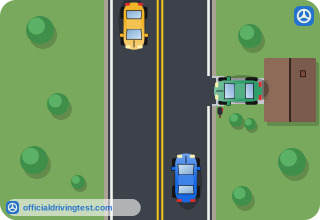
- Signal immediately and keep your speed
- Wait until you have passed it to signal your turn
- Sound your horn and then signal
- Turn on your hazard lights instead of your turn signal
Show answer
Correct answer: Wait until you have passed it to signal your turn
The manual says to wait until you have passed the vehicle before signaling your turn.
Source: Arkansas Driver License Study Guide (Volume 1, Edition 10, October 2026), page 53 · Open this page in the manual (Manual page 53)