Arkansas: Signals and vehicle controls — Part 1 Practice Test
Questions in this part include: “The turning diagrams show when a driver should begin to signal and reduce speed before a turn. How far from the corner?” · “Before you get into your vehicle to back up, what should you do?”
Independent educational site · not affiliated with any government agency or DMV
Ready? Test yourself
- Instant feedback with an explanation
- Every answer cites its source in the manual
- Your best score is saved on this device
Questions are original and based on the official manual "Arkansas Driver License Study Guide" (Volume 1, Edition 10, October 2026), Arkansas State Police (ASP).
All 19 questions in this practice test
Take the test above first, then use this list to study. Tap “Show answer” to see the correct answer and explanation.
Show the questions and answersHide the questions
-
The turning diagrams show when a driver should begin to signal and reduce speed before a turn. How far from the corner?
- At least 100 feet
- At least 25 feet
- At least 50 feet
- At least 300 feet
Show answer
Correct answer: At least 100 feet
Both turning diagrams say to begin the signal and reduce speed at least 100 feet from the corner.
Source: Arkansas Driver License Study Guide (Volume 1, Edition 10, October 2026), page 33 · Open this page in the manual (Manual page 33)
-
How should the gas pedal be pressed when accelerating?
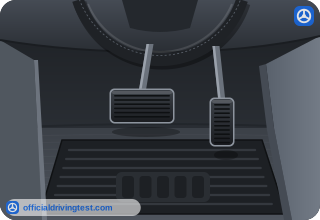
- Quickly and firmly
- Slowly and smoothly
- In short, repeated bursts
- All the way down at once
Show answer
Correct answer: Slowly and smoothly
The manual says acceleration should be pressed slowly and smoothly.
Source: Arkansas Driver License Study Guide (Volume 1, Edition 10, October 2026), page 44 · Open this page in the manual (Manual page 44)
-
What can pressing the gas pedal too fast cause, especially on wet pavement?
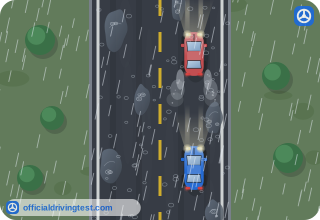
- The brakes to lock up and the vehicle to stop
- The engine to stall and the lights to dim
- The tires to wear out and the engine to overheat
- Drive wheels spinning or the vehicle sliding
Show answer
Correct answer: Drive wheels spinning or the vehicle sliding
The manual says depressing the gas pedal too fast can cause the drive wheels to spin or the vehicle to slide.
Source: Arkansas Driver License Study Guide (Volume 1, Edition 10, October 2026), page 44 · Open this page in the manual (Manual page 44)
-
Why do drivers with manual transmissions need practice with the clutch and accelerator?
- To avoid stalling or over-accelerating the engine
- To avoid wearing out the tires on sharp turns
- To keep the brakes from overheating on hills
- To stay within the speed limit on long trips
Show answer
Correct answer: To avoid stalling or over-accelerating the engine
The manual says manual-transmission drivers need practice to avoid stalling or over-accelerating the engine.
Source: Arkansas Driver License Study Guide (Volume 1, Edition 10, October 2026), page 44 · Open this page in the manual (Manual page 44)
-
Where should your hands be placed on the steering wheel?
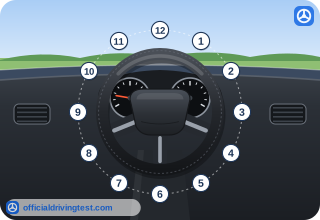
- Both together at the top of the wheel
- Both at the bottom of the wheel
- On opposite sides of the wheel
- One on the wheel and one on the gearshift
Show answer
Correct answer: On opposite sides of the wheel
The manual says hands on opposite sides of the wheel are more comfortable and let you turn without taking your hands off the wheel.
Source: Arkansas Driver License Study Guide (Volume 1, Edition 10, October 2026), page 44 · Open this page in the manual (Manual page 44)
-
Which technique should you use to steer through a sharp turn, such as around the corner of an intersection?
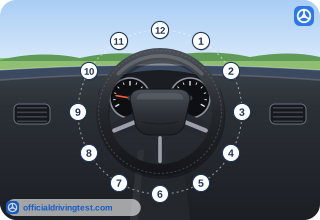
- Turning the wheel in the palm of one hand
- The hand-over-hand technique
- Holding the wheel with one hand at the top
- Letting the wheel slide through your hands
Show answer
Correct answer: The hand-over-hand technique
The manual says to use the "hand-over-hand" technique and not to turn the wheel in the palm of your hand.
Source: Arkansas Driver License Study Guide (Volume 1, Edition 10, October 2026), page 44 · Open this page in the manual (Manual page 44)
-
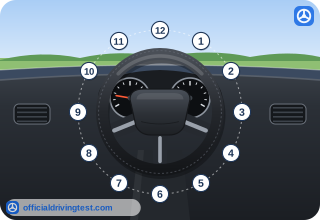
When you complete a turn, what should you do with the steering wheel?
- Hold it in place until the vehicle straightens itself
- Let go of it and let it spin back by itself
- Leave it turned until you reach the next intersection
- Return it to the position for the direction you are moving
Show answer
Correct answer: Return it to the position for the direction you are moving
The manual says to return the steering wheel to the appropriate position in the direction the vehicle should be moving.
Source: Arkansas Driver License Study Guide (Volume 1, Edition 10, October 2026), page 44 · Open this page in the manual (Manual page 44)
-
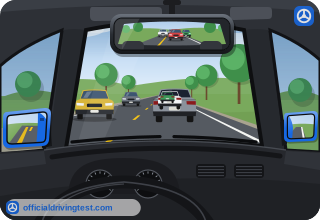
What does checking your mirrors help you see when you look behind you in heavy traffic?
- Only the vehicles that are in your blind spots
- The condition of the road surface behind you
- The lanes that are about to end ahead of you
- Vehicles approaching too fast or following too close
Show answer
Correct answer: Vehicles approaching too fast or following too close
The manual says checking mirrors lets you see rear traffic approaching too fast and vehicles following too close, giving you more time to react.
Source: Arkansas Driver License Study Guide (Volume 1, Edition 10, October 2026), page 49 · Open this page in the manual (Manual page 49)
-
What should you use before making a lane change to be sure it is safe?
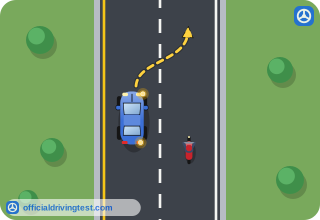
- Both mirrors and a look over your shoulder
- The rearview mirror alone, without looking back
- Only your turn signal and the side mirrors
- Your hazard flashers and the side mirrors
Show answer
Correct answer: Both mirrors and a look over your shoulder
The manual says to use the rearview mirror, side mirrors, and look over your shoulder before a lane change.
Source: Arkansas Driver License Study Guide (Volume 1, Edition 10, October 2026), page 49 · Open this page in the manual (Manual page 49)
-
Which of these is counted as a lane change in the manual?
- Staying in your lane while passing an exit
- Slowing down in your own lane
- Merging onto a roadway from an entrance ramp
- Turning your headlights on
Show answer
Correct answer: Merging onto a roadway from an entrance ramp
The manual defines a lane change as moving from one lane to another or merging onto a roadway from an entrance ramp, turn lane, or curb or shoulder entrance.
Source: Arkansas Driver License Study Guide (Volume 1, Edition 10, October 2026), page 49 · Open this page in the manual (Manual page 49)
-
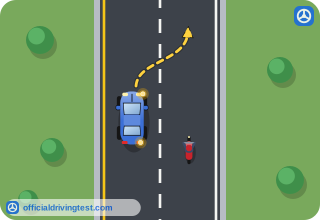
Why must you look over your shoulder in the direction you plan to move before changing lanes?
- Mirrors only show traffic far behind you
- Your signal does not warn drivers in the next lane
- It shows you whether the lane ahead is clear
- Mirrors do not show vehicles in your blind spots
Show answer
Correct answer: Mirrors do not show vehicles in your blind spots
The manual says the rearview and side mirrors will not show vehicles in your blind spots.
Source: Arkansas Driver License Study Guide (Volume 1, Edition 10, October 2026), page 49 · Open this page in the manual (Manual page 49)
-
How should you check your blind spot?
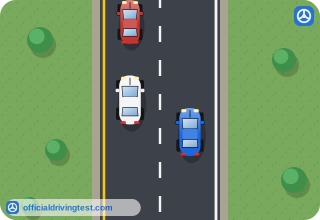
- Turn your head for a quick glance over your shoulder
- Turn your head fully and hold the look until it is clear
- Lean toward the side window and look slowly
- Look in the rearview mirror twice, then move over
Show answer
Correct answer: Turn your head for a quick glance over your shoulder
The manual says to quickly glance over your shoulder because traffic ahead could stop suddenly.
Source: Arkansas Driver License Study Guide (Volume 1, Edition 10, October 2026), page 49 · Open this page in the manual (Manual page 49)
-
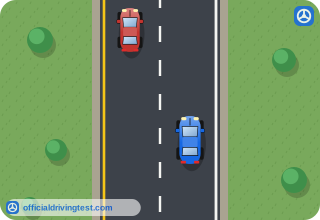
What is a blind spot in a vehicle?
- An area directly in front of the hood lit by the headlights
- An area around the vehicle the driver cannot directly see
- The area on the road more than a quarter mile ahead
- A section of road hidden by fog or darkness
Show answer
Correct answer: An area around the vehicle the driver cannot directly see
The manual defines a blind spot as an area around the vehicle that cannot be directly observed by the driver while at the controls.
Source: Arkansas Driver License Study Guide (Volume 1, Edition 10, October 2026), page 50 · Open this page in the manual (Manual page 50)
-
Before you get into your vehicle to back up, what should you do?
- Adjust your mirrors for a better view of the rear
- Turn on the radio
- Check behind your vehicle
- Leave the door open
Show answer
Correct answer: Check behind your vehicle
The manual says to check behind your vehicle before you get in, because children or small objects cannot be seen from the driver's seat.
Source: Arkansas Driver License Study Guide (Volume 1, Edition 10, October 2026), page 50 · Open this page in the manual (Manual page 50)
-
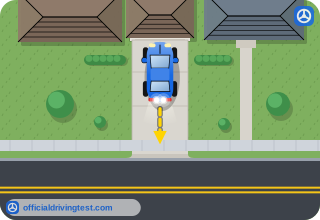
When backing, how should you look behind you?
- Rely on your rearview and side mirrors alone
- Turn your body and look through the rear and side windows
- Keep your eyes on the left mirror while turning the wheel
- Look only through the rearview mirror and go slowly
Show answer
Correct answer: Turn your body and look through the rear and side windows
The manual says not to depend on mirrors, because you cannot see directly behind your vehicle.
Source: Arkansas Driver License Study Guide (Volume 1, Edition 10, October 2026), page 50 · Open this page in the manual (Manual page 50)
-
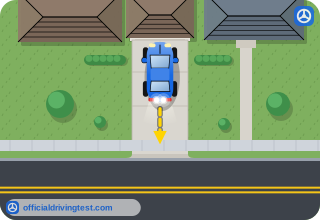
How fast should you back your vehicle?
- Quickly, to clear the space sooner
- At the normal speed for the road
- At any speed that finishes in one move
- Slowly, since it is harder to steer
Show answer
Correct answer: Slowly, since it is harder to steer
The manual says to back slowly because your vehicle is much harder to steer while you are backing.
Source: Arkansas Driver License Study Guide (Volume 1, Edition 10, October 2026), page 50 · Open this page in the manual (Manual page 50)
-
Whenever possible, who should help you when backing?
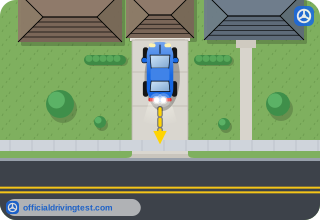
- A person outside the vehicle
- A passenger in the back seat
- A passenger who watches the mirrors
- Nobody; you should do it alone
Show answer
Correct answer: A person outside the vehicle
The manual says to use a person outside the vehicle to help you back whenever possible.
Source: Arkansas Driver License Study Guide (Volume 1, Edition 10, October 2026), page 50 · Open this page in the manual (Manual page 50)
-
According to the manual, when does Arkansas law require drivers to turn on their headlights?
- When windshield wipers are needed
- Only when driving after midnight
- Only on roads that have no streetlights
- Only when driving on a highway or freeway
Show answer
Correct answer: When windshield wipers are needed
Arkansas law requires drivers to turn on their headlights when windshield wipers are needed.
Source: Arkansas Driver License Study Guide (Volume 1, Edition 10, October 2026), page 51 · Open this page in the manual (Manual page 51)
-
When should you turn on your headlights in relation to sunset and sunrise?
- At the moment of sunset and at the moment of sunrise
- One hour after sunset and one hour before sunrise
- A half hour (30 minutes) after sunset and a half hour before sunrise
- Fifteen minutes after sunset and fifteen minutes before sunrise
Show answer
Correct answer: A half hour (30 minutes) after sunset and a half hour before sunrise
The manual says to turn headlights on a half hour after sunset and a half hour before sunrise.
Source: Arkansas Driver License Study Guide (Volume 1, Edition 10, October 2026), page 51 · Open this page in the manual (Manual page 51)