Arkansas: Sharing the road — Part 1 Practice Test
Questions in this part include: “When is a driver NOT required to stop for a school bus with its red lights flashing?” · “With what are drivers charged who fail to obey the school bus law and cause the death of a person?”
Independent educational site · not affiliated with any government agency or DMV
Ready? Test yourself
- Instant feedback with an explanation
- Every answer cites its source in the manual
- Your best score is saved on this device
Questions are original and based on the official manual "Arkansas Driver License Study Guide" (Volume 1, Edition 10, October 2026), Arkansas State Police (ASP).
All 20 questions in this practice test
Take the test above first, then use this list to study. Tap “Show answer” to see the correct answer and explanation.
Show the questions and answersHide the questions
-
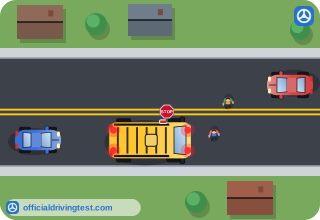
What must you do when approaching a stopped school bus with its red lights flashing?
- Slow down and pass with caution once the road ahead is clear
- Make a complete stop and stay stopped until the lights are turned off
- Stop only if you are in the same lane of traffic as the bus
- Stop only if you are behind the bus or approaching an intersection
Show answer
Correct answer: Make a complete stop and stay stopped until the lights are turned off
A driver must make a complete stop until the lights are turned off, wherever the vehicle is positioned relative to the bus.
Source: Arkansas Driver License Study Guide (Volume 1, Edition 10, October 2026), page 12 · Open this page in the manual (Manual page 12)
-
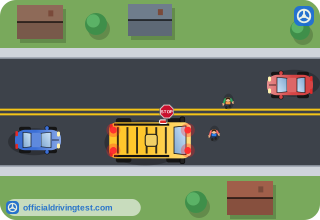
When may a driver pass a stopped school bus?
- As soon as all the children have safely crossed the road in front of the bus
- When the bus driver waves you past after checking for children
- Once you have slowed to a crawl and checked carefully for children nearby
- After the bus finishes loading and unloading and starts moving with no red lights flashing
Show answer
Correct answer: After the bus finishes loading and unloading and starts moving with no red lights flashing
The driver must never pass in any direction until the bus has finished receiving or discharging passengers and begins moving without its red lights flashing.
Source: Arkansas Driver License Study Guide (Volume 1, Edition 10, October 2026), page 12 · Open this page in the manual (Manual page 12)
-
When is a driver NOT required to stop for a school bus with its red lights flashing?
- When the bus is approaching in an opposite lane separated by a median 20 feet or more wide
- When the bus is approaching in an opposite lane separated by a painted center line
- When the bus is stopped at an intersection
- When the bus is approaching in an opposite lane of any divided road
Show answer
Correct answer: When the bus is approaching in an opposite lane separated by a median 20 feet or more wide
Drivers are not required to stop if the bus approaches along an opposite lane separated by a median twenty feet or more in width.
Source: Arkansas Driver License Study Guide (Volume 1, Edition 10, October 2026), page 12 · Open this page in the manual (Manual page 12)
-
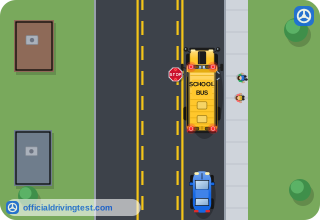
On a two-lane roadway with a center turning lane, which traffic must stop when a school bus stops for passengers?
- Only traffic following the bus
- All traffic from both directions
- Only traffic in the bus's lane
- Only traffic in the center turning lane
Show answer
Correct answer: All traffic from both directions
The diagram caption says that on a two-lane roadway with a center turning lane, all traffic from both directions must stop.
Source: Arkansas Driver License Study Guide (Volume 1, Edition 10, October 2026), page 13 · Open this page in the manual (Manual page 13)
-
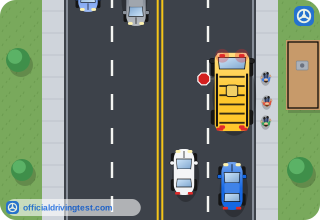
On a four-lane roadway without a median separation, which traffic must stop when a school bus stops for passengers?
- Only traffic following the bus
- Only traffic in the right lane behind the bus
- Only traffic coming toward the bus
- All traffic from both directions
Show answer
Correct answer: All traffic from both directions
The diagram caption says that on a four-lane roadway without a median separation, all traffic from both directions must stop.
Source: Arkansas Driver License Study Guide (Volume 1, Edition 10, October 2026), page 13 · Open this page in the manual (Manual page 13)
-
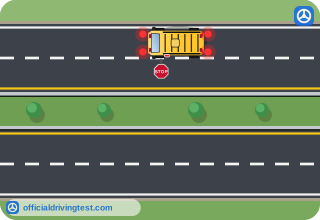
On a divided highway of four lanes or more with a median separation of 20 feet or more, which traffic must stop when a school bus stops for passengers?
- Only traffic following the bus
- All traffic from both directions
- Only traffic coming toward the bus
- No traffic needs to stop
Show answer
Correct answer: Only traffic following the bus
The diagram caption says that on a divided highway of four lanes or more with a median separation, only traffic following the bus must stop.
Source: Arkansas Driver License Study Guide (Volume 1, Edition 10, October 2026), page 13 · Open this page in the manual (Manual page 13)
-
How is a driver who passes a stopped school bus with its red lights flashing charged, and what is the minimum fine upon conviction?
- With a misdemeanor and a minimum fine of $100
- With a felony and a minimum fine of $500
- With a misdemeanor and a minimum fine of $250
- With a traffic infraction and a minimum fine of $50
Show answer
Correct answer: With a misdemeanor and a minimum fine of $250
Drivers passing a stopped school bus with red lights flashing are charged with a misdemeanor and, upon conviction, fined a minimum of $250.
Source: Arkansas Driver License Study Guide (Volume 1, Edition 10, October 2026), page 13 · Open this page in the manual (Manual page 13)
-
Passing a stopped school bus with its red lights flashing can bring up to how many days in jail?
- Thirty days
- Ninety days
- Sixty days
- One hundred eighty days
Show answer
Correct answer: Ninety days
The penalty can include up to ninety days in jail, a fine of $250 to $1,000, or both.
Source: Arkansas Driver License Study Guide (Volume 1, Edition 10, October 2026), page 13 · Open this page in the manual (Manual page 13)
-
With what are drivers charged who fail to obey the school bus law and cause the death of a person?
- A misdemeanor
- A traffic infraction
- A fine only
- A felony
Show answer
Correct answer: A felony
Drivers who fail to obey the law and cause the death of a person will be charged with a felony.
Source: Arkansas Driver License Study Guide (Volume 1, Edition 10, October 2026), page 13 · Open this page in the manual (Manual page 13)
-
Under Isaac's Law, what is a person who negligently causes the death of another person subject to?
- A Class C felony for negligent homicide
- A Class A misdemeanor for reckless driving
- A Class B felony for manslaughter
- A Class D felony for vehicular assault
Show answer
Correct answer: A Class C felony for negligent homicide
Isaac's Law makes a person who negligently causes the death of another person subject to a Class C felony for negligent homicide.
Source: Arkansas Driver License Study Guide (Volume 1, Edition 10, October 2026), page 13 · Open this page in the manual (Manual page 13)
-
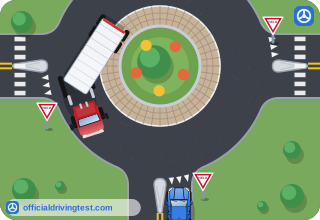
What should drivers do when large vehicles like trucks or buses are in the roundabout?
- Drive alongside them to pass quickly
- Follow as closely as possible behind them
- Stop in the roundabout until they have left
- Give them space and avoid driving next to them
Show answer
Correct answer: Give them space and avoid driving next to them
The roundabout page says to give large vehicles space and avoid driving next to them inside the roundabout.
Source: Arkansas Driver License Study Guide (Volume 1, Edition 10, October 2026), page 38 · Open this page in the manual (Manual page 38)
-
Which road users does the manual say can be especially hard to see when you are entering the roadway from the curb or driveway?
- Tractor-trailers, buses and school buses
- Police vehicles, ambulances and fire trucks
- Motorcycles, bicycles and pedestrians
- Parked cars, mailboxes and utility poles
Show answer
Correct answer: Motorcycles, bicycles and pedestrians
The manual says to look carefully for motorcycles, bicycles and pedestrians, which are especially hard to see when entering the roadway from the curb or driveway.
Source: Arkansas Driver License Study Guide (Volume 1, Edition 10, October 2026), page 49 · Open this page in the manual (Manual page 49)
-
Where does the manual say you should not drive in relation to other vehicles?
- Directly behind other vehicles in your lane
- More than 100 feet from other vehicles
- In the center lane of a multi-lane road
- Alongside or slightly behind other vehicles
Show answer
Correct answer: Alongside or slightly behind other vehicles
The blind spot tips say not to drive on either side or slightly in the rear of other vehicles.
Source: Arkansas Driver License Study Guide (Volume 1, Edition 10, October 2026), page 50 · Open this page in the manual (Manual page 50)
-
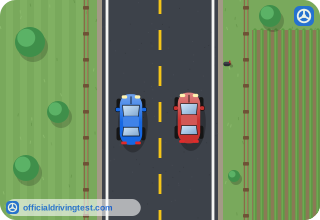
When passing another vehicle, what should you avoid?
- Staying in the other driver's blind spot
- Using your turn signal
- Looking at the other vehicle
- Moving back into your lane after passing
Show answer
Correct answer: Staying in the other driver's blind spot
The blind spot tips say not to stay in another driver's blind spot when passing.
Source: Arkansas Driver License Study Guide (Volume 1, Edition 10, October 2026), page 50 · Open this page in the manual (Manual page 50)
-
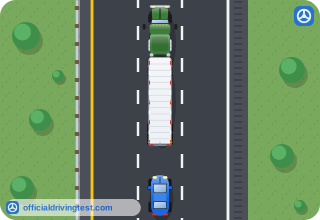
What should you never do around a large vehicle such as a tractor-trailer or bus?
- Pass it on the left
- Follow it at a distance
- Stay alongside it
- Signal near it
Show answer
Correct answer: Stay alongside it
The blind spot tips say never to stay alongside a large vehicle such as a tractor-trailer or bus.
Source: Arkansas Driver License Study Guide (Volume 1, Edition 10, October 2026), page 50 · Open this page in the manual (Manual page 50)
-
How can you get out of another driver's blind spot?
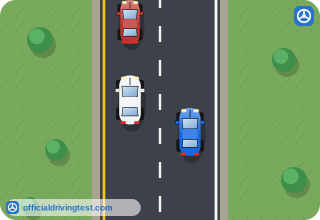
- By staying alongside and honking
- By speeding up or slowing down
- By staying in the same position
- By changing lanes without signaling
Show answer
Correct answer: By speeding up or slowing down
The blind spot tips say to get out of the other driver's blind spot as soon as possible by speeding up or slowing down.
Source: Arkansas Driver License Study Guide (Volume 1, Edition 10, October 2026), page 50 · Open this page in the manual (Manual page 50)
-
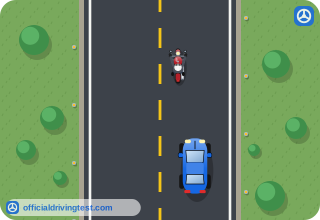
What should you do when following a motorcycle?
- Follow at the same distance as for a car
- Allow an extra cushion of space
- Stay close behind so it can see you
- Drive beside it in the same lane
Show answer
Correct answer: Allow an extra cushion of space
The manual says to allow an extra cushion of space when following a motorcycle.
Source: Arkansas Driver License Study Guide (Volume 1, Edition 10, October 2026), page 59 · Open this page in the manual (Manual page 59)
-
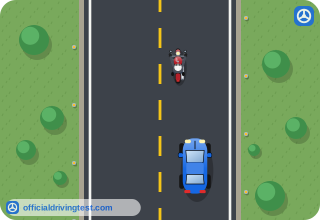
Which road conditions can increase a motorcyclist's chance of falling, according to the manual?
- Dry, smooth asphalt and freshly painted lane lines
- Wide shoulders and long straight roads with no traffic
- Roads with a median divider and several lanes
- Wet, icy or gravel roads, and bridges or railroad tracks
Show answer
Correct answer: Wet, icy or gravel roads, and bridges or railroad tracks
The manual lists wet, icy or gravel roads and metal surfaces such as bridges, gratings, and streetcar and railroad tracks.
Source: Arkansas Driver License Study Guide (Volume 1, Edition 10, October 2026), page 59 · Open this page in the manual (Manual page 59)
-
Why should you be prepared when following trucks, buses, vans, or vehicles pulling campers or trailers?
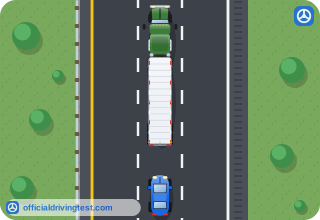
- Their drivers may not see you behind them and could stop suddenly
- They are required to stop at every intersection they approach
- They always travel faster than the traffic around them on highways
- Their brake lights cannot be seen from behind in daylight
Show answer
Correct answer: Their drivers may not see you behind them and could stop suddenly
The manual says these drivers may not see you behind them and could suddenly stop.
Source: Arkansas Driver License Study Guide (Volume 1, Edition 10, October 2026), page 59 · Open this page in the manual (Manual page 59)
-
Why should you keep extra space between your vehicle and parked cars?
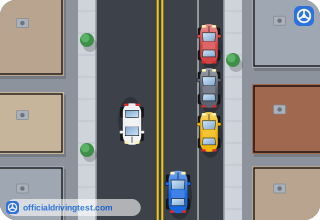
- Parked cars are required to move over when you pass
- Parked cars always have their doors locked and windows up
- The road is always wider beside a row of parked cars
- A pedestrian could step out or a car could pull out
Show answer
Correct answer: A pedestrian could step out or a car could pull out
The manual says a pedestrian could step out from a parked vehicle or between vehicles, or a vehicle could be pulling out of a space.
Source: Arkansas Driver License Study Guide (Volume 1, Edition 10, October 2026), page 60 · Open this page in the manual (Manual page 60)