Arkansas: Pavement markings Practice Test
White and yellow lines, the fog line, shared center lanes and the markings at crosswalks and stop lines.
Independent educational site · not affiliated with any government agency or DMV
Ready? Test yourself
- Instant feedback with an explanation
- Every answer cites its source in the manual
- Your best score is saved on this device
Questions are original and based on the official manual "Arkansas Driver License Study Guide" (Volume 1, Edition 10, October 2026), Arkansas State Police (ASP).
All 12 questions in this practice test
Take the test above first, then use this list to study. Tap “Show answer” to see the correct answer and explanation.
Show the questions and answersHide the questions
-
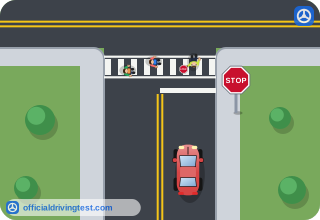
What may a painted line next to a stop sign indicate?
- Where the road narrows ahead
- Where passing is allowed
- Where the vehicle must stop
- Where parking is permitted
Show answer
Correct answer: Where the vehicle must stop
The manual says a painted line next to a stop sign indicates where the vehicle must stop.
Source: Arkansas Driver License Study Guide (Volume 1, Edition 10, October 2026), page 25 · Open this page in the manual (Manual page 25)
-
What do the pavement markings at a railroad crossing consist of, which mean the same as the Advance Warning sign?
- Two yellow arrows with the word TRAIN painted across both lanes
- A white circle with a number showing how many tracks are ahead
- An "X" with the letters "RR" and a no-passing marking on two-lane roads
- A row of white diamonds painted across the lane before the tracks
Show answer
Correct answer: An "X" with the letters "RR" and a no-passing marking on two-lane roads
Pavement markings at a crossing consist of an X with the letters RR and a no-passing marking on two-lane roads.
Source: Arkansas Driver License Study Guide (Volume 1, Edition 10, October 2026), page 28 · Open this page in the manual (Manual page 28)
-
What color is the stop line that may be painted on the pavement before the railroad tracks?
- White
- Yellow
- Red
- Orange
Show answer
Correct answer: White
The manual says there may be a white Stop Line painted on the pavement before the railroad tracks.
Source: Arkansas Driver License Study Guide (Volume 1, Edition 10, October 2026), page 28 · Open this page in the manual (Manual page 28)
-
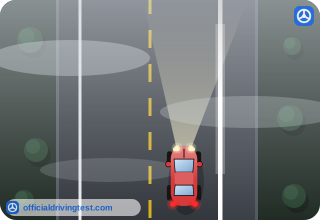
What does a solid white line along the side of the roadway (a fog line) tell the driver?
- Where the outer edge of the roadway is located
- Where the center of the roadway is located
- That passing is prohibited on that side
- That the lane is reserved for slow vehicles
Show answer
Correct answer: Where the outer edge of the roadway is located
The fog line is a solid white line that marks the outer edge of the roadway.
Source: Arkansas Driver License Study Guide (Volume 1, Edition 10, October 2026), page 31 · Open this page in the manual (Manual page 31)
-
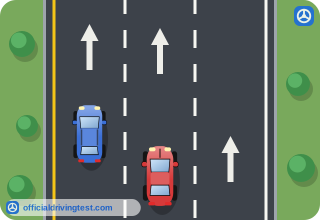
What does a dashed white line between lanes of traffic mean?
- A driver may never cross the line
- The lanes on both sides carry traffic moving in opposite directions
- A driver may cross the line to change lanes, when safe
- A driver may cross the line only to turn into a driveway
Show answer
Correct answer: A driver may cross the line to change lanes, when safe
A dashed white line separates lanes moving in the same direction, and a driver may cross it to change lanes when it is safe.
Source: Arkansas Driver License Study Guide (Volume 1, Edition 10, October 2026), page 31 · Open this page in the manual (Manual page 31)
-
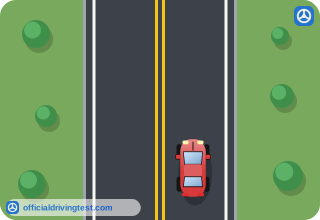
What does a solid double yellow line separate?
- Lanes of traffic moving in the same direction
- Lanes of traffic moving in opposite directions
- A travel lane from the shoulder
- A travel lane from a parking lane
Show answer
Correct answer: Lanes of traffic moving in opposite directions
The manual states that a solid double yellow line separates lanes of traffic moving in opposite directions.
Source: Arkansas Driver License Study Guide (Volume 1, Edition 10, October 2026), page 31 · Open this page in the manual (Manual page 31)
-
A double yellow line in the center of the roadway means passing is
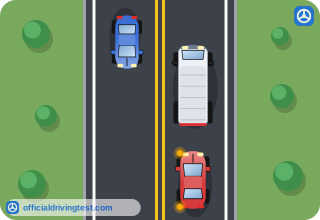
- allowed only for vehicles in the right lane
- allowed when no vehicle is in sight
- prohibited only for vehicles traveling uphill
- prohibited for vehicles traveling in either direction
Show answer
Correct answer: prohibited for vehicles traveling in either direction
A double yellow center line prohibits passing for vehicles traveling in either direction.
Source: Arkansas Driver License Study Guide (Volume 1, Edition 10, October 2026), page 31 · Open this page in the manual (Manual page 31)
-
When may a driver cross a solid yellow line?
- To turn into a driveway when no opposing traffic is approaching
- To pass a slow vehicle when the road ahead looks clear of traffic
- To change lanes when the driver signals
- To enter a shoulder to let faster traffic by
Show answer
Correct answer: To turn into a driveway when no opposing traffic is approaching
The manual allows crossing a solid yellow line to turn into a driveway if there is no opposing traffic approaching the turn site.
Source: Arkansas Driver License Study Guide (Volume 1, Edition 10, October 2026), page 31 · Open this page in the manual (Manual page 31)
-
What does a broken yellow line between opposing lanes of traffic indicate?
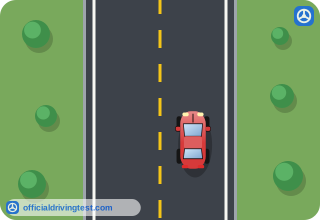
- Passing is prohibited in both directions at all times
- Passing is allowed only on the right side of the road
- A driver may cross it to pass if there is no opposing traffic
- The road ahead is a one-way street with no oncoming traffic
Show answer
Correct answer: A driver may cross it to pass if there is no opposing traffic
A broken yellow line between opposing lanes lets a driver cross to pass when there is no opposing traffic.
Source: Arkansas Driver License Study Guide (Volume 1, Edition 10, October 2026), page 31 · Open this page in the manual (Manual page 31)
-
A center line has a solid yellow line on one side and a broken yellow line on the other. On which side is passing permitted?
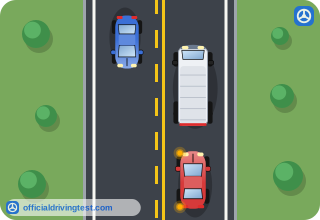
- On the side with the solid line
- On the side with the broken line
- On neither side
- On both sides
Show answer
Correct answer: On the side with the broken line
The diagram on this page shows passing is permitted on the side with the broken line and not permitted on the side with the solid line.
Source: Arkansas Driver License Study Guide (Volume 1, Edition 10, October 2026), page 31 · Open this page in the manual (Manual page 31)
-
In Arkansas, a driver making a left turn from an intersecting street or driveway may use a center turn lane to gain access or merge into traffic lanes. What may the driver NOT use the center left turn lane as?
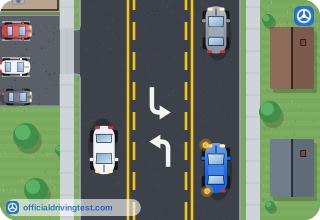
- A lane for turning left
- A lane for entering traffic
- A lane for crossing the road
- An acceleration lane
Show answer
Correct answer: An acceleration lane
The manual allows the maneuver but states it is not permissible to use the center left turn lane as an acceleration lane.
Source: Arkansas Driver License Study Guide (Volume 1, Edition 10, October 2026), page 32 · Open this page in the manual (Manual page 32)
-
Shared center lanes are reserved for what use?
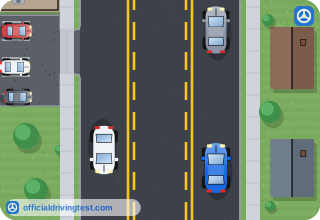
- Making left turns by vehicles traveling in either direction
- Passing slower vehicles in either direction
- Making left turns by vehicles traveling in one direction only
- Stopping and parking for short periods
Show answer
Correct answer: Making left turns by vehicles traveling in either direction
Shared center lanes are reserved for left turns and can be used by vehicles traveling in either direction.
Source: Arkansas Driver License Study Guide (Volume 1, Edition 10, October 2026), page 32 · Open this page in the manual (Manual page 32)