Arkansas: Emergencies — Part 2 Practice Test
Questions in this part include: “What advantage does ABS give you when you need to avoid a collision by turning?” · “In which situation might you need to speed up to avoid a collision?”
Independent educational site · not affiliated with any government agency or DMV
Ready? Test yourself
- Instant feedback with an explanation
- Every answer cites its source in the manual
- Your best score is saved on this device
Questions are original and based on the official manual "Arkansas Driver License Study Guide" (Volume 1, Edition 10, October 2026), Arkansas State Police (ASP).
All 20 questions in this practice test
Take the test above first, then use this list to study. Tap “Show answer” to see the correct answer and explanation.
Show the questions and answersHide the questions
-
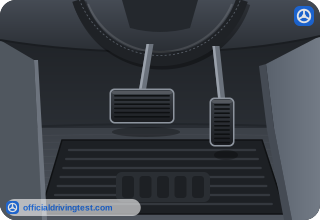
If your vehicle does not have antilock brakes and you must stop quickly, how should you apply the brakes?
- With full force, locking the wheels
- Lightly, in short taps
- Only with the parking brake
- As hard as you can without locking them
Show answer
Correct answer: As hard as you can without locking them
Without ABS you brake as hard as you can without locking the brakes, since braking too hard can cause a skid.
Source: Arkansas Driver License Study Guide (Volume 1, Edition 10, October 2026), page 78 · Open this page in the manual (Manual page 78)
-
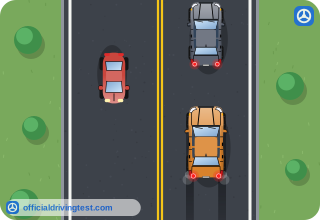
In a vehicle without ABS, the brakes lock up and you feel the vehicle start to skid. What should you do?
- Quickly let up on the brake pedal
- Press the brake pedal harder
- Turn off the ignition
- Shift into neutral
Show answer
Correct answer: Quickly let up on the brake pedal
If the brakes lock up and the vehicle starts to skid, you quickly let up on the pedal.
Source: Arkansas Driver License Study Guide (Volume 1, Edition 10, October 2026), page 78 · Open this page in the manual (Manual page 78)
-
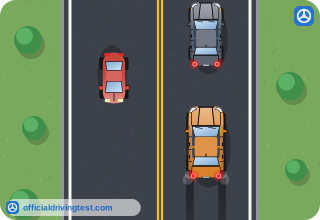
In a vehicle without ABS, what do you do as soon as the vehicle stops skidding?
- Keep your foot off the brake until you are stopped
- Switch to the parking brake
- Push down on the brake pedal again and repeat until stopped
- Shift into a lower gear
Show answer
Correct answer: Push down on the brake pedal again and repeat until stopped
You push the brake down again and keep doing this until the vehicle has stopped.
Source: Arkansas Driver License Study Guide (Volume 1, Edition 10, October 2026), page 78 · Open this page in the manual (Manual page 78)
-
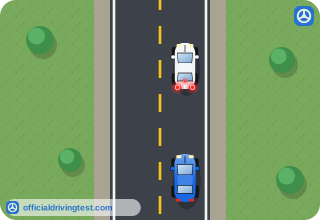
Why should you consider turning to avoid a collision?
- Turning always takes less room than speeding up
- A vehicle can usually be turned quicker than stopped
- Steering is easier than braking on wet roads
- A turn is safer than stopping in every situation
Show answer
Correct answer: A vehicle can usually be turned quicker than stopped
The manual says most of the time a vehicle can be turned quicker than it can be stopped.
Source: Arkansas Driver License Study Guide (Volume 1, Edition 10, October 2026), page 78 · Open this page in the manual (Manual page 78)
-
According to the manual, what is the best way to grip the steering wheel when turning to avoid danger?
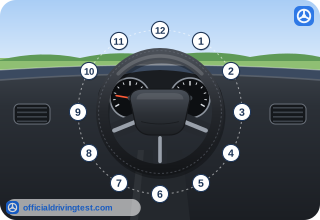
- With both hands at the 9 o’clock and 3 o’clock positions
- With one hand at the top of the wheel
- With both hands at the bottom of the wheel
- With both hands at the 10 o’clock and 2 o’clock positions
Show answer
Correct answer: With both hands at the 10 o’clock and 2 o’clock positions
The manual says both hands should be on the wheel at 10 and 2.
Source: Arkansas Driver License Study Guide (Volume 1, Edition 10, October 2026), page 78 · Open this page in the manual (Manual page 78)
-
After you turn away or change lanes to avoid danger, what must you be ready to do?
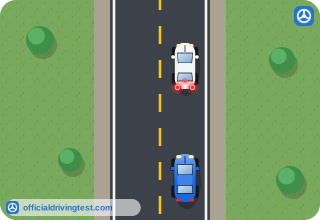
- Keep the vehicle under control
- Stop immediately in the new lane
- Speed up to leave the danger behind
- Return to your first lane at once
Show answer
Correct answer: Keep the vehicle under control
The manual warns that some drivers steer away from one collision only to end up in another.
Source: Arkansas Driver License Study Guide (Volume 1, Edition 10, October 2026), page 78 · Open this page in the manual (Manual page 78)
-
What advantage does ABS give you when you need to avoid a collision by turning?
- You can turn without using the steering wheel
- You never need to brake before a turn
- You can turn while braking without skidding
- You can turn at any speed without risk
Show answer
Correct answer: You can turn while braking without skidding
With ABS you can turn while braking without skidding, which helps with turning, stopping or slowing down.
Source: Arkansas Driver License Study Guide (Volume 1, Edition 10, October 2026), page 78 · Open this page in the manual (Manual page 78)
-
If your vehicle does not have ABS, how do you turn quickly to avoid a collision?
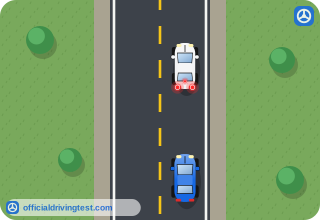
- Keep the brake pressed down while you turn
- Brake, then let up and turn the steering wheel
- Release the gas and turn without braking
- Pull the parking brake and turn the wheel
Show answer
Correct answer: Brake, then let up and turn the steering wheel
Braking puts more weight on the front tires for a quicker turn, then you let up and steer.
Source: Arkansas Driver License Study Guide (Volume 1, Edition 10, October 2026), page 78 · Open this page in the manual (Manual page 78)
-
Without ABS, what should you avoid doing when braking or turning to avoid a collision?
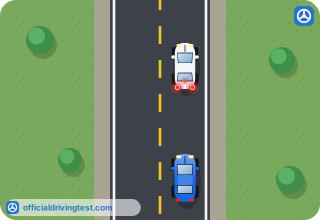
- Letting up on the brake pedal
- Using both hands on the steering wheel
- Slowing down before the turn
- Locking up the front wheels
Show answer
Correct answer: Locking up the front wheels
The manual says not to lock up the front wheels when braking or when turning so sharp that the vehicle can only plow ahead.
Source: Arkansas Driver License Study Guide (Volume 1, Edition 10, October 2026), page 78 · Open this page in the manual (Manual page 78)
-
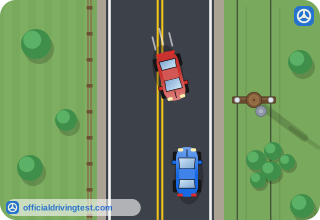
According to the manual, which is generally better when a collision cannot be avoided?
- Run off the road rather than crash head-on
- Crash head-on rather than run off the road
- Stop in the lane and brake hard
- Swerve into the oncoming lane
Show answer
Correct answer: Run off the road rather than crash head-on
The manual says it is generally better to run off the road than crash head-on.
Source: Arkansas Driver License Study Guide (Volume 1, Edition 10, October 2026), page 78 · Open this page in the manual (Manual page 78)
-
In which situation might you need to speed up to avoid a collision?
- When another vehicle is stopped in front of you
- When you are approaching a red light
- When a vehicle is about to hit you from the side
- When you are entering a school zone
Show answer
Correct answer: When a vehicle is about to hit you from the side
The manual lists a vehicle about to hit you from the side or behind, or open space ahead, as reasons to accelerate.
Source: Arkansas Driver License Study Guide (Volume 1, Edition 10, October 2026), page 78 · Open this page in the manual (Manual page 78)
-
After you speed up to get out of danger, what should you be sure to do once the danger has passed?
- Keep your speed to stay ahead
- Slow down
- Stop at once
- Change lanes
Show answer
Correct answer: Slow down
The manual says to slow down once the danger has passed.
Source: Arkansas Driver License Study Guide (Volume 1, Edition 10, October 2026), page 78 · Open this page in the manual (Manual page 78)
-
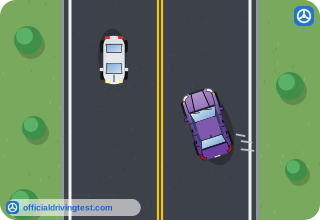
What causes a skid?
- The engine runs at too low a speed
- The brake pedal is pressed too lightly
- The steering wheel is held too tightly
- The tires can no longer grip the road
Show answer
Correct answer: The tires can no longer grip the road
Skids occur when the tires can no longer grip the road, and you cannot control a vehicle while it skids.
Source: Arkansas Driver License Study Guide (Volume 1, Edition 10, October 2026), page 79 · Open this page in the manual (Manual page 79)
-
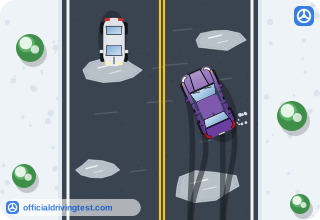
If your vehicle begins to skid, why should you stay off the brake?
- Braking would turn the vehicle off the road
- Brakes will not work until the vehicle slows down
- Braking would stall the engine
- Braking always makes the tires blow out
Show answer
Correct answer: Brakes will not work until the vehicle slows down
The manual says the brakes will not work until the vehicle slows down and could make the skid worse.
Source: Arkansas Driver License Study Guide (Volume 1, Edition 10, October 2026), page 79 · Open this page in the manual (Manual page 79)
-
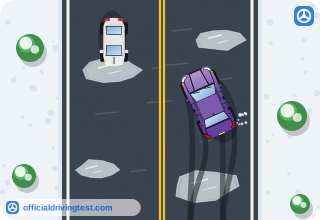
If your vehicle begins to skid, which way should you turn the steering wheel?
- Away from the direction you want to go
- Straight ahead and hold it
- Do not turn it; brake hard instead
- In the direction you want the vehicle to go
Show answer
Correct answer: In the direction you want the vehicle to go
You steer toward the direction you want the vehicle to go.
Source: Arkansas Driver License Study Guide (Volume 1, Edition 10, October 2026), page 79 · Open this page in the manual (Manual page 79)
-
In a skid, the vehicle begins to straighten out. What should you do with the steering wheel?
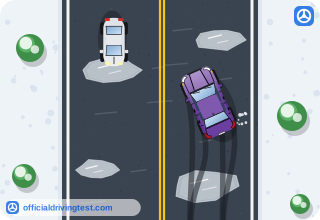
- Turn it back the other way
- Turn it further in the same direction
- Let go of the wheel
- Hold it where it is
Show answer
Correct answer: Turn it back the other way
If you fail to turn it back, the vehicle may swing around the other way and start a new skid.
Source: Arkansas Driver License Study Guide (Volume 1, Edition 10, October 2026), page 79 · Open this page in the manual (Manual page 79)
-
How long should you continue to correct your steering, left and right, during a skid?
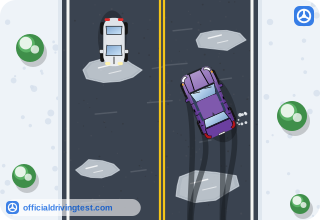
- Until you see a straight stretch of road
- Until you reach the next intersection
- Until you gain control of the vehicle
- Until you have counted to three
Show answer
Correct answer: Until you gain control of the vehicle
The manual says to keep correcting your steering until you regain control.
Source: Arkansas Driver License Study Guide (Volume 1, Edition 10, October 2026), page 79 · Open this page in the manual (Manual page 79)
-
When should you stop at the scene of a crash?
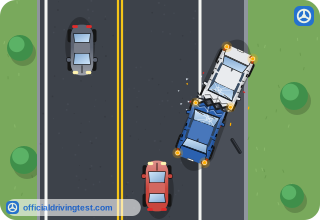
- Whenever you pass a crash, to offer help
- Only if you are involved or help has not arrived
- Only if a police officer asks you to stop
- Never, even if you are involved in the crash
Show answer
Correct answer: Only if you are involved or help has not arrived
Otherwise the manual says to focus on your driving and keep moving, watching for people in or near the road.
Source: Arkansas Driver License Study Guide (Volume 1, Edition 10, October 2026), page 80 · Open this page in the manual (Manual page 80)
-
Why should you not drive to the scene of an accident, fire, or other disaster?
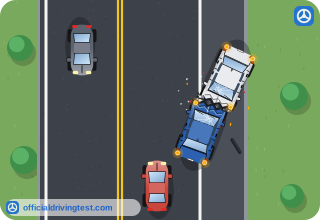
- It could make the road dirty
- It is illegal to take photographs at a scene
- You may be asked to pay for the damage
- It could block the way for rescue vehicles
Show answer
Correct answer: It could block the way for rescue vehicles
The manual warns that your vehicle could block rescue vehicles.
Source: Arkansas Driver License Study Guide (Volume 1, Edition 10, October 2026), page 80 · Open this page in the manual (Manual page 80)
-
What must you do if you are involved in a traffic crash?
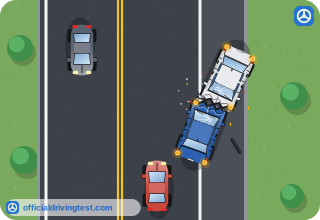
- Stop
- Keep driving and call the police later
- Drive to the nearest police station
- Stop only if someone is hurt
Show answer
Correct answer: Stop
The manual says that if you are involved in a crash you must stop.
Source: Arkansas Driver License Study Guide (Volume 1, Edition 10, October 2026), page 80 · Open this page in the manual (Manual page 80)