Alaska: Traffic signals Practice Test
Red, yellow and green lights, arrows, flashing signals, unlit signals and lane-control signals.
Independent educational site · not affiliated with any government agency or DMV
Ready? Test yourself
- Instant feedback with an explanation
- Every answer cites its source in the manual
- Your best score is saved on this device
Questions are original and based on the official manual "Alaska Driver Manual" (Revised October 2025), Alaska Department of Administration, Division of Motor Vehicles (DMV).
All 24 questions in this practice test
Take the test above first, then use this list to study. Tap “Show answer” to see the correct answer and explanation.
Show the questions and answersHide the questions
-
At a steady red ball signal, where must you stop?
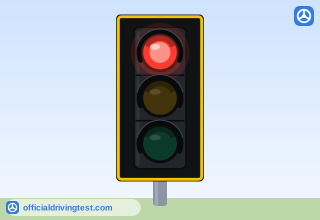
- Behind the crosswalk or stop line, or before the intersection if none
- In the middle of the crosswalk, so you can see the cross traffic
- Past the stop line, as far into the intersection as you need to see
- Only at the curb line, whether or not a stop line is painted
Show answer
Correct answer: Behind the crosswalk or stop line, or before the intersection if none
The manual says to stop behind the crosswalk, the stop line, or, if none, before entering the intersection.
Source: Alaska Driver Manual (Revised October 2025), page 50 · Open this page in the manual (Manual page 50)
-
What does a steady yellow ball signal tell you?
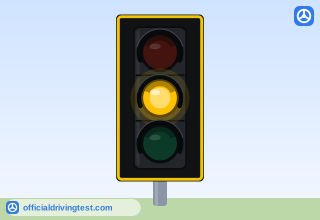
- The signal is broken and traffic must yield to the right
- A red light is about to appear
- Cross traffic is already stopped and you may speed up
- The signal will turn green again in a few seconds
Show answer
Correct answer: A red light is about to appear
The manual says a yellow ball means a red light is about to appear.
Source: Alaska Driver Manual (Revised October 2025), page 50 · Open this page in the manual (Manual page 50)
-
When you see a steady yellow ball, when are you NOT required to stop?
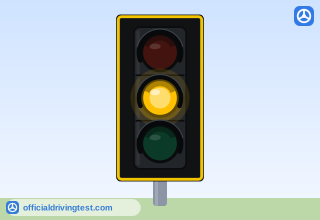
- When no other vehicle is approaching the intersection
- When you are driving faster than the posted speed limit allows
- When you plan to turn left at the next block
- When you are already in the intersection, or too close to stop safely
Show answer
Correct answer: When you are already in the intersection, or too close to stop safely
Stop unless you are already within the intersection or too close to stop safely.
Source: Alaska Driver Manual (Revised October 2025), page 50 · Open this page in the manual (Manual page 50)
-
The light changes to yellow just as you enter the intersection. What may you do?
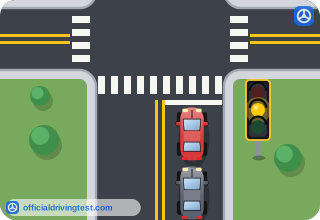
- Proceed with extreme caution
- Stop immediately where you are
- Back up to the stop line behind you
- Speed up and ignore cross traffic
Show answer
Correct answer: Proceed with extreme caution
If the light changes to yellow as you enter the intersection, you may proceed with extreme caution.
Source: Alaska Driver Manual (Revised October 2025), page 50 · Open this page in the manual (Manual page 50)
-
What does a steady green ball signal tell you to do?
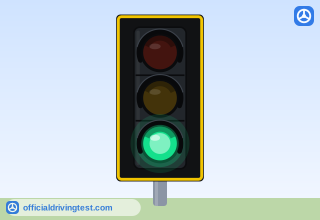
- Go at once, because other traffic must wait for you
- Slow down and prepare to stop at the next signal
- Go if the intersection is clear
- Stop first, then go when other vehicles have passed
Show answer
Correct answer: Go if the intersection is clear
The manual says to go if the intersection is clear.
Source: Alaska Driver Manual (Revised October 2025), page 50 · Open this page in the manual (Manual page 50)
-
At a green ball signal, whom must you yield to?
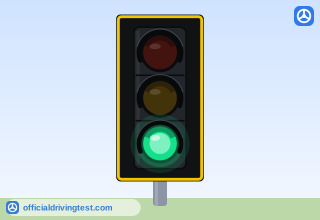
- Only vehicles that are turning right from the cross street
- Pedestrians and vehicles still in the intersection or entering it with the right-of-way
- Only pedestrians who are walking against the signal
- No one, because a green light gives you the right-of-way over all traffic
Show answer
Correct answer: Pedestrians and vehicles still in the intersection or entering it with the right-of-way
Even on green you yield to pedestrians and vehicles in or entering the intersection with the right-of-way.
Source: Alaska Driver Manual (Revised October 2025), page 50 · Open this page in the manual (Manual page 50)
-
What does a red arrow signal require of you?
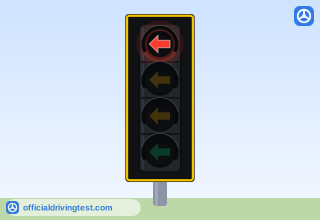
- Do not make the movement the arrow indicates
- Make the movement the arrow indicates, with caution
- Stop only if other traffic is approaching
- Slow down and yield to oncoming vehicles
Show answer
Correct answer: Do not make the movement the arrow indicates
A red arrow means do not make the indicated movement; stop behind the crosswalk or stop line.
Source: Alaska Driver Manual (Revised October 2025), page 50 · Open this page in the manual (Manual page 50)
-
When are turns allowed again after you stop for a red arrow?
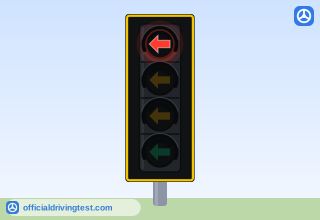
- As soon as no other vehicle is in the intersection
- As soon as the light for the cross street turns red
- Once the arrow changes to green or flashing yellow
- After a five-second wait with a full stop
Show answer
Correct answer: Once the arrow changes to green or flashing yellow
No turns are allowed until the arrow changes to green or flashing yellow.
Source: Alaska Driver Manual (Revised October 2025), page 50 · Open this page in the manual (Manual page 50)
-
What does a yellow arrow signal mean?
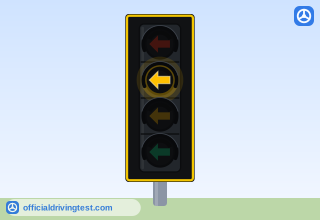
- The turn is protected, so you may turn without watching other traffic
- A red light is about to appear, so stop unless you are too close to stop safely
- The turn is allowed only after you yield to oncoming vehicles
- The signal is out of order for that movement
Show answer
Correct answer: A red light is about to appear, so stop unless you are too close to stop safely
A yellow arrow warns that a red is about to appear; stop unless already in or too close to the intersection.
Source: Alaska Driver Manual (Revised October 2025), page 50 · Open this page in the manual (Manual page 50)
-
What should you do when you make a movement on a green arrow signal?
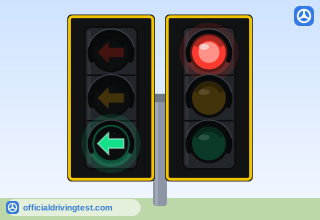
- Make the movement quickly, because no one else may enter the intersection
- Wait for oncoming traffic to clear before you start the turn
- Stop first, then make the movement shown by the arrow
- Make the movement, but use caution and yield to those with the right-of-way
Show answer
Correct answer: Make the movement, but use caution and yield to those with the right-of-way
A green arrow movement has the right-of-way, but you must still observe caution and yield to those with the right-of-way.
Source: Alaska Driver Manual (Revised October 2025), page 51 · Open this page in the manual (Manual page 51)
-
What must you do at a flashing red ball signal?
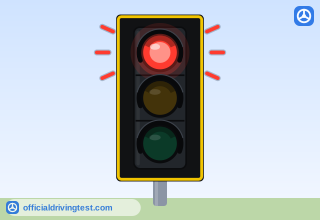
- Stop, look in all directions, and go only when safe
- Slow down and go ahead if the way looks clear to you
- Stop only if another vehicle is approaching the intersection
- Yield to pedestrians but keep rolling slowly through
Show answer
Correct answer: Stop, look in all directions, and go only when safe
A flashing red ball is treated as a stop: stop, look in all directions, and go only when safe.
Source: Alaska Driver Manual (Revised October 2025), page 51 · Open this page in the manual (Manual page 51)
-
Why might a flashing red beacon be placed above a stop sign?
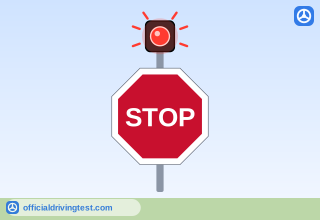
- It tells drivers that the stop sign is not in force
- It shows that the intersection is closed to traffic
- It supplements the sign where special emphasis is needed
- It allows drivers to treat the stop sign as a yield sign
Show answer
Correct answer: It supplements the sign where special emphasis is needed
Individual flashing red balls supplement the sign where special emphasis may be needed.
Source: Alaska Driver Manual (Revised October 2025), page 51 · Open this page in the manual (Manual page 51)
-
What must you do at a flashing red arrow signal?
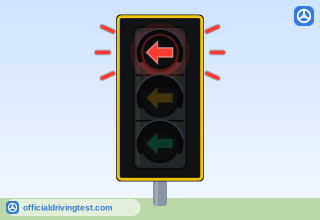
- Yield to oncoming traffic and then make the turn
- Stop, look in all directions, and go only when safe
- Stop only if a pedestrian is in the crosswalk
- Slow down and use caution while making the movement
Show answer
Correct answer: Stop, look in all directions, and go only when safe
A flashing red arrow requires a stop behind the crosswalk or stop line, then proceeding only when safe.
Source: Alaska Driver Manual (Revised October 2025), page 51 · Open this page in the manual (Manual page 51)
-
What should you do at a flashing yellow ball signal?
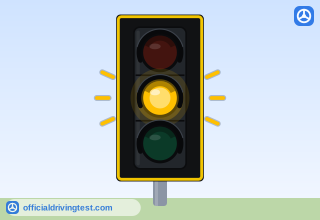
- Stop completely and wait for the signal to turn green
- Treat the intersection as an uncontrolled one and yield to the right
- Maintain your speed, because cross traffic must stop
- Reduce speed, use caution, and yield to pedestrians and vehicles there
Show answer
Correct answer: Reduce speed, use caution, and yield to pedestrians and vehicles there
A flashing yellow ball means reduce speed and use caution, yielding to pedestrians and vehicles in the intersection.
Source: Alaska Driver Manual (Revised October 2025), page 51 · Open this page in the manual (Manual page 51)
-
What should you do while making the movement shown by a flashing yellow arrow?
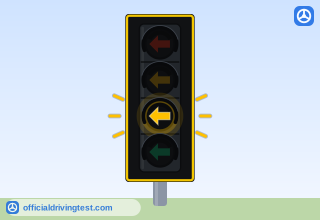
- Use caution and yield to oncoming traffic, pedestrians, and vehicles
- Stop first, then make the movement
- Make the movement, because the arrow gives you the right-of-way
- Make the movement only after the arrow turns green
Show answer
Correct answer: Use caution and yield to oncoming traffic, pedestrians, and vehicles
A flashing yellow arrow means caution and yielding to oncoming traffic, pedestrians, and vehicles in the intersection.
Source: Alaska Driver Manual (Revised October 2025), page 51 · Open this page in the manual (Manual page 51)
-
A signal has no bulbs working, no other signal head works for your direction, and no one is directing traffic. How is the intersection treated?
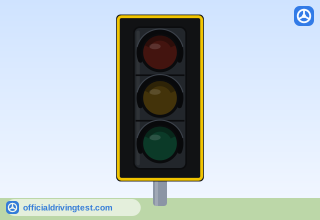
- As a flashing yellow, so you slow down and continue
- As a free-flow intersection, so traffic on your right yields to you
- As an uncontrolled intersection, and you must stop
- As a green light for the road with more lanes
Show answer
Correct answer: As an uncontrolled intersection, and you must stop
The manual says the intersection is uncontrolled and you must stop.
Source: Alaska Driver Manual (Revised October 2025), page 52 · Open this page in the manual (Manual page 52)
-
What should you do about an intersection signal that has no working bulbs?
- Report it only after you see a crash happen there
- Report it to the next driver who stops there with you
- Report it to the nearest DMV office within a week
- Report it to the nearest police department promptly
Show answer
Correct answer: Report it to the nearest police department promptly
The manual says to report this condition to the nearest police department as soon as possible.
Source: Alaska Driver Manual (Revised October 2025), page 52 · Open this page in the manual (Manual page 52)
-
A police officer, fireperson, or authorized flagger gives you a direction that conflicts with a sign or signal. What must you do?
- Follow the person’s directions regardless of signs or signals
- Obey the sign or signal, since it is permanent
- Obey the sign or signal if it is a stop sign
- Follow the person’s directions only if no other cars are around
Show answer
Correct answer: Follow the person’s directions regardless of signs or signals
You must follow the directions of a police officer, fireperson, or authorized flag person regardless of signs or signals.
Source: Alaska Driver Manual (Revised October 2025), page 52 · Open this page in the manual (Manual page 52)
-
Where are lane control signals with X’s or down arrows used?
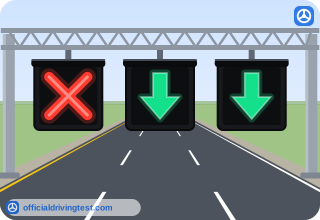
- Above reversible lanes
- Above lanes reserved for left turns only
- Above the ramps of a highway
- Above lanes that are closed for the winter
Show answer
Correct answer: Above reversible lanes
Distinctive signals with X’s or down arrows are used above reversible lanes.
Source: Alaska Driver Manual (Revised October 2025), page 53 · Open this page in the manual (Manual page 53)
-
What must you do if the lane control signals above a reversible lane are not illuminated?
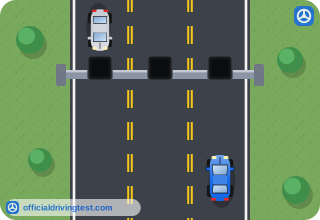
- Use the lane if no traffic is coming
- Do not enter the lane
- Use the lane at a reduced speed
- Use the lane only to pass another vehicle
Show answer
Correct answer: Do not enter the lane
The manual says not to enter the lane if signals are not illuminated.
Source: Alaska Driver Manual (Revised October 2025), page 53 · Open this page in the manual (Manual page 53)
-
A lane control signal above your lane shows a steady red X. What does it mean?
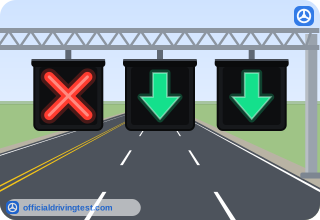
- Use the lane with caution at a reduced speed
- Clear the lane because a red X is about to appear
- Travel in the lane is permitted
- Do not use the lane; opposing traffic may use it
Show answer
Correct answer: Do not use the lane; opposing traffic may use it
A steady red X means don’t use the lane; opposing traffic is permitted to use it.
Source: Alaska Driver Manual (Revised October 2025), page 53 · Open this page in the manual (Manual page 53)
-
A lane control signal above your lane shows a steady yellow X. What must you do?
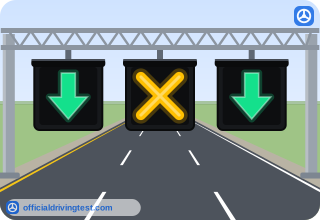
- Clear the lane safely, because a red X is about to appear
- Stop in the lane and wait for the signal to change
- Keep using the lane until a green arrow shows up
- Speed up to get through before the lane closes
Show answer
Correct answer: Clear the lane safely, because a red X is about to appear
A steady yellow X means clear the lane in a safe manner because a red X is about to appear.
Source: Alaska Driver Manual (Revised October 2025), page 53 · Open this page in the manual (Manual page 53)
-
A lane control signal above your lane shows a steady green arrow pointing down. What does it mean?
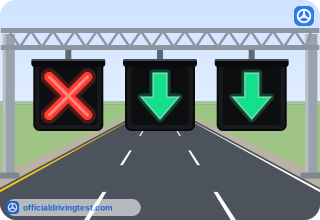
- Clear the lane in a safe manner
- Do not use the lane, since opposing traffic may use it
- Travel in the lane is permitted
- Use the lane only to make a left turn
Show answer
Correct answer: Travel in the lane is permitted
A steady green arrow means travel in the lane is permitted.
Source: Alaska Driver Manual (Revised October 2025), page 53 · Open this page in the manual (Manual page 53)
-
How does the manual say to approach a “stale” green traffic signal, especially in inclement weather?
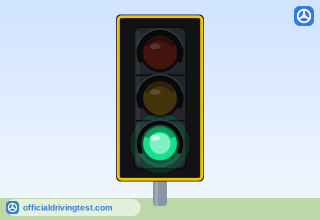
- Slower, ready to stop if the light changes
- Faster, to clear the intersection before it changes
- At the same speed, since you have the right of way
- At the same speed, honking to warn cross traffic
Show answer
Correct answer: Slower, ready to stop if the light changes
The manual says to approach stale green signals slower to be ready to stop if the light changes, especially during inclement weather.
Source: Alaska Driver Manual (Revised October 2025), page 59 · Open this page in the manual (Manual page 59 · PDF 71)