Alaska: Road signs — Part 1 Practice Test
Questions in this part include: “According to the manual, many fatal crashes occur when a driver does what?” · “To become a better "sign" driver, what should you do with the sign section of the manual?”
Independent educational site · not affiliated with any government agency or DMV
Ready? Test yourself
- Instant feedback with an explanation
- Every answer cites its source in the manual
- Your best score is saved on this device
Questions are original and based on the official manual "Alaska Driver Manual" (Revised October 2025), Alaska Department of Administration, Division of Motor Vehicles (DMV).
All 17 questions in this practice test
Take the test above first, then use this list to study. Tap “Show answer” to see the correct answer and explanation.
Show the questions and answersHide the questions
-
According to the manual, many fatal crashes occur when a driver does what?
- Does not heed a clearly visible traffic sign
- Cannot see a sign covered by snow
- Drives faster than other traffic on the road
- Stops too long at a posted stop sign
Show answer
Correct answer: Does not heed a clearly visible traffic sign
The manual says many fatal crashes occur when a driver does not heed a clearly visible traffic sign, and tells drivers to obey signs.
Source: Alaska Driver Manual (Revised October 2025), page 38 · Open this page in the manual (Manual page 38)
-
What do signs do for conditions ahead that require caution or extra alertness?
- They close the road until the conditions clear
- They tell drivers to stop and wait
- They warn drivers of them
- They list them in the order they occur
Show answer
Correct answer: They warn drivers of them
One way signs help is by warning of conditions ahead that require caution or extra alertness.
Source: Alaska Driver Manual (Revised October 2025), page 38 · Open this page in the manual (Manual page 38)
-
How do signs guide drivers to their destination?
- By measuring each driver's speed
- By identifying the route
- By marking every fuel stop on the road
- By showing the shortest trip in miles only
Show answer
Correct answer: By identifying the route
The manual says signs guide drivers to their destination by identifying the route.
Source: Alaska Driver Manual (Revised October 2025), page 38 · Open this page in the manual (Manual page 38)
-
Besides warning and guiding drivers, what do signs do?
- Replace the need for pavement markings
- Measure the speed of traffic
- Issue citations to violators
- Inform drivers of regulations
Show answer
Correct answer: Inform drivers of regulations
Signs help drivers by informing them of regulations.
Source: Alaska Driver Manual (Revised October 2025), page 38 · Open this page in the manual (Manual page 38)
-
To become a better "sign" driver, what should you do with the sign section of the manual?
- Memorize only the signs that have numbers printed on them
- Read the warning signs only, since they matter the most
- Skip signs you already know from other places you drove
- Study it and match each sign's meaning to the expected behavior
Show answer
Correct answer: Study it and match each sign's meaning to the expected behavior
The manual says to study the sign section and associate each sign's meaning with the behavior expected of you.
Source: Alaska Driver Manual (Revised October 2025), page 38 · Open this page in the manual (Manual page 38)
-
What should you do with your eyes to avoid missing traffic signs?
- Fix them on the vehicle in front of you
- Look far ahead and keep moving them
- Keep them on the center of the road
- Look only at signs on your side of the road
Show answer
Correct answer: Look far ahead and keep moving them
The manual says to look far ahead and move your eyes, because it is easy for a "stare" driver to miss traffic signs.
Source: Alaska Driver Manual (Revised October 2025), page 38 · Open this page in the manual (Manual page 38)
-
What is the result of good sign observance?
- Never needing to check mirrors
- Avoiding every traffic citation
- Doing the right thing at the right time
- Driving at the same speed everywhere
Show answer
Correct answer: Doing the right thing at the right time
The manual says the result of good sign observance is doing the right thing at the right time.
Source: Alaska Driver Manual (Revised October 2025), page 38 · Open this page in the manual (Manual page 38)
-
What backs regulatory signs?
- State statute, regulation, or local ordinance
- Federal law alone
- Advice from local drivers' groups
- The preferences of the road crew that posts them
Show answer
Correct answer: State statute, regulation, or local ordinance
Regulatory signs give instructions that must be obeyed and are backed by state statute, regulation, or local ordinance.
Source: Alaska Driver Manual (Revised October 2025), page 38 · Open this page in the manual (Manual page 38)
-
What can result from violating the instructions on a regulatory sign?
- Nothing, since the sign is only advisory
- Mandatory driver education
- A traffic citation
- Cancellation of your insurance
Show answer
Correct answer: A traffic citation
Violating a regulatory sign's instructions can result in the issuance of a traffic citation.
Source: Alaska Driver Manual (Revised October 2025), page 38 · Open this page in the manual (Manual page 38)
-
At a stop sign, where must you make your complete stop?
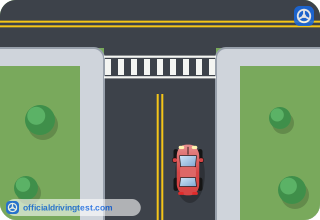
- In the middle of the crosswalk so that you can see the cross traffic
- Just past the stop line, at the very edge of the intersection itself
- Only at the point where the other traffic first becomes visible to you
- Before entering the intersection or at the stop line, behind the crosswalk
Show answer
Correct answer: Before entering the intersection or at the stop line, behind the crosswalk
You make a complete stop before entering the intersection or at the stop line, and you stop behind the crosswalk.
Source: Alaska Driver Manual (Revised October 2025), page 38 · Open this page in the manual (Manual page 38)
-
After stopping at a stop sign, what should you look for?
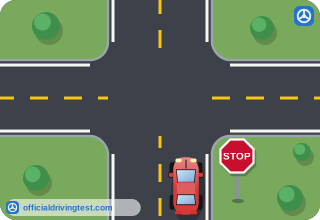
- Only traffic coming from the right
- Only pedestrians in the crosswalk
- Only traffic that has a green light
- Traffic and pedestrians on both sides
Show answer
Correct answer: Traffic and pedestrians on both sides
At a stop sign you look both right and left for traffic and pedestrians.
Source: Alaska Driver Manual (Revised October 2025), page 38 · Open this page in the manual (Manual page 38)
-
In addition to stopping at a stop sign, what must you do?
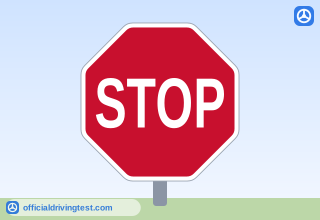
- Sound your horn
- Yield right-of-way
- Flash your headlights
- Turn on your hazard lights
Show answer
Correct answer: Yield right-of-way
The manual lists yielding right-of-way as part of obeying a stop sign.
Source: Alaska Driver Manual (Revised October 2025), page 38 · Open this page in the manual (Manual page 38)
-
What should you do as you approach a yield sign?
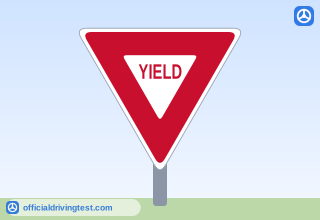
- Slow down as required
- Stop completely every time
- Speed up to clear the intersection
- Change lanes before reaching it
Show answer
Correct answer: Slow down as required
You slow down as required when approaching a yield sign.
Source: Alaska Driver Manual (Revised October 2025), page 38 · Open this page in the manual (Manual page 38)
-
What must you yield to at a yield sign?
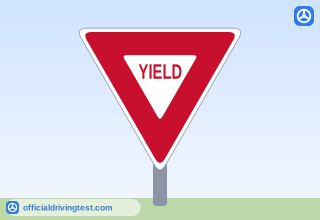
- Traffic and pedestrians
- Only vehicles on your left
- Only pedestrians
- Only emergency vehicles
Show answer
Correct answer: Traffic and pedestrians
At a yield sign you look both left and right and yield to traffic and pedestrians.
Source: Alaska Driver Manual (Revised October 2025), page 38 · Open this page in the manual (Manual page 38)
-
When must you stop at a yield sign?
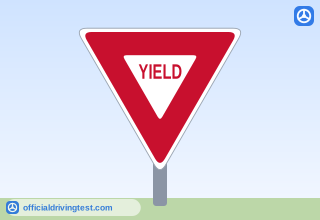
- Only when a police officer is directing traffic at the corner
- Every time, whether or not other traffic is nearby
- When necessary to avoid pedestrians or traffic on the protected street
- Only when there is a stop line painted on the road
Show answer
Correct answer: When necessary to avoid pedestrians or traffic on the protected street
A stop is required at a yield sign when necessary to avoid a pedestrian or traffic on the protected street.
Source: Alaska Driver Manual (Revised October 2025), page 38 · Open this page in the manual (Manual page 38)
-
A DO NOT ENTER sign faces which traffic?
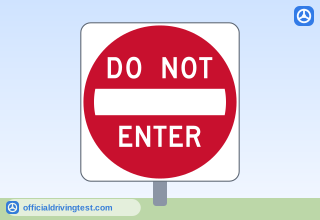
- Traffic leaving a highway on a marked exit ramp
- Vehicles that are too heavy for the road ahead
- Traffic approaching a bridge that has only one lane
- Traffic entering a roadway or ramp in the wrong direction
Show answer
Correct answer: Traffic entering a roadway or ramp in the wrong direction
The sign faces traffic entering a roadway or ramp in the wrong direction, and you must not proceed beyond it.
Source: Alaska Driver Manual (Revised October 2025), page 39 · Open this page in the manual (Manual page 39)
-
Which sign may be placed further down the prohibited direction after a DO NOT ENTER sign?
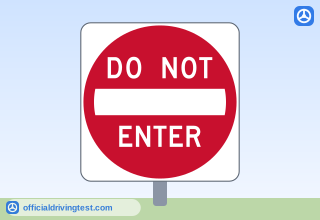
- A red and white YIELD sign
- A black on white SPEED LIMIT sign
- A black on orange DETOUR sign
- A white on red WRONG WAY sign
Show answer
Correct answer: A white on red WRONG WAY sign
A white on red WRONG WAY sign may be placed further down the prohibited direction.
Source: Alaska Driver Manual (Revised October 2025), page 39 · Open this page in the manual (Manual page 39)