Alaska: Right-of-way and turning — Part 4 Practice Test
Questions in this part include: “On the highway, you should not turn around near a curve or hill if you cannot see how far in each direction?” · “Which backing practice does the manual call dangerous?”
Independent educational site · not affiliated with any government agency or DMV
Ready? Test yourself
- Instant feedback with an explanation
- Every answer cites its source in the manual
- Your best score is saved on this device
Questions are original and based on the official manual "Alaska Driver Manual" (Revised October 2025), Alaska Department of Administration, Division of Motor Vehicles (DMV).
All 16 questions in this practice test
Take the test above first, then use this list to study. Tap “Show answer” to see the correct answer and explanation.
Show the questions and answersHide the questions
-
What must you do at a red flashing light?
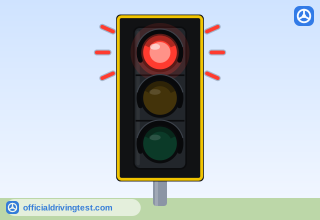
- Slow down and proceed without stopping if the way is clear
- Stop, then proceed when the way is clear and it is safe
- Stop and wait there until the light stops flashing
- Yield only if other traffic is approaching
Show answer
Correct answer: Stop, then proceed when the way is clear and it is safe
At a red flashing light you stop, then proceed when the way is clear and it is safe to do so.
Source: Alaska Driver Manual (Revised October 2025), page 36 · Open this page in the manual (Manual page 36)
-
When the traffic signals at an intersection are not working, what does the manual say you must do?
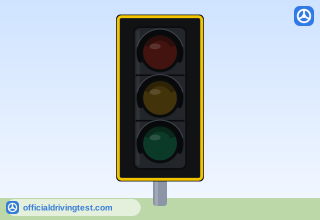
- Proceed as if the light were green
- Yield only to vehicles on your left
- Proceed with caution at the posted speed
- Stop at the intersection
Show answer
Correct answer: Stop at the intersection
The list of required stops includes an uncontrolled intersection when signals are not working.
Source: Alaska Driver Manual (Revised October 2025), page 36 · Open this page in the manual (Manual page 36)
-
When may you turn right at a steady red ball signal?
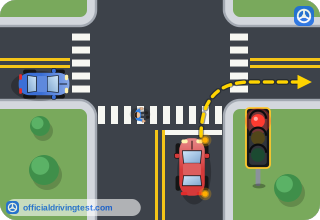
- Without stopping, as long as no pedestrian is in the crosswalk
- Only when a police officer waves you through the intersection
- After a full stop, when it is safe and no “No turn on red” sign prohibits it
- Only after the signal has stayed red for at least one full minute
Show answer
Correct answer: After a full stop, when it is safe and no “No turn on red” sign prohibits it
Right turns on red are permitted only after a full stop, when safe, and not restricted by a “No turn on red” sign.
Source: Alaska Driver Manual (Revised October 2025), page 50 · Open this page in the manual (Manual page 50)
-
You are turning left on a green ball signal. Whom must you yield to?
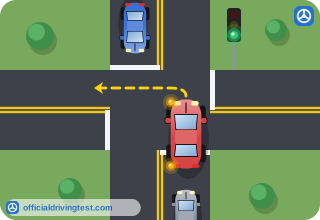
- Vehicles that are waiting in line behind you
- Vehicles that are turning right behind you
- Vehicles stopped at the cross street to your right
- Vehicles going straight through from the opposite direction
Show answer
Correct answer: Vehicles going straight through from the opposite direction
The manual says to yield to vehicles going straight through in the opposite direction when making a left turn.
Source: Alaska Driver Manual (Revised October 2025), page 50 · Open this page in the manual (Manual page 50)
-
At an intersection where the signal is completely dark, whom do you yield to?
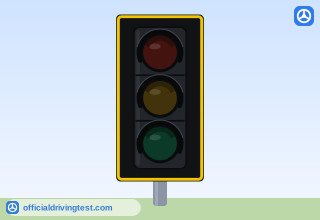
- Traffic approaching the intersection on your left
- Traffic approaching the intersection on your right
- Traffic on the wider of the two roads
- Only vehicles that are already stopped
Show answer
Correct answer: Traffic approaching the intersection on your right
The manual says to stop and yield to traffic approaching the intersection on your right.
Source: Alaska Driver Manual (Revised October 2025), page 52 · Open this page in the manual (Manual page 52)
-
What is different about a two-way left turn lane compared with a one-way left turn lane?
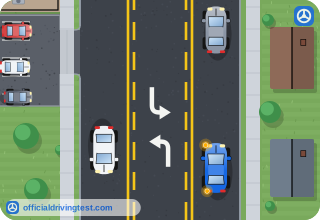
- Vehicles may not yield to oncoming traffic in the two-way lane
- Opposing traffic also may use the two-way lane for left turns
- Vehicles may use the two-way lane to pass other vehicles
- The two-way lane is used only by vehicles coming toward you
Show answer
Correct answer: Opposing traffic also may use the two-way lane for left turns
In the Two-Way Left Turn only lane, opposing traffic also may use the lane for left turns.
Source: Alaska Driver Manual (Revised October 2025), page 53 · Open this page in the manual (Manual page 53)
-
What must you do when you turn from a lane marked with a one-way left turn arrow?
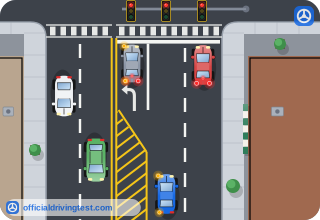
- Turn without yielding, because opposing traffic cannot use the lane
- Stop and let the cars behind you pass first
- Yield only to oncoming traffic, not to pedestrians
- Use caution and yield to oncoming traffic and pedestrians
Show answer
Correct answer: Use caution and yield to oncoming traffic and pedestrians
The manual says to yield to oncoming traffic and pedestrians while making the turn.
Source: Alaska Driver Manual (Revised October 2025), page 53 · Open this page in the manual (Manual page 53)
-
When may you enter the limits of an intersection?
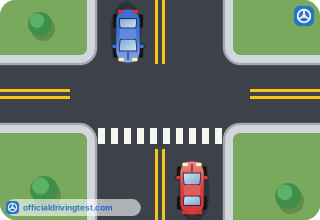
- As soon as the light turns green, whatever is ahead
- As soon as you reach the stop line
- When no vehicle is waiting behind you
- Only when you may enter it with safety
Show answer
Correct answer: Only when you may enter it with safety
The manual says to stay outside the limits of an intersection until you may enter it with safety.
Source: Alaska Driver Manual (Revised October 2025), page 56 · Open this page in the manual (Manual page 56)
-
You are in the wrong lane to turn as you enter an intersection. What should you do?
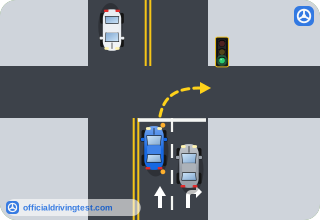
- Do not turn or impede traffic; continue around the block
- Cut across the lane quickly to reach the turn you need
- Stop in the lane and wait for a gap in traffic
- Back up to the previous lane
Show answer
Correct answer: Do not turn or impede traffic; continue around the block
The manual says not to turn or impede so you can turn; continue around the block.
Source: Alaska Driver Manual (Revised October 2025), page 57 · Open this page in the manual (Manual page 57)
-
On the highway, you should not turn around near a curve or hill if you cannot see how far in each direction?
- 500 feet or more
- 100 feet
- 250 feet
- 1,000 feet
Show answer
Correct answer: 500 feet or more
The manual says not to turn around near a curve or hill when you cannot see 500 feet or more in each direction.
Source: Alaska Driver Manual (Revised October 2025), page 67 · Open this page in the manual (Manual page 67)
-
What is the safest way to turn around in the city?
- Make a U-turn at the nearest intersection
- Drive around the block
- Back into a driveway
- Stop in the lane and turn
Show answer
Correct answer: Drive around the block
The manual says the safest method is to drive around the block.
Source: Alaska Driver Manual (Revised October 2025), page 67 · Open this page in the manual (Manual page 67)
-
What should you be alert for when turning around in the city?
- Signs marking school zones
- Pedestrians wearing bright clothes
- Parking meters
- Signs prohibiting U-turns
Show answer
Correct answer: Signs prohibiting U-turns
The manual says to be alert for signs prohibiting “U” turns.
Source: Alaska Driver Manual (Revised October 2025), page 67 · Open this page in the manual (Manual page 67)
-
Which backing practice does the manual call dangerous?
- Opening the door and sticking your head out
- Looking over your shoulder to see behind
- Backing up slowly and very carefully
- Checking behind the vehicle before you get in
Show answer
Correct answer: Opening the door and sticking your head out
The manual says to always look before backing and warns that opening the door and sticking your head out is dangerous.
Source: Alaska Driver Manual (Revised October 2025), page 67 · Open this page in the manual (Manual page 67)
-
When backing, to which vehicles must you yield the right-of-way?
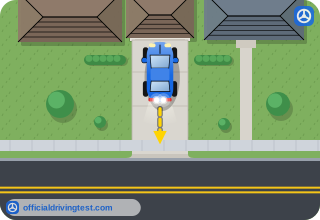
- Only vehicles that are larger than the vehicle you are driving
- Only vehicles that are directly behind your vehicle as you back
- Vehicles approaching on the highway or intersecting highway
- No one at all, as long as you signal before you start backing
Show answer
Correct answer: Vehicles approaching on the highway or intersecting highway
The manual says you must yield the right-of-way to a vehicle approaching on the highway or intersecting highway when backing.
Source: Alaska Driver Manual (Revised October 2025), page 67 · Open this page in the manual (Manual page 67)
-
Where is it illegal to back up, unless directed by police, fire or construction flag personnel?
- On a controlled access highway or its ramps
- On any two-lane road in a small city
- In any parking lot, garage, or driveway
- On a residential street during the night
Show answer
Correct answer: On a controlled access highway or its ramps
The manual makes backing illegal on a controlled access highway and its entrance or exit ramps, unless directed by police, fire or construction flag personnel.
Source: Alaska Driver Manual (Revised October 2025), page 67 · Open this page in the manual (Manual page 67)
-
Who may direct you to back up on a controlled access highway or its ramps?
- Any other driver on the road near you
- A passenger who is riding in your vehicle
- Police, fire or construction flag personnel
- The driver of a nearby tow truck or bus
Show answer
Correct answer: Police, fire or construction flag personnel
Backing there is illegal unless directed by police, fire or construction flag personnel.
Source: Alaska Driver Manual (Revised October 2025), page 67 · Open this page in the manual (Manual page 67)