Alaska: Right-of-way and turning — Part 3 Practice Test
Questions in this part include: “Most roundabouts are designed for speeds of about what?” · “How should you enter a roundabout in relation to the center island?”
Independent educational site · not affiliated with any government agency or DMV
Ready? Test yourself
- Instant feedback with an explanation
- Every answer cites its source in the manual
- Your best score is saved on this device
Questions are original and based on the official manual "Alaska Driver Manual" (Revised October 2025), Alaska Department of Administration, Division of Motor Vehicles (DMV).
All 16 questions in this practice test
Take the test above first, then use this list to study. Tap “Show answer” to see the correct answer and explanation.
Show the questions and answersHide the questions
-
As you enter a roundabout, what must you yield to?
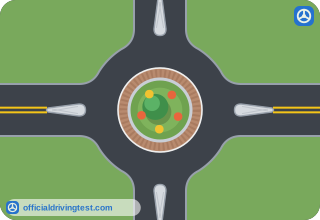
- Traffic entering from the street on your left
- Any traffic already in the circle
- Only vehicles in the lane next to you
- Only pedestrians in the crosswalks
Show answer
Correct answer: Any traffic already in the circle
Approaching traffic must yield to traffic already in the circle.
Source: Alaska Driver Manual (Revised October 2025), page 34 · Open this page in the manual (Manual page 34)
-
Most roundabouts are designed for speeds of about what?
- 15-20 mph
- 5-10 mph
- 25-30 mph
- 35-40 mph
Show answer
Correct answer: 15-20 mph
The manual says most roundabouts are designed for speeds of about 15-20 mph.
Source: Alaska Driver Manual (Revised October 2025), page 34 · Open this page in the manual (Manual page 34)
-
How should you enter a roundabout in relation to the center island?
- Always enter to the left of the center island
- Drive across the center island to the exit
- Always enter to the right of the center island
- Enter on whichever side has the least traffic
Show answer
Correct answer: Always enter to the right of the center island
The manual says to always enter to the right of the center island.
Source: Alaska Driver Manual (Revised October 2025), page 34 · Open this page in the manual (Manual page 34)
-
When should you enter a roundabout?
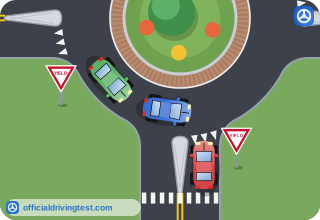
- As soon as the vehicle ahead of you has entered
- When there is a gap in traffic
- When the circle is completely empty of vehicles
- When pedestrians have stopped crossing
Show answer
Correct answer: When there is a gap in traffic
You should enter when there is a gap in traffic.
Source: Alaska Driver Manual (Revised October 2025), page 34 · Open this page in the manual (Manual page 34)
-
As you exit a roundabout, whom must you yield to?
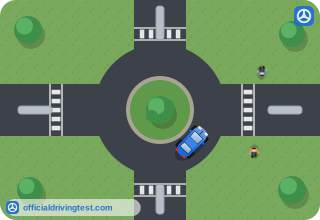
- Only pedestrians who have already stepped off the curb into the street
- Only bicyclists riding in the circle; pedestrians must yield to you
- Only vehicles still in the circle, not people crossing the exit
- Pedestrians and bicyclists in the roundabout and at the marked crosswalk
Show answer
Correct answer: Pedestrians and bicyclists in the roundabout and at the marked crosswalk
You yield to all pedestrians and bicyclists in the roundabout and those crossing at the marked crosswalk as you exit.
Source: Alaska Driver Manual (Revised October 2025), page 34 · Open this page in the manual (Manual page 34)
-
Once you are inside a roundabout, what should you do?
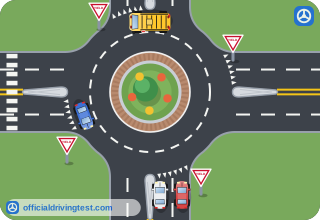
- Stop at each crosswalk to check for pedestrians before continuing
- Stop and wait for a gap before you reach your exit
- Do not stop; follow signs or pavement markings about which lane to use
- Change lanes freely to reach your exit as quickly as you can
Show answer
Correct answer: Do not stop; follow signs or pavement markings about which lane to use
Once inside, do not stop and follow directions on signs or pavement markings about which lane to use.
Source: Alaska Driver Manual (Revised October 2025), page 34 · Open this page in the manual (Manual page 34)
-
If more than one lane goes in the same direction in a roundabout, what should you do before entering?
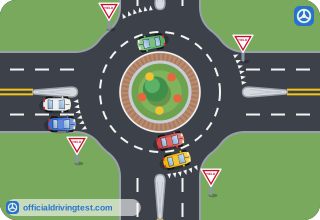
- Make sure you know where you want to go and are in the proper lane
- Enter in any lane and change lanes inside the circle
- Stop at the entrance until a lane is completely empty
- Use the lane closest to the center island, then exit across traffic
Show answer
Correct answer: Make sure you know where you want to go and are in the proper lane
You must know where you want to go and be in the proper lane before entering.
Source: Alaska Driver Manual (Revised October 2025), page 34 · Open this page in the manual (Manual page 34)
-
In a roundabout, if another vehicle arrives at the same time as you, which vehicle do you yield to?
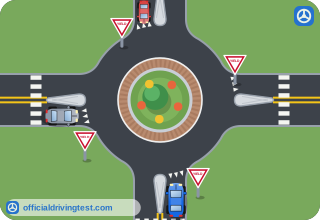
- The vehicle on your left
- The larger vehicle
- The vehicle in the outer lane
- The vehicle on your right
Show answer
Correct answer: The vehicle on your right
If another vehicle arrives at the same time, you yield to the vehicle if it is on your right.
Source: Alaska Driver Manual (Revised October 2025), page 34 · Open this page in the manual (Manual page 34)
-
What may you do if you miss your exit in a roundabout?
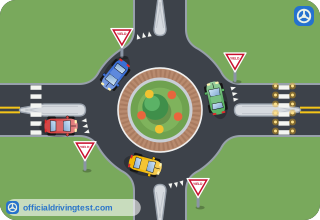
- Stop and back up to the exit
- Exit at any street or continue around
- Make a U-turn against the flow of traffic
- Stop on the center island and wait
Show answer
Correct answer: Exit at any street or continue around
You may exit at any street or continue around if you miss your exit.
Source: Alaska Driver Manual (Revised October 2025), page 34 · Open this page in the manual (Manual page 34)
-
Which traffic must you yield to when entering an intersection?
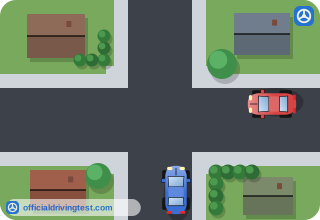
- Traffic so close it is a hazard, and vehicles already in the intersection
- Only vehicles already inside the intersection, not traffic that is approaching
- Only traffic that is traveling faster than the posted speed limit
- Only vehicles that are larger than yours and still approaching
Show answer
Correct answer: Traffic so close it is a hazard, and vehicles already in the intersection
The manual says to yield to all traffic that is so close as to be a hazard, and to a vehicle already in the intersection.
Source: Alaska Driver Manual (Revised October 2025), page 35 · Open this page in the manual (Manual page 35)
-
At a yield sign, whom must you yield to?
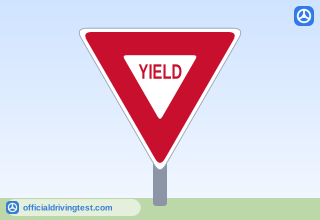
- Only motor vehicles on the protected route, not non-motorized users
- Only the traffic that is approaching from your right side
- All traffic on the protected route, including non-motorized users
- Only pedestrians in a marked crosswalk directly ahead of you
Show answer
Correct answer: All traffic on the protected route, including non-motorized users
At a yield sign you yield to all traffic, including non-motorized users, traveling on the protected route.
Source: Alaska Driver Manual (Revised October 2025), page 35 · Open this page in the manual (Manual page 35)
-
If you must stop at a yield sign, where should you stop?
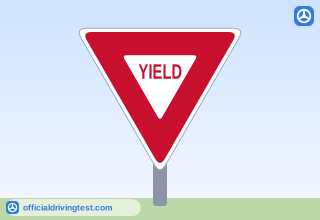
- In the middle of the intersection
- In advance of the unmarked crosswalk
- After the unmarked crosswalk
- Beside the yield sign
Show answer
Correct answer: In advance of the unmarked crosswalk
The manual says to stop in advance of the unmarked crosswalk if a stop is necessary.
Source: Alaska Driver Manual (Revised October 2025), page 35 · Open this page in the manual (Manual page 35)
-
At a signaled intersection, when the light turns green, whom must you yield to?
- Only vehicles that entered on a yellow light
- Only pedestrians waiting at the curb
- Only vehicles turning right from the cross street
- Pedestrians and vehicles caught in the intersection
Show answer
Correct answer: Pedestrians and vehicles caught in the intersection
When the light turns green you yield to pedestrians and vehicles caught in the intersection.
Source: Alaska Driver Manual (Revised October 2025), page 35 · Open this page in the manual (Manual page 35)
-
What must you do when entering a street or road from an alley, driveway, or building?
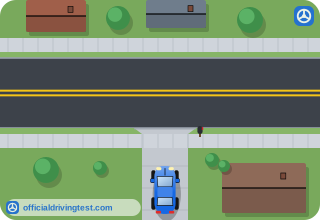
- Merge at the speed of traffic without stopping
- Slow down and proceed if the street looks clear
- Stop and yield to traffic
- Sound your horn and then enter the street
Show answer
Correct answer: Stop and yield to traffic
You must stop and yield when entering a street or road from an alley, driveway, or building.
Source: Alaska Driver Manual (Revised October 2025), page 35 · Open this page in the manual (Manual page 35)
-
Which of these is a correct place to stop at a stop sign?
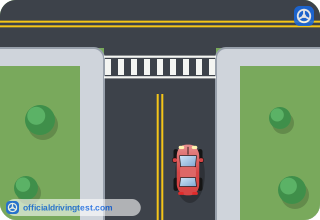
- Behind the crosswalk
- Past the crosswalk but before the intersection
- In the middle of the crosswalk so you can see
- Beside the sign, even if it is past the stop line
Show answer
Correct answer: Behind the crosswalk
At a stop sign you stop behind the crosswalk, at the painted stop line or behind the intersecting roadway shoulder line.
Source: Alaska Driver Manual (Revised October 2025), page 36 · Open this page in the manual (Manual page 36)
-
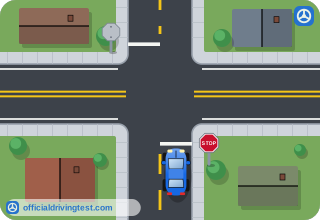
At a stop sign, whom must you yield to before entering the intersection?
- Only traffic on the cross street, not pedestrians
- Only vehicles that arrived at the intersection before you
- Only pedestrians in the crosswalk; traffic must yield to you
- Pedestrians, bicyclists if present, and traffic
Show answer
Correct answer: Pedestrians, bicyclists if present, and traffic
You yield to pedestrians, bicyclists if present, and traffic before entering.
Source: Alaska Driver Manual (Revised October 2025), page 36 · Open this page in the manual (Manual page 36)