Alaska: Right-of-way and turning — Part 2 Practice Test
Questions in this part include: “In a three-point turn, when you turn left across the street, what should your vehicle be pointing at?” · “For extra safety in a three-point turn, what can you do before backing?”
Independent educational site · not affiliated with any government agency or DMV
Ready? Test yourself
- Instant feedback with an explanation
- Every answer cites its source in the manual
- Your best score is saved on this device
Questions are original and based on the official manual "Alaska Driver Manual" (Revised October 2025), Alaska Department of Administration, Division of Motor Vehicles (DMV).
All 16 questions in this practice test
Take the test above first, then use this list to study. Tap “Show answer” to see the correct answer and explanation.
Show the questions and answersHide the questions
-
In a three-point turn, when you turn left across the street, what should your vehicle be pointing at?
- The center line of the road ahead
- The curb or left shoulder of the road
- The right shoulder of the road
- The lane you came from
Show answer
Correct answer: The curb or left shoulder of the road
You turn left crossing the street until the vehicle is pointing at the curb or left shoulder of the road.
Source: Alaska Driver Manual (Revised October 2025), page 32 · Open this page in the manual (Manual page 32)
-
In a three-point turn, how should your wheels be turned before you back up to the opposite side of the street?
- To the right as far as they will go
- To the left as far as they will go
- Straight ahead
- Halfway to the right
Show answer
Correct answer: To the right as far as they will go
The manual says to turn your wheels to the right as far as they will go and then back up to the opposite side.
Source: Alaska Driver Manual (Revised October 2025), page 32 · Open this page in the manual (Manual page 32)
-
What do you do after backing up to the opposite side of the street in a three-point turn?
- Sound your horn and drive straight ahead at once
- Signal right and back into the original lane
- Stop, check again for traffic, then drive forward
- Pull over to the far right and stop
Show answer
Correct answer: Stop, check again for traffic, then drive forward
The final step is to stop, check again for traffic, and drive forward to complete the maneuver.
Source: Alaska Driver Manual (Revised October 2025), page 32 · Open this page in the manual (Manual page 32)
-
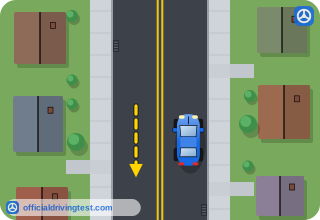
Whom must you watch for and yield to while making a three-point turn?
- Only motor vehicles approaching from the direction you came from
- Approaching traffic, bicyclists, and pedestrians from both directions
- Only pedestrians and bicyclists approaching from your left side
- Only vehicles that are parked along the street you are leaving
Show answer
Correct answer: Approaching traffic, bicyclists, and pedestrians from both directions
You must watch for and yield to approaching traffic including bicyclists and pedestrians approaching from both directions.
Source: Alaska Driver Manual (Revised October 2025), page 32 · Open this page in the manual (Manual page 32)
-
For extra safety in a three-point turn, what can you do before backing?
- Turn on your high beams
- Flash your brake lights twice
- Roll down all of your windows
- Sound your horn
Show answer
Correct answer: Sound your horn
The manual says you can always sound your horn before backing for extra safety.
Source: Alaska Driver Manual (Revised October 2025), page 32 · Open this page in the manual (Manual page 32)
-
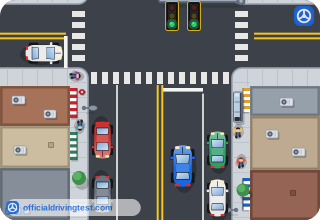
What must you do with your speed when approaching and traversing an intersection?
- Keep it the same until you see another vehicle
- Increase it to clear the intersection quickly
- Reduce it to a reasonable and proper rate
- Reduce it only if a stop sign is posted
Show answer
Correct answer: Reduce it to a reasonable and proper rate
Drivers must reduce their speed to a reasonable and proper rate when approaching and traversing an intersection.
Source: Alaska Driver Manual (Revised October 2025), page 33 · Open this page in the manual (Manual page 33)
-
What makes an intersection uncontrolled?
- No stop signs, yield signs, or traffic lights protect it
- No crosswalks or lane lines are painted on the cross street
- A police officer is not present to direct the traffic there
- The intersection is located outside of a city or town
Show answer
Correct answer: No stop signs, yield signs, or traffic lights protect it
A street or highway not protected with stop signs, yield signs or traffic lights has uncontrolled intersections.
Source: Alaska Driver Manual (Revised October 2025), page 33 · Open this page in the manual (Manual page 33)
-
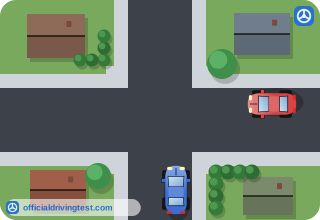
What are you required to do at an uncontrolled intersection, at a cross street or crossroad?
- Speed up to clear the intersection quickly
- Sound your horn and continue at the same speed
- Stop only if you see another vehicle
- Slow down and have your vehicle under control
Show answer
Correct answer: Slow down and have your vehicle under control
You are required to slow down and have your vehicle under control at a cross street or crossroad.
Source: Alaska Driver Manual (Revised October 2025), page 33 · Open this page in the manual (Manual page 33)
-
Slowing down and having your vehicle under control at an uncontrolled intersection applies at cross streets and crossroads that include what?
- Only crosswalks with painted lines on the road
- Unmarked crosswalks for non-motorized users
- Only crosswalks that are located near schools
- Railroad crossings on private roads and driveways
Show answer
Correct answer: Unmarked crosswalks for non-motorized users
Cross streets and crossroads include unmarked crosswalks for non-motorized users.
Source: Alaska Driver Manual (Revised October 2025), page 33 · Open this page in the manual (Manual page 33)
-
Which statement about driving through an uncontrolled intersection is true?
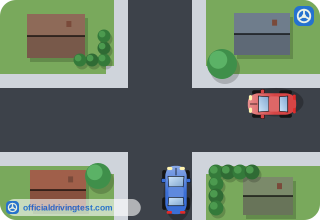
- Approaching from the right does not excuse you from slowing down
- Drivers approaching from the right may keep their speed
- Slowing down is needed only when another vehicle is in sight
- Slowing down is required only for the driver on the left
Show answer
Correct answer: Approaching from the right does not excuse you from slowing down
The manual states that approaching from the right does not excuse you from slowing down and having your vehicle under control.
Source: Alaska Driver Manual (Revised October 2025), page 33 · Open this page in the manual (Manual page 33)
-
Two vehicles approach an uncontrolled intersection at such a position and time that there is danger of collision. Who must yield?
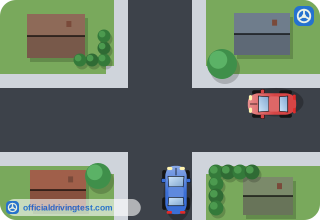
- The driver of the vehicle on the right
- The driver of the larger vehicle
- The driver of the vehicle on the left
- The driver of the faster vehicle
Show answer
Correct answer: The driver of the vehicle on the left
The driver of the vehicle on the left must yield to the driver of the vehicle on the right.
Source: Alaska Driver Manual (Revised October 2025), page 33 · Open this page in the manual (Manual page 33)
-
When do you have the right of way as the driver approaching an uncontrolled intersection from the right?
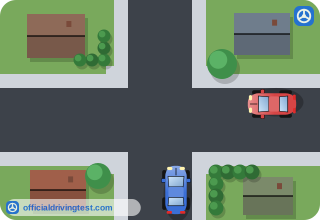
- Always, because you are on the right
- Only when the other driver gives it to you
- Whenever your vehicle is larger than the other
- Whenever you arrive at the intersection first
Show answer
Correct answer: Only when the other driver gives it to you
You have the right of way only when the other driver gives it to you, and only if another vehicle is not already within the intersection.
Source: Alaska Driver Manual (Revised October 2025), page 33 · Open this page in the manual (Manual page 33)
-
When approaching an uncontrolled intersection from the right, you do not have the right of way if what is true?
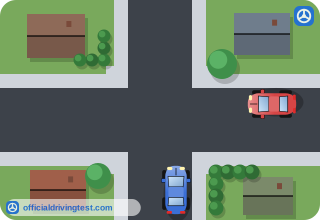
- You are driving a smaller vehicle
- Your turn signal is not on
- Another vehicle is approaching from the left
- Another vehicle is already within the intersection
Show answer
Correct answer: Another vehicle is already within the intersection
You have the right of way only if another vehicle is not already within the intersection.
Source: Alaska Driver Manual (Revised October 2025), page 33 · Open this page in the manual (Manual page 33)
-
Who has the right of way through uncontrolled intersections over motorized vehicles?
- A truck pulling a trailer
- The vehicle approaching from the left
- A non-motorized user
- A vehicle that is turning right
Show answer
Correct answer: A non-motorized user
A non-motorized user has the right of way through uncontrolled intersections to motorized vehicles.
Source: Alaska Driver Manual (Revised October 2025), page 33 · Open this page in the manual (Manual page 33)
-
What are roundabouts designed to do?
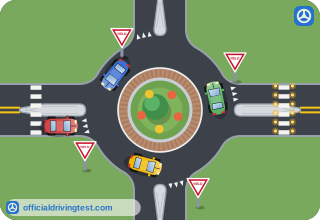
- Promote safe, efficient traffic flow without necessarily stopping traffic
- Require every driver to stop and wait for the circle to empty
- Increase the speed of vehicles passing through an intersection
- Give vehicles entering the circle priority over traffic inside it
Show answer
Correct answer: Promote safe, efficient traffic flow without necessarily stopping traffic
Roundabouts are designed to promote safe and efficient traffic flow without necessarily stopping the flow of traffic.
Source: Alaska Driver Manual (Revised October 2025), page 34 · Open this page in the manual (Manual page 34)
-
In which direction do vehicles travel around the center island of a roundabout?
- Clockwise
- Straight across it
- Either way, depending on the lane
- Counterclockwise
Show answer
Correct answer: Counterclockwise
In a roundabout vehicles travel counterclockwise around a center island.
Source: Alaska Driver Manual (Revised October 2025), page 34 · Open this page in the manual (Manual page 34)