Alaska: Pavement markings Practice Test
Yellow and white lines, no-passing zones, center turn lanes, reversible lanes and other markings on the road.
Independent educational site · not affiliated with any government agency or DMV
Ready? Test yourself
- Instant feedback with an explanation
- Every answer cites its source in the manual
- Your best score is saved on this device
Questions are original and based on the official manual "Alaska Driver Manual" (Revised October 2025), Alaska Department of Administration, Division of Motor Vehicles (DMV).
All 28 questions in this practice test
Take the test above first, then use this list to study. Tap “Show answer” to see the correct answer and explanation.
Show the questions and answersHide the questions
-
On a two-way road, when are you prohibited from passing because of a solid yellow line?
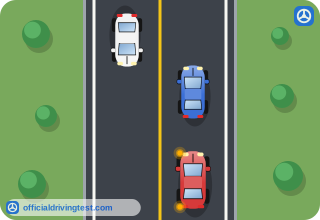
- When the solid yellow line is in your lane
- When the solid yellow line is only in the oncoming lane
- Only when oncoming traffic is in sight
- Never; yellow lines do not affect passing
Show answer
Correct answer: When the solid yellow line is in your lane
You may not pass if the solid yellow line is in your lane.
Source: Alaska Driver Manual (Revised October 2025), page 37 · Open this page in the manual (Manual page 37)
-
How may a reversible lane be marked on the pavement?
- With a single solid white line on each side
- With a solid yellow line on one side only
- With double yellow dashed lines on each side
- With double white solid lines on each side
Show answer
Correct answer: With double yellow dashed lines on each side
Such lanes may be marked with double yellow dashed lines on each side.
Source: Alaska Driver Manual (Revised October 2025), page 53 · Open this page in the manual (Manual page 53)
-
What are pavement markings used for?
- To warn, regulate, and inform traffic, like roadway signs
- To decorate the roadway and guide road crews only
- To give advice that drivers may ignore
- To show the owner of the road
Show answer
Correct answer: To warn, regulate, and inform traffic, like roadway signs
Pavement markings are used like roadway signs to warn, regulate, and inform traffic.
Source: Alaska Driver Manual (Revised October 2025), page 54 · Open this page in the manual (Manual page 54)
-
What do yellow pavement markings, such as center lines, separate?
- Lanes of traffic going the same way
- Parking spaces from the travel lane
- Traffic flowing in opposite directions
- Crosswalks from the intersection
Show answer
Correct answer: Traffic flowing in opposite directions
Yellow markings separate traffic flow going in opposite directions.
Source: Alaska Driver Manual (Revised October 2025), page 54 · Open this page in the manual (Manual page 54)
-
What do white pavement markings, such as lane lines, separate?
- Traffic going in opposite directions
- Traffic going in the same direction
- The roadway from private driveways
- Lanes where passing is never allowed
Show answer
Correct answer: Traffic going in the same direction
White markings separate traffic going in the same direction.
Source: Alaska Driver Manual (Revised October 2025), page 54 · Open this page in the manual (Manual page 54)
-
What does a dashed pavement line mean in general?
- It is restrictive
- It is prohibitive
- It is regulatory only for trucks
- It is permissive
Show answer
Correct answer: It is permissive
The manual says dashed lines are permissive.
Source: Alaska Driver Manual (Revised October 2025), page 54 · Open this page in the manual (Manual page 54)
-
What do solid white lines and solid yellow lines indicate in general?
- Solid white lines are restrictive and solid yellow lines are prohibitive
- Solid white lines are permissive and solid yellow lines are restrictive
- Both are permissive when no other traffic is near
- Solid white lines are prohibitive and solid yellow lines are permissive
Show answer
Correct answer: Solid white lines are restrictive and solid yellow lines are prohibitive
Solid white lines are restrictive, and solid yellow lines are prohibitive.
Source: Alaska Driver Manual (Revised October 2025), page 54 · Open this page in the manual (Manual page 54)
-
Is it legal to drive on the shoulder of a roadway?
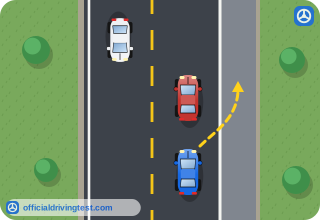
- Yes, in order to pass slower traffic on the roadway
- Yes, whenever the travel lane is crowded with traffic
- No, it is illegal to drive on the shoulder of roadways
- Yes, at speeds below 25 miles per hour on a road
Show answer
Correct answer: No, it is illegal to drive on the shoulder of roadways
The manual states it is illegal to drive on the shoulder of roadways.
Source: Alaska Driver Manual (Revised October 2025), page 54 · Open this page in the manual (Manual page 54)
-
On a multi-lane, two-way road, what is a restricted lane?
- A lane used only for left turns by traffic coming from both directions
- A lane that changes direction during specified periods
- A lane reserved for vehicles driving on the shoulder
- A preferential lane for buses, carpools, etc., marked with diamonds and signs
Show answer
Correct answer: A preferential lane for buses, carpools, etc., marked with diamonds and signs
Restricted lanes are preferential lanes assigned to buses, carpools, etc., and diamond markings and special signs are required.
Source: Alaska Driver Manual (Revised October 2025), page 55 · Open this page in the manual (Manual page 55)
-
On divided or one-way roadways, which kind of edge line is marked on the left?
- Yellow
- White
- Red
- Solid green
Show answer
Correct answer: Yellow
Yellow left edge lines are on all divided or one-way roadways.
Source: Alaska Driver Manual (Revised October 2025), page 55 · Open this page in the manual (Manual page 55)
-
On a two-lane, two-way road where passing is prohibited in both directions, when may you cross the centerline?
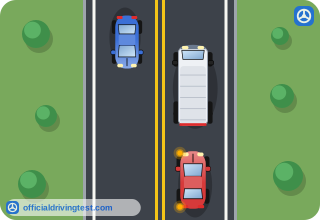
- Only to pass a slow-moving vehicle
- Only when the road ahead is clear for a quarter mile
- Only as part of a left turn maneuver
- Whenever no oncoming vehicle is in sight
Show answer
Correct answer: Only as part of a left turn maneuver
The picture caption allows crossing the centerline only as part of a left turn maneuver.
Source: Alaska Driver Manual (Revised October 2025), page 55 · Open this page in the manual (Manual page 55)
-
What is a shared center lane?
- A lane for traffic that goes one direction in the morning and the other in the evening
- A two-way left turn lane reserved exclusively for left-turning vehicles in either direction
- A lane for buses and carpools, marked with diamonds
- A passing lane for use by both directions of traffic
Show answer
Correct answer: A two-way left turn lane reserved exclusively for left-turning vehicles in either direction
A shared center lane is a two-way left turn lane reserved exclusively for left turning vehicles in either direction.
Source: Alaska Driver Manual (Revised October 2025), page 55 · Open this page in the manual (Manual page 55)
-
Which of these is NOT permissible in a center left turn lane?
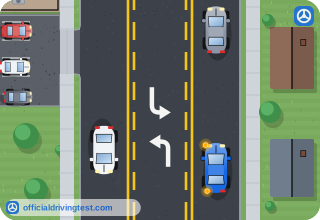
- Using it to make a left turn
- Using it to turn left from either direction of travel
- Following the pavement marking arrows in it
- Using it as a driving, accelerating, or passing lane
Show answer
Correct answer: Using it as a driving, accelerating, or passing lane
It is not permissible to use the center left turn lane as a driving, accelerating, or passing lane.
Source: Alaska Driver Manual (Revised October 2025), page 55 · Open this page in the manual (Manual page 55)
-
What is a reversible center lane?
- A center lane whose direction is reversible during specified periods
- A center lane reserved only for vehicles making left turns
- A center lane that is reserved for buses and carpools
- A center lane where passing is permitted in both directions
Show answer
Correct answer: A center lane whose direction is reversible during specified periods
The caption describes a reversible center lane whose direction is reversible during specified periods, and signs or signals are required.
Source: Alaska Driver Manual (Revised October 2025), page 55 · Open this page in the manual (Manual page 55)
-
On a multi-lane, undivided two-way roadway, when may you cross the centerline?
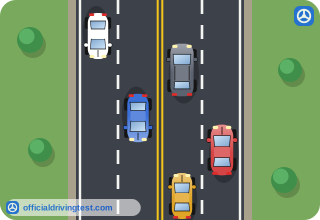
- When you are moving to the lane of a slower vehicle
- When the other lane is empty
- Only as part of a left turn maneuver
- Whenever you signal at least 100 feet before
Show answer
Correct answer: Only as part of a left turn maneuver
The caption says crossing the centerline is permitted only as part of a left turn maneuver.
Source: Alaska Driver Manual (Revised October 2025), page 55 · Open this page in the manual (Manual page 55)
-
What does a dashed yellow line on a two-lane, two-way road indicate?
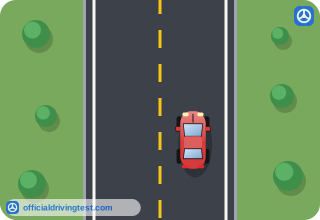
- Passing is prohibited
- Passing is permitted
- Only left turns are permitted
- The road is a one-way road
Show answer
Correct answer: Passing is permitted
Dashed yellow line markings indicate where passing is permitted on two-lane, two-way roadways.
Source: Alaska Driver Manual (Revised October 2025), page 56 · Open this page in the manual (Manual page 56)
-
What do solid yellow center lines indicate, and what is still allowed across them?
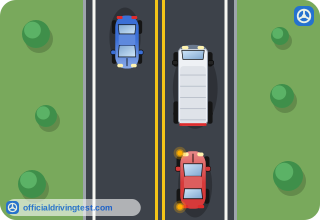
- Passing is permitted, but turning is not allowed
- Passing is not permitted, and turning across them is not allowed
- Passing is permitted only when the road is dry
- Passing is not permitted, but turning into a driveway across them is allowed
Show answer
Correct answer: Passing is not permitted, but turning into a driveway across them is allowed
Solid yellow center lines mean no passing, although turning into a driveway across them is allowed.
Source: Alaska Driver Manual (Revised October 2025), page 56 · Open this page in the manual (Manual page 56)
-
What does a single solid yellow line mark?
- The left edge of a divided roadway
- The right edge of the pavement
- The edge of the shoulder
- The boundary between two same-direction lanes
Show answer
Correct answer: The left edge of a divided roadway
A single solid yellow line indicates the left edge of a divided roadway.
Source: Alaska Driver Manual (Revised October 2025), page 56 · Open this page in the manual (Manual page 56)
-
What do dashed white lines separate?
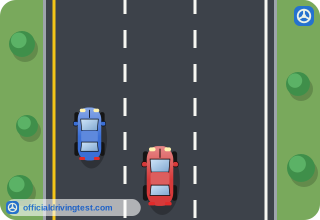
- Lanes where changing lanes is discouraged and each lane has a set use
- The shoulder from the travel lane of the roadway
- Lanes where changing lanes is not restricted and lane use is not specified
- Lanes of traffic that go in opposite directions on the road
Show answer
Correct answer: Lanes where changing lanes is not restricted and lane use is not specified
Dashed white lines separate lanes where changing lanes is not restricted and the lane use is not specified.
Source: Alaska Driver Manual (Revised October 2025), page 56 · Open this page in the manual (Manual page 56)
-
What do solid white lines between lanes indicate?
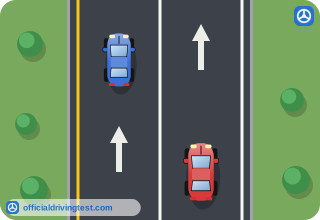
- Lanes where drivers may pass in either direction at will
- Edges of lanes for set uses, where changing lanes is discouraged
- Lanes where changing lanes is not restricted at all
- The center of a two-lane, two-way road
Show answer
Correct answer: Edges of lanes for set uses, where changing lanes is discouraged
Solid white lines indicate the edges of lanes specified for certain uses, where changing lanes is to be discouraged.
Source: Alaska Driver Manual (Revised October 2025), page 56 · Open this page in the manual (Manual page 56)
-
What else are solid white lines used for besides marking lanes for certain uses?
- The left edge of a divided roadway or a one-way road
- The center of a two-lane road
- A lane reserved for emergency vehicles
- The outside edge of the pavement or the edge of the shoulder
Show answer
Correct answer: The outside edge of the pavement or the edge of the shoulder
Solid white lines also mark the outside edge of the pavement or the edge of the shoulder.
Source: Alaska Driver Manual (Revised October 2025), page 56 · Open this page in the manual (Manual page 56)
-
How should you drive in relation to a lane, according to the pavement marking rules?
- Drive within a lane and do not move from it until it is safe to do so
- Straddle the lane line to keep to the middle of the road
- Change lanes often to find the fastest lane
- Stay on the lane line when you are driving next to a truck
Show answer
Correct answer: Drive within a lane and do not move from it until it is safe to do so
The manual says to drive within a lane and not move from it until it is safe.
Source: Alaska Driver Manual (Revised October 2025), page 56 · Open this page in the manual (Manual page 56)
-
A pavement arrow is painted in your lane. What must you do?
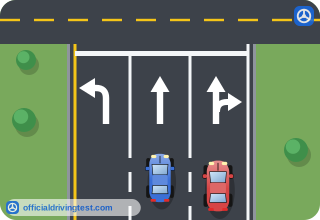
- Treat the arrow as a suggestion and go straight
- Make the movement only if there are no other cars
- Make the movement the arrow shows, since the lane is reserved for it
- Use the lane only if you are making the opposite movement
Show answer
Correct answer: Make the movement the arrow shows, since the lane is reserved for it
An arrow means the lane is reserved exclusively for the indicated movement, and you must make it.
Source: Alaska Driver Manual (Revised October 2025), page 56 · Open this page in the manual (Manual page 56)
-
What do special pavement legends such as “STOP AHEAD,” “SCHOOL,” and “R X R” tell you?
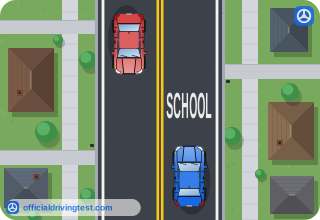
- They are regulatory markings that give you the right-of-way
- They mark special conditions needing extreme caution; be ready to stop
- They show that the lane ahead is closed to all traffic
- They apply only to heavy vehicles
Show answer
Correct answer: They mark special conditions needing extreme caution; be ready to stop
These legends mark conditions requiring extreme caution; the manual says to pay special heed and be prepared to stop.
Source: Alaska Driver Manual (Revised October 2025), page 56 · Open this page in the manual (Manual page 56)
-
What color are transverse markings such as stop lines, crosswalks, and parking space markings?
- White
- Yellow
- Red
- Blue
Show answer
Correct answer: White
Transverse markings are white lines intended to guide the driver.
Source: Alaska Driver Manual (Revised October 2025), page 56 · Open this page in the manual (Manual page 56)
-
What does a stop line indicate?
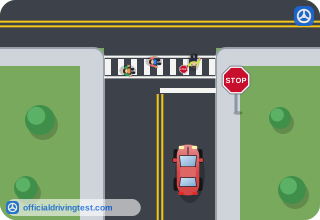
- The point where pedestrians must wait to cross the road
- The point where the lane ends at the intersection ahead
- The farthest point into the intersection a vehicle may extend
- The speed limit for vehicles entering the intersection
Show answer
Correct answer: The farthest point into the intersection a vehicle may extend
Stop lines indicate the farthest point into the intersection an automobile may extend to allow a clear view of approaching traffic.
Source: Alaska Driver Manual (Revised October 2025), page 56 · Open this page in the manual (Manual page 56)
-
Where a crosswalk is marked, how are the limits of the intersection shown?
- A stop line is painted just before the crosswalk lines
- The crosswalk line farthest from the crossroad shows the limits
- A yellow line is painted across the roadway ahead
- The crosswalk line nearest to the crossroad shows the limits
Show answer
Correct answer: The crosswalk line farthest from the crossroad shows the limits
Stop lines are not used with crosswalks where the line farthest from the crossroad indicates the limits of the intersection.
Source: Alaska Driver Manual (Revised October 2025), page 56 · Open this page in the manual (Manual page 56)
-
Where should you park, according to the manual’s guidance on transverse markings?
- Within marked parking stalls
- On the stop line
- Across two marked stalls
- On the crosswalk lines
Show answer
Correct answer: Within marked parking stalls
The manual says to park within marked parking stalls.
Source: Alaska Driver Manual (Revised October 2025), page 56 · Open this page in the manual (Manual page 56)