Alaska: Parking rules Practice Test
Where parking is not allowed, parallel parking, parking on a hill and leaving a parking space.
Independent educational site · not affiliated with any government agency or DMV
Ready? Test yourself
- Instant feedback with an explanation
- Every answer cites its source in the manual
- Your best score is saved on this device
Questions are original and based on the official manual "Alaska Driver Manual" (Revised October 2025), Alaska Department of Administration, Division of Motor Vehicles (DMV).
All 22 questions in this practice test
Take the test above first, then use this list to study. Tap “Show answer” to see the correct answer and explanation.
Show the questions and answersHide the questions
-
When parking next to the roadway outside of city limits, how should the vehicle be positioned?
- Two wheels on the pavement and two off it
- All four wheels on the pavement
- Half the vehicle on the center line
- All four wheels off the pavement, if possible
Show answer
Correct answer: All four wheels off the pavement, if possible
The manual says all four wheels must be off the pavement, if possible, when parking adjacent to the roadway outside city limits.
Source: Alaska Driver Manual (Revised October 2025), page 62 · Open this page in the manual (Manual page 62)
-
When parked next to the roadway outside city limits at night, what lights must be left on, unless the vehicle is 8 feet from the edge of the pavement?
- High beam headlights and fog lights
- Parking lights or low beam headlights
- The interior dome light and hazard flashers
- Hazard flashers and brake lights
Show answer
Correct answer: Parking lights or low beam headlights
The manual says parking lights or low beam headlights are to be left on at night, unless 8 feet from the edge of the pavement.
Source: Alaska Driver Manual (Revised October 2025), page 62 · Open this page in the manual (Manual page 62)
-
How are "no parking zones" in cities and towns usually marked?
- By a sign or a yellow or red painted curb
- By a green or blue painted curb only
- By a white painted curb only
- By orange traffic cones only
Show answer
Correct answer: By a sign or a yellow or red painted curb
The manual says no parking zones in cities and towns are usually marked by a sign or yellow or red painted curb.
Source: Alaska Driver Manual (Revised October 2025), page 62 · Open this page in the manual (Manual page 62)
-
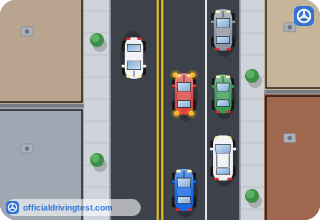
What does the manual say about double parking?
- It is allowed for up to five minutes
- It is allowed when your hazard lights are on
- It is prohibited by law
- It is allowed on streets without marked lanes
Show answer
Correct answer: It is prohibited by law
The manual says double parking is prohibited by law.
Source: Alaska Driver Manual (Revised October 2025), page 62 · Open this page in the manual (Manual page 62)
-
To prevent theft, what should you never do with a parked, unattended vehicle?
- Lock all the doors and trunk
- Leave the key in the ignition
- Park in a well-lit location
- Close the windows and sunroof
Show answer
Correct answer: Leave the key in the ignition
The manual says never leave the key in the ignition of a parked unattended vehicle, and to remove keys or fobs.
Source: Alaska Driver Manual (Revised October 2025), page 62 · Open this page in the manual (Manual page 62)
-
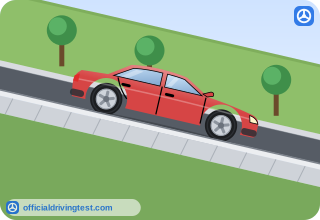
When parking on a downhill, which way should you turn your front wheels?
- Away from the curb
- Straight ahead
- Toward the center of the road
- Toward the curb
Show answer
Correct answer: Toward the curb
The manual says that on a downhill you turn the front wheels toward the curb.
Source: Alaska Driver Manual (Revised October 2025), page 62 · Open this page in the manual (Manual page 62)
-
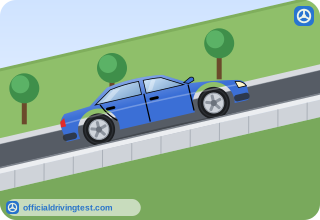
When parking on an uphill with a curb, which way should you turn your front wheels?
- Toward the curb
- Straight ahead
- Away from the curb
- Toward the curb, then back to straight
Show answer
Correct answer: Away from the curb
The manual says that on an uphill you turn the front wheels away from the curb.
Source: Alaska Driver Manual (Revised October 2025), page 62 · Open this page in the manual (Manual page 62)
-
In parallel parking, how close must the wheels be to the near curb?
- Within 12 inches
- Within 6 inches
- Within 24 inches
- Within 36 inches
Show answer
Correct answer: Within 12 inches
The manual says that in parallel parking the wheels must be within 12 inches of the near curb.
Source: Alaska Driver Manual (Revised October 2025), page 62 · Open this page in the manual (Manual page 62)
-
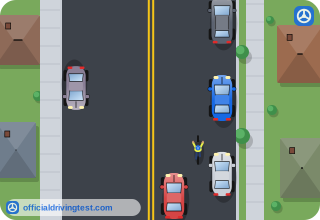
What must a driver do when moving out of a parking place?
- Signal and expect traffic to yield
- Honk and pull out ahead of traffic
- Back out quickly to clear the space
- Look, signal, and yield the right-of-way
Show answer
Correct answer: Look, signal, and yield the right-of-way
The manual says the driver must look, signal, and yield the right-of-way when moving out of a parking place.
Source: Alaska Driver Manual (Revised October 2025), page 62 · Open this page in the manual (Manual page 62)
-
It is illegal to park closer than what distance from a fire hydrant?
- 5 feet
- 15 feet
- 10 feet
- 30 feet
Show answer
Correct answer: 15 feet
The manual lists 15 feet as the closest you may park to a fire hydrant.
Source: Alaska Driver Manual (Revised October 2025), page 62 · Open this page in the manual (Manual page 62)
-
It is illegal to park closer than what distance from a stop sign?
- 30 feet
- 10 feet
- 15 feet
- 50 feet
Show answer
Correct answer: 30 feet
The manual lists 30 feet as the closest you may park to a stop sign.
Source: Alaska Driver Manual (Revised October 2025), page 62 · Open this page in the manual (Manual page 62)
-
It is illegal to park closer than what distance from the entrance to a fire station?
- 5 feet
- 15 feet
- 20 feet
- 50 feet
Show answer
Correct answer: 20 feet
The manual lists 20 feet as the closest you may park to the entrance to a fire station.
Source: Alaska Driver Manual (Revised October 2025), page 62 · Open this page in the manual (Manual page 62)
-
It is illegal to park closer than what distance from a crosswalk or intersection?
- 10 feet
- 20 feet
- 30 feet
- 50 feet
Show answer
Correct answer: 20 feet
The manual lists 20 feet as the closest you may park to a crosswalk or intersection.
Source: Alaska Driver Manual (Revised October 2025), page 62 · Open this page in the manual (Manual page 62)
-
It is illegal to park closer than what distance from a railroad crossing?
- 15 feet
- 20 feet
- 30 feet
- 50 feet
Show answer
Correct answer: 50 feet
The manual lists 50 feet as the closest you may park to a railroad crossing.
Source: Alaska Driver Manual (Revised October 2025), page 62 · Open this page in the manual (Manual page 62)
-
It is illegal to park closer than what distance from fire apparatus that has stopped with emergency lights flashing?
- 50 feet
- 150 feet
- 500 feet
- 300 feet
Show answer
Correct answer: 500 feet
The manual lists 500 feet as the closest you may park to fire apparatus stopped with emergency lights flashing.
Source: Alaska Driver Manual (Revised October 2025), page 62 · Open this page in the manual (Manual page 62)
-
At the start of parallel parking (Step 1), how do you position your vehicle after signaling?
- Stop even with the front vehicle, about a foot and a half out from it
- Stop about six feet out from the front vehicle
- Stop directly behind the front vehicle, touching its bumper
- Stop one car length ahead of the space, close to the curb
Show answer
Correct answer: Stop even with the front vehicle, about a foot and a half out from it
Step 1 says to signal and stop even with the front vehicle about a foot and a half out from it, with the rear bumpers even.
Source: Alaska Driver Manual (Revised October 2025), page 62 · Open this page in the manual (Manual page 62)
-
In Step 2 of parallel parking, you back slowly until your vehicle is at about what angle with the street?
- 15 degrees
- 30 degrees
- 90 degrees
- 45 degrees
Show answer
Correct answer: 45 degrees
Step 2 says to back slowly turning the steering wheel sharp right until the vehicle is at about a 45-degree angle with the street.
Source: Alaska Driver Manual (Revised October 2025), page 62 · Open this page in the manual (Manual page 62)
-
In parallel parking, what do you do when your front bumper is even with the other vehicle's back bumper?
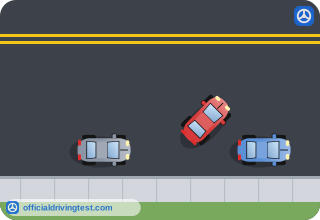
- Turn the wheels sharply to the right and stop completely
- Turn the wheels sharply and rapidly left as far as possible
- Straighten the wheels and back up fast toward the curb
- Pull forward toward the curb with the wheels turned left
Show answer
Correct answer: Turn the wheels sharply and rapidly left as far as possible
Step 3 says to turn the wheels sharply and rapidly to the left as far as possible, then back slowly to the vehicle behind without touching it.
Source: Alaska Driver Manual (Revised October 2025), page 62 · Open this page in the manual (Manual page 62)
-
In the last step of parallel parking, how do you turn the steering wheel as you pull forward toward the curb?
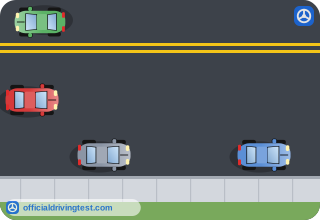
- Sharply to the right
- Sharply to the left
- Straight ahead
- Left, then right, in small turns
Show answer
Correct answer: Sharply to the right
Step 4 says to turn the steering wheel sharply to the right and slowly pull forward toward the curb, then center the vehicle in the space.
Source: Alaska Driver Manual (Revised October 2025), page 62 · Open this page in the manual (Manual page 62)
-
When you park uphill with no curb, which way does the manual show turning the wheels?
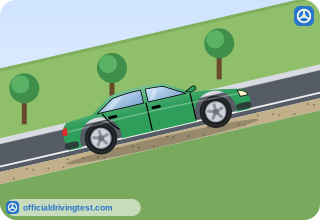
- To the left
- Straight ahead
- To the right
- Toward the center of the road
Show answer
Correct answer: To the right
The diagram for parking uphill without a curb says to turn the wheels to the right.
Source: Alaska Driver Manual (Revised October 2025), page 63 · Open this page in the manual (Manual page 63)
-
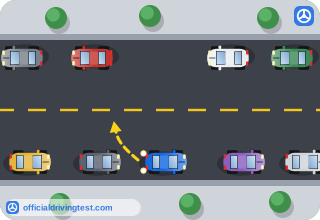
Who has the chief responsibility for avoiding a collision when leaving a parking space?
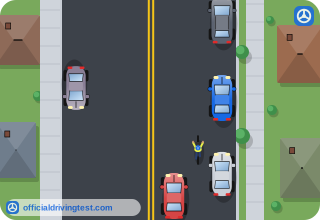
- The driver of the nearest moving vehicle
- The driver who is leaving the parking space
- The driver of the parked vehicle behind
- Both drivers share it equally
Show answer
Correct answer: The driver who is leaving the parking space
The manual says the chief responsibility for avoiding a collision lies with the driver who is leaving a parking space.
Source: Alaska Driver Manual (Revised October 2025), page 63 · Open this page in the manual (Manual page 63)
-
Why does the manual say to use extraordinary caution when backing up in residential areas?
- Garage doors may open into the roadway without warning
- Parked vehicles may start moving at any time
- Street signs are often hidden behind parked vehicles
- Children may be present behind and between parked vehicles
Show answer
Correct answer: Children may be present behind and between parked vehicles
The manual says children may be present behind and between parked vehicles in residential areas.
Source: Alaska Driver Manual (Revised October 2025), page 63 · Open this page in the manual (Manual page 63)