Alaska: Freeway driving Practice Test
Entering, driving on and leaving controlled-access highways, changing lanes and passing on multi-lane roads.
Independent educational site · not affiliated with any government agency or DMV
Ready? Test yourself
- Instant feedback with an explanation
- Every answer cites its source in the manual
- Your best score is saved on this device
Questions are original and based on the official manual "Alaska Driver Manual" (Revised October 2025), Alaska Department of Administration, Division of Motor Vehicles (DMV).
All 21 questions in this practice test
Take the test above first, then use this list to study. Tap “Show answer” to see the correct answer and explanation.
Show the questions and answersHide the questions
-
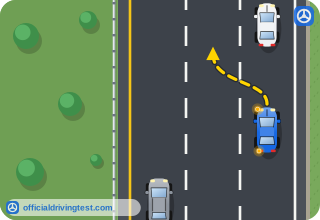
Before changing lanes on a controlled access multi-lane road, what should you do besides checking your mirrors?
- Flash your headlights at the vehicles behind you
- Look over your shoulder toward the rear
- Slow to half the speed of traffic around you
- Sound your horn to warn nearby vehicles
Show answer
Correct answer: Look over your shoulder toward the rear
The manual says to check mirrors and look over your shoulder toward the rear before changing lanes.
Source: Alaska Driver Manual (Revised October 2025), page 57 · Open this page in the manual (Manual page 57 · PDF 69)
-
On a controlled access multi-lane road, what does the manual say not to do if traffic conditions permit?
- Check your mirrors before changing lanes
- Signal your intentions before moving over
- Change lanes gradually and carefully
- Cruise in the blind spot of the vehicle ahead
Show answer
Correct answer: Cruise in the blind spot of the vehicle ahead
The manual says that if traffic conditions permit you should not cruise in the blind spot of the vehicle ahead.
Source: Alaska Driver Manual (Revised October 2025), page 57 · Open this page in the manual (Manual page 57 · PDF 69)
-
Which type of crash does the manual say is one of the most prevalent on high-speed roadways?
- Rear end crashes
- Head-on crashes
- Rollover crashes
- Crashes with animals
Show answer
Correct answer: Rear end crashes
The manual says rear end crashes are one of the most prevalent crash types on high-speed roadways.
Source: Alaska Driver Manual (Revised October 2025), page 57 · Open this page in the manual (Manual page 57 · PDF 69)
-
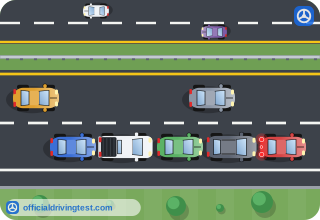
Which following-distance rule does the manual tell you to use on controlled access multi-lane roads?
- The Ten-Second Rule
- The One-Car-Length Rule
- The Four-Second Rule
- The Three-Car Rule
Show answer
Correct answer: The Four-Second Rule
The manual says to use the Four-Second Rule when following on these roads.
Source: Alaska Driver Manual (Revised October 2025), page 57 · Open this page in the manual (Manual page 57 · PDF 69)
-
Why does the manual say not to follow the same vehicle or group of vehicles for a long distance?
- You will tire your eyes by watching the same taillights
- You become complacent about the car ahead as a source of danger
- Other drivers will not be able to pass you safely
- You will lose track of the speed limit
Show answer
Correct answer: You become complacent about the car ahead as a source of danger
The manual says following the same vehicle or group results in complacency, and you cease to consider the car ahead as a source of danger.
Source: Alaska Driver Manual (Revised October 2025), page 57 · Open this page in the manual (Manual page 57 · PDF 69)
-
According to the manual, other drivers cannot see you with their inside mirror when you are near which part of their vehicle?
- The center of the rear bumper
- The front bumper
- The rear license plate
- The left or right rear fender
Show answer
Correct answer: The left or right rear fender
The manual says that near another driver’s left or right rear fender you are in their blind spot and cannot be seen in their inside mirror.
Source: Alaska Driver Manual (Revised October 2025), page 57 · Open this page in the manual (Manual page 57 · PDF 69)
-
On a controlled access multi-lane road, which vehicles must keep right?
- Slow moving vehicles
- Vehicles that are passing another vehicle
- Vehicles carrying heavy loads only
- All vehicles at all times
Show answer
Correct answer: Slow moving vehicles
Under passing, the manual says slow moving vehicles must keep right.
Source: Alaska Driver Manual (Revised October 2025), page 57 · Open this page in the manual (Manual page 57 · PDF 69)
-
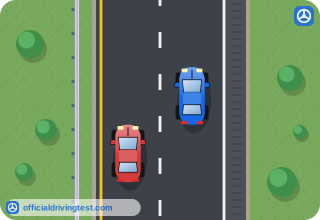
What does the manual say to do about your speed when another vehicle is passing you?
- Speed up slightly to finish the pass sooner
- Brake hard to let the vehicle by
- Do not speed up
- Flash your lights as a signal to pass
Show answer
Correct answer: Do not speed up
The manual says safe passing depends on cooperation between drivers, so do not speed up when being passed.
Source: Alaska Driver Manual (Revised October 2025), page 57 · Open this page in the manual (Manual page 57 · PDF 69)
-
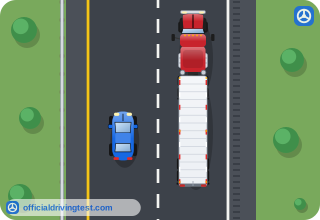
Why should you not cut in too soon after passing?
- It causes your tires to wear out more quickly
- Quick movements at high speed can be fatal
- It may cause the other driver to speed up
- It wastes fuel and increases engine heat
Show answer
Correct answer: Quick movements at high speed can be fatal
The manual says not to cut in too soon because quick movements at high speed can be fatal.
Source: Alaska Driver Manual (Revised October 2025), page 57 · Open this page in the manual (Manual page 57 · PDF 69)
-
In the manual’s steps for changing lanes, what is the first step?
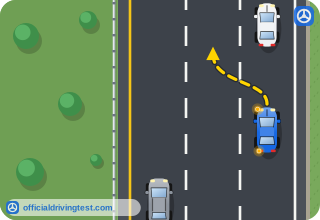
- Use mirrors
- Signal intentions
- Check blind spots
- Change lanes gradually and carefully
Show answer
Correct answer: Use mirrors
The first of the five steps for changing lanes is to use mirrors.
Source: Alaska Driver Manual (Revised October 2025), page 57 · Open this page in the manual (Manual page 57 · PDF 69)
-
In the manual’s steps for changing lanes, what do you do right after signaling your intentions?
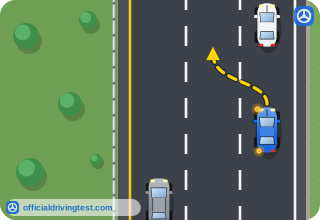
- Accelerate sharply into the new lane
- Sound your horn and begin moving over
- Check mirrors and blind spots again
- Brake to open a gap behind you
Show answer
Correct answer: Check mirrors and blind spots again
After signaling intentions, step 4 is to check mirrors and blind spots again.
Source: Alaska Driver Manual (Revised October 2025), page 57 · Open this page in the manual (Manual page 57 · PDF 69)
-
How does the manual say you should change lanes?
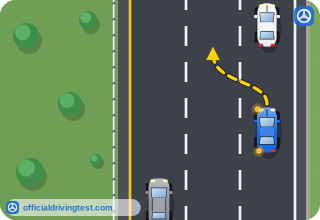
- Quickly, to avoid delaying traffic
- Gradually and carefully
- Sharply, as soon as you signal
- Only after braking hard
Show answer
Correct answer: Gradually and carefully
The last step for changing lanes is to change lanes gradually and carefully.
Source: Alaska Driver Manual (Revised October 2025), page 57 · Open this page in the manual (Manual page 57 · PDF 69)
-
What should you use the acceleration lane for when entering a controlled access highway?
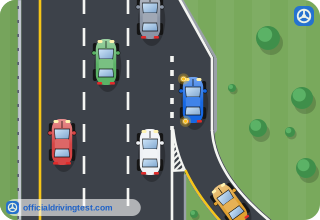
- To stop and wait for a gap in traffic
- To pass slower vehicles already on the freeway
- To check your mirrors while stopped
- To get up to cruising speed before merging
Show answer
Correct answer: To get up to cruising speed before merging
The manual says to use the acceleration lane to get up to cruising speed before attempting to merge into the traffic stream.
Source: Alaska Driver Manual (Revised October 2025), page 58 · Open this page in the manual (Manual page 58 · PDF 70)
-
As you are about to enter a freeway, what does the manual say to do about approaching freeway traffic?
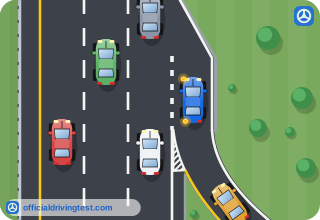
- Yield, and stop if necessary, watching vehicles behind
- Enter first, since freeway drivers must give way to you
- Never stop in the acceleration lane, even without a gap
- Speed up and force your way into the lane
Show answer
Correct answer: Yield, and stop if necessary, watching vehicles behind
The manual says to yield to approaching freeway traffic and stop if necessary, but to be cautious of the vehicles following you.
Source: Alaska Driver Manual (Revised October 2025), page 58 · Open this page in the manual (Manual page 58 · PDF 70)
-
When leaving the expressway, what should you do before slowing down?
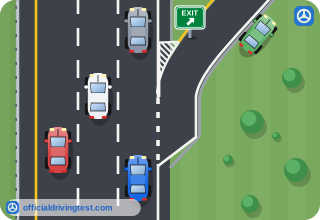
- Brake hard in the through lane
- Stop on the shoulder first
- Move to the deceleration lane
- Slow down in the through lane first
Show answer
Correct answer: Move to the deceleration lane
The manual says to keep moving, then move to the deceleration lane and then slow down.
Source: Alaska Driver Manual (Revised October 2025), page 58 · Open this page in the manual (Manual page 58 · PDF 70)
-
What can result from stopping on the expressway when you are leaving it?
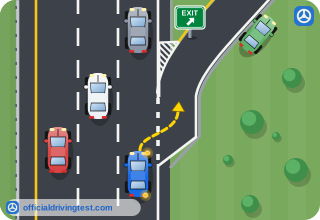
- Engine overheating
- A serious rear end crash
- A flat tire
- Loss of steering control
Show answer
Correct answer: A serious rear end crash
The manual says that a stop on the expressway can result in a serious rear end crash.
Source: Alaska Driver Manual (Revised October 2025), page 58 · Open this page in the manual (Manual page 58 · PDF 70)
-
What does the manual say to do if you miss an exit on a freeway?
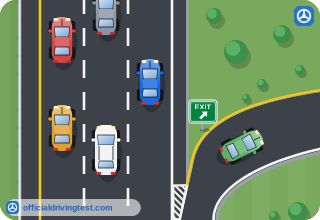
- Back up along the shoulder to the exit
- Stop on the shoulder and wait for a gap
- Make a U-turn across the median
- Do not back up; go to the next exit
Show answer
Correct answer: Do not back up; go to the next exit
The manual says if you miss an exit you should not back up but go to the next exit.
Source: Alaska Driver Manual (Revised October 2025), page 58 · Open this page in the manual (Manual page 58 · PDF 70)
-
Why does the manual say not to stop if you take a wrong exit?
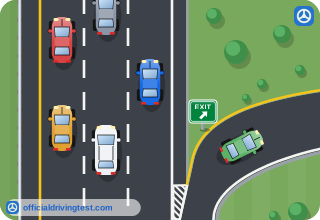
- Stops are a primary cause of rear end crashes
- Stopping on an exit ramp uses too much fuel
- Other drivers will mistake your car for a disabled one
- It is a violation to stop for more than a minute
Show answer
Correct answer: Stops are a primary cause of rear end crashes
The manual says stops are a primary cause of rear end crashes.
Source: Alaska Driver Manual (Revised October 2025), page 58 · Open this page in the manual (Manual page 58 · PDF 70)
-
Except in an emergency, where is parking prohibited on a controlled access highway (freeway)?
- On the paved portion only, but shoulders are allowed for short stops
- On the paved portion and the left shoulder, but not the right shoulder
- On the paved portion, the shoulders, or anywhere within right-of-way
- Anywhere within right-of-way, except for stops under ten minutes
Show answer
Correct answer: On the paved portion, the shoulders, or anywhere within right-of-way
The manual says that except in an emergency, parking is prohibited on the paved portion, the shoulders, or anywhere within right-of-way.
Source: Alaska Driver Manual (Revised October 2025), page 58 · Open this page in the manual (Manual page 58 · PDF 70)
-
What kind of turns does the manual say you may make on a highway or freeway?
- Any turn if no vehicles are in sight
- Only authorized turns
- U-turns when traffic is light
- Turns from the left lane at any point
Show answer
Correct answer: Only authorized turns
The manual says to make only authorized turns on the highway or freeway.
Source: Alaska Driver Manual (Revised October 2025), page 58 · Open this page in the manual (Manual page 58 · PDF 70)
-
What does the manual say about dimming headlights on divided highways?
- It is not required because lanes are separated
- It is required only on undivided roads
- It is required only when traffic is heavy
- It is required there as it is elsewhere
Show answer
Correct answer: It is required there as it is elsewhere
The manual says dimming of headlights is required on divided highways as it is elsewhere.
Source: Alaska Driver Manual (Revised October 2025), page 58 · Open this page in the manual (Manual page 58 · PDF 70)