Alaska: Emergency vehicles and work zones Practice Test
Yielding to emergency vehicles, the Move Over law, flaggers and work zones.
Independent educational site · not affiliated with any government agency or DMV
Ready? Test yourself
- Instant feedback with an explanation
- Every answer cites its source in the manual
- Your best score is saved on this device
Questions are original and based on the official manual "Alaska Driver Manual" (Revised October 2025), Alaska Department of Administration, Division of Motor Vehicles (DMV).
All 31 questions in this practice test
Take the test above first, then use this list to study. Tap “Show answer” to see the correct answer and explanation.
Show the questions and answersHide the questions
-
What do orange flags and signs indicate?
- A school crossing ahead on the road
- A "high hazard area" (maintenance and construction)
- A place where animals commonly cross the road
- An area where parking is allowed on the road
Show answer
Correct answer: A "high hazard area" (maintenance and construction)
The manual says orange flags and signs indicate a "high hazard area" for maintenance and construction.
Source: Alaska Driver Manual (Revised October 2025), page 26 · Open this page in the manual (Manual page 26)
-
What does "Moving Over" (AS 28.35.185) require you to do?
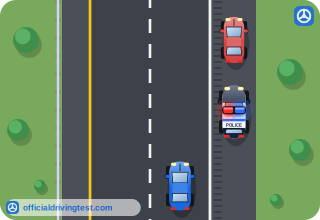
- Pull over and stop for any vehicle behind you
- Move to the left lane whenever you see a police car
- Give emergency vehicles on the shoulder additional safety
- Slow to 20 mph on every highway
Show answer
Correct answer: Give emergency vehicles on the shoulder additional safety
The manual says to give emergency vehicles on the shoulder additional safety by moving over, as it is the law.
Source: Alaska Driver Manual (Revised October 2025), page 29 · Open this page in the manual (Manual page 29)
-
Which devices are the most used to alert drivers to unusual or potentially dangerous conditions in work areas?
- Orange flags, reflectors, and painted lane lines
- Detour signs, cattle guards, and speed bumps
- Guard rails, concrete walls, and wooden fences
- Barricades, vertical panels, cones, tubes, and drums
Show answer
Correct answer: Barricades, vertical panels, cones, tubes, and drums
Barricades, vertical panels, cones, tubes, and drums are the most used devices to alert drivers in work areas.
Source: Alaska Driver Manual (Revised October 2025), page 42 · Open this page in the manual (Manual page 42)
-
What are barricades, vertical panels, cones, tubes, and drums used to do in work areas?
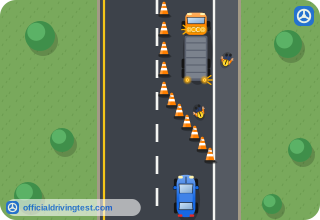
- Warn drivers that a road is permanently closed
- Show drivers where to park near the work
- Slow drivers down only during the daytime
- Guide drivers safely through the work zone
Show answer
Correct answer: Guide drivers safely through the work zone
These devices are used to guide drivers safely through the work zone.
Source: Alaska Driver Manual (Revised October 2025), page 42 · Open this page in the manual (Manual page 42)
-
At night, work-area devices are often equipped with what?
- Sirens that sound as vehicles approach
- Flashing or steady burn lights
- Large spotlights aimed at oncoming drivers
- Reflective flags that wave in the wind
Show answer
Correct answer: Flashing or steady burn lights
At night, work-area devices are often equipped with flashing or steady burn lights.
Source: Alaska Driver Manual (Revised October 2025), page 42 · Open this page in the manual (Manual page 42)
-
When may large flashing or sequencing arrow panels be used in work zones?
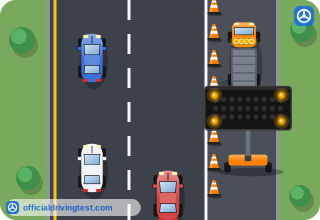
- Only at night
- Only in daylight
- Both day and night
- Only during rain or snow
Show answer
Correct answer: Both day and night
Large flashing or sequencing arrow panels may be used both day and night.
Source: Alaska Driver Manual (Revised October 2025), page 42 · Open this page in the manual (Manual page 42)
-
Large flashing or sequencing arrow panels are used to guide drivers where?
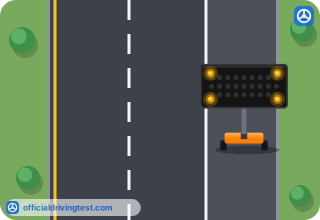
- Into certain traffic lanes
- Onto the nearest paved shoulder
- Toward the nearest rest area
- Past the next signal ahead
Show answer
Correct answer: Into certain traffic lanes
Arrow panels guide drivers into certain traffic lanes.
Source: Alaska Driver Manual (Revised October 2025), page 42 · Open this page in the manual (Manual page 42)
-
What do large flashing or sequencing arrow panels inform drivers of?
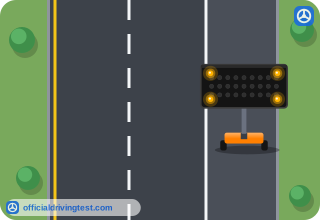
- That part of the road or street ahead is closed
- That a flagger is working on the road ahead
- That the speed limit has been lowered ahead
- That a detour route begins at the next corner
Show answer
Correct answer: That part of the road or street ahead is closed
Arrow panels inform drivers that part of the road or street ahead of them is closed.
Source: Alaska Driver Manual (Revised October 2025), page 42 · Open this page in the manual (Manual page 42)
-
Why are flag persons often provided in highway and street work zones?
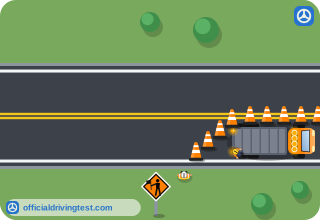
- To collect tolls from vehicles entering the work area
- To close the road to all traffic until work is complete
- To stop, slow, or guide traffic safely through the area
- To check driver licenses before entering the work zone
Show answer
Correct answer: To stop, slow, or guide traffic safely through the area
Flag persons are provided to stop, slow, or guide traffic safely through the work area.
Source: Alaska Driver Manual (Revised October 2025), page 42 · Open this page in the manual (Manual page 42)
-
What do flag persons generally wear?
- White coats and black hats
- Orange vests, shirts or jackets
- Bright blue uniforms with badges
- Red caps and green jackets
Show answer
Correct answer: Orange vests, shirts or jackets
Flag persons generally wear orange vests, shirts or jackets.
Source: Alaska Driver Manual (Revised October 2025), page 42 · Open this page in the manual (Manual page 42)
-
What do flag persons use to direct traffic through work zones?
- Green flags or yield paddles
- Orange flags or blue lights
- Whistles and white batons only
- Red flags or stop/slow paddles
Show answer
Correct answer: Red flags or stop/slow paddles
Flag persons use red flags or stop/slow paddles to direct traffic through work zones.
Source: Alaska Driver Manual (Revised October 2025), page 42 · Open this page in the manual (Manual page 42)
-
What are vehicles operated by police and fire departments, as well as ambulances, equipped with?
- Horns and rear amber lights only
- Sirens and white roof lights only
- Sirens and front red and/or blue lights
- Yellow flashing lights on the front only
Show answer
Correct answer: Sirens and front red and/or blue lights
The manual says police and fire vehicles and ambulances are equipped with sirens and front red and/or blue lights.
Source: Alaska Driver Manual (Revised October 2025), page 64 · Open this page in the manual (Manual page 64)
-
Which of these is it against the law for an unauthorized vehicle to have?
- A red light visible from the front, or a blue light visible from the side
- At least two red taillights on the rear, both of them in working order
- A white light that lights up the rear license plate for at least 50 feet
- Two brake lights that work only when the foot brake is applied
Show answer
Correct answer: A red light visible from the front, or a blue light visible from the side
The manual says it is against the law for an unauthorized vehicle to have a red light visible from the front, or a blue light visible from the side.
Source: Alaska Driver Manual (Revised October 2025), page 64 · Open this page in the manual (Manual page 64)
-
When must you yield to an emergency vehicle displaying a flashing red and/or blue light?
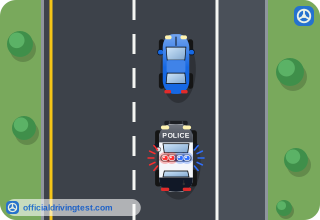
- Only when its siren is sounding
- Whether or not its siren is in operation
- Only when it approaches from behind
- Only on roads with two or more lanes
Show answer
Correct answer: Whether or not its siren is in operation
The manual says to yield "whether a siren is in operation or not."
Source: Alaska Driver Manual (Revised October 2025), page 64 · Open this page in the manual (Manual page 64)
-
Which of these does the manual include among emergency vehicles responding to an emergency?
- A tow truck
- A school bus
- A mail truck
- A delivery van
Show answer
Correct answer: A tow truck
The manual lists ambulances, fire trucks, law enforcement and tow trucks responding to an emergency.
Source: Alaska Driver Manual (Revised October 2025), page 64 · Open this page in the manual (Manual page 64)
-
You approach a stationary emergency vehicle or tow truck with overhead flashing lights on a four-lane road. What must you do if it is safe?
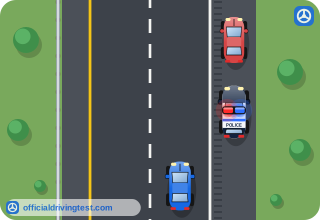
- Stay in your lane and continue at your normal speed
- Stop completely until the emergency lights are turned off
- Move into the lane closest to the emergency vehicle
- Pull to the lane opposite the emergency vehicle or tow truck
Show answer
Correct answer: Pull to the lane opposite the emergency vehicle or tow truck
The manual says that on a four-lane road drivers must pull to the lane opposite the emergency vehicle or tow truck if it is safe to do so.
Source: Alaska Driver Manual (Revised October 2025), page 64 · Open this page in the manual (Manual page 64)
-
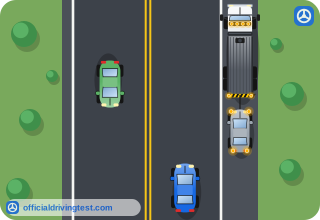
You approach a stationary emergency vehicle or tow truck with flashing lights on a two-lane road. What must you do when passing?
- Stop until the emergency vehicle leaves
- Pass at your normal driving speed
- Slow to a reasonable and prudent speed
- Slow to a walking pace and honk
Show answer
Correct answer: Slow to a reasonable and prudent speed
The manual says that on a two-lane road, or if it is not safe to change lanes, you must slow to a reasonable and prudent speed when passing.
Source: Alaska Driver Manual (Revised October 2025), page 64 · Open this page in the manual (Manual page 64)
-
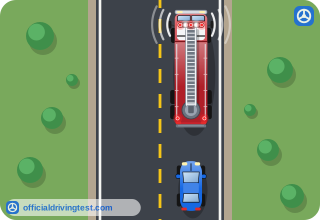
How close may a vehicle follow an emergency vehicle traveling in response to an emergency?
- No closer than 500 feet
- No closer than 100 feet
- No closer than 250 feet
- No closer than 1,000 feet
Show answer
Correct answer: No closer than 500 feet
The manual says a vehicle may not follow an emergency vehicle responding to an emergency closer than 500 feet.
Source: Alaska Driver Manual (Revised October 2025), page 64 · Open this page in the manual (Manual page 64)
-
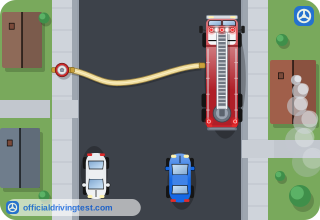
What do you need before driving over a fire department hose?
- The approval of a police officer
- A written permit from the local city
- Nothing, if you drive over it slowly
- The consent of a department official
Show answer
Correct answer: The consent of a department official
The manual says not to drive over a fire department hose without the consent of a department official.
Source: Alaska Driver Manual (Revised October 2025), page 65 · Open this page in the manual (Manual page 65)
-
What is the penalty stated for driving over a fire hose?
- A $50 fine and 2 points
- A $100 fine and 2 points
- A $100 fine and 4 points
- A $250 fine and 2 points
Show answer
Correct answer: A $100 fine and 2 points
The manual lists a $100 fine and 2 points for driving over a fire hose.
Source: Alaska Driver Manual (Revised October 2025), page 65 · Open this page in the manual (Manual page 65)
-
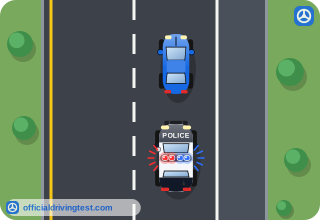
How must drivers stop when signaled to do so by police?
- As soon as is practical and in a reasonably safe manner
- Immediately, in the exact lane where they were driving
- Only after they have reached their planned destination
- Only after the officer has turned on a siren and horn
Show answer
Correct answer: As soon as is practical and in a reasonably safe manner
The manual says drivers must stop as soon as is practical and in a reasonably safe manner when signaled by police.
Source: Alaska Driver Manual (Revised October 2025), page 65 · Open this page in the manual (Manual page 65)
-
If an officer contacts you and you have a deadly weapon concealed on your person, what must you do?
- Wait until the officer asks about it
- Keep it hidden unless you are searched
- Notify the officer immediately
- Tell the officer only if it is loaded
Show answer
Correct answer: Notify the officer immediately
The manual says you must notify the officer immediately if you have a concealed deadly weapon.
Source: Alaska Driver Manual (Revised October 2025), page 65 · Open this page in the manual (Manual page 65)
-
If you are being pulled over, what does the manual say to do?
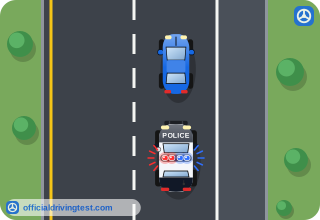
- Stop in the left lane, even on a four-lane road, to stay clear of traffic
- Slow down in your lane and wait for the officer to wave you over to a safe spot
- Signal and pull over to the right as soon as it is safe, even from the left lane
- Pull to whichever side of the roadway is closest, even if the stop is unsafe
Show answer
Correct answer: Signal and pull over to the right as soon as it is safe, even from the left lane
The manual says to signal immediately and pull over to the right as soon as it is safe, even if you are in the left lane of a four-lane roadway.
Source: Alaska Driver Manual (Revised October 2025), page 65 · Open this page in the manual (Manual page 65)
-
Where does the manual say you should try not to stop when being pulled over?
- On a curve, just after the crest of a hill, or next to a guardrail
- On a straight, level section with a wide, safe shoulder
- In a well-lit area away from curves and the crest of a hill
- On a level, paved pullout away from any guardrail
Show answer
Correct answer: On a curve, just after the crest of a hill, or next to a guardrail
The manual says to try not to stop on a curve, just after the crest of a hill, next to a guardrail, or other location that would make the stop unsafe.
Source: Alaska Driver Manual (Revised October 2025), page 65 · Open this page in the manual (Manual page 65)
-
During a stop by law enforcement, who should stay in the vehicle?
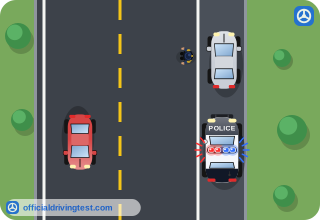
- Only the driver
- Only the front-seat passenger
- The driver, while passengers wait outside
- The driver and all passengers
Show answer
Correct answer: The driver and all passengers
The manual says the driver and all passengers should stay in the vehicle.
Source: Alaska Driver Manual (Revised October 2025), page 65 · Open this page in the manual (Manual page 65)
-
What should you do during a stop by law enforcement in times of darkness?
- Switch the headlights to high beam
- Turn on the interior lights of the vehicle
- Turn off all lights, including headlights
- Turn on the hazard lights and step out
Show answer
Correct answer: Turn on the interior lights of the vehicle
The manual says that in times of darkness you should turn on the interior lights of the vehicle.
Source: Alaska Driver Manual (Revised October 2025), page 65 · Open this page in the manual (Manual page 65)
-
During a stop by law enforcement, where should you keep your hands?
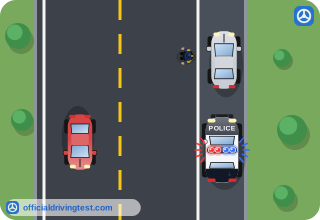
- Visible, such as on the steering wheel
- In your pockets
- Under the seat
- On the dashboard near the glove compartment
Show answer
Correct answer: Visible, such as on the steering wheel
The manual says to keep your hands visible, such as on the steering wheel.
Source: Alaska Driver Manual (Revised October 2025), page 65 · Open this page in the manual (Manual page 65)
-
When should you retrieve documents from a wallet, purse, center console, or glove compartment during a traffic stop?
- Before the officer reaches your window
- As soon as you stop the vehicle
- After the officer asks for them
- While the officer returns to the patrol car
Show answer
Correct answer: After the officer asks for them
The manual says to wait for the officer to ask before retrieving any documents.
Source: Alaska Driver Manual (Revised October 2025), page 65 · Open this page in the manual (Manual page 65)
-
What should you do if you have a disability and cannot comply with an officer's orders?
- Stay silent and wait
- Notify the officer
- Exit the vehicle and wait outside
- Pull away and stop farther down the road
Show answer
Correct answer: Notify the officer
The manual says to notify the officer if you have a disability and cannot comply with the orders.
Source: Alaska Driver Manual (Revised October 2025), page 65 · Open this page in the manual (Manual page 65)
-
When a stop by law enforcement is complete, the officer will remain in place until when, unless instructed otherwise?
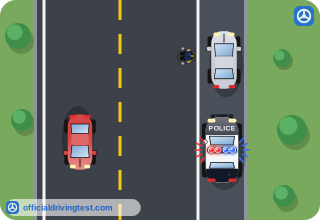
- You turn off your engine and your hazard lights
- You have driven completely out of the officer’s sight
- You have counted to sixty after the officer leaves
- You signal and safely reenter the lane of traffic
Show answer
Correct answer: You signal and safely reenter the lane of traffic
The manual says the officer will remain in place until you signal and safely reenter the lane of traffic unless they instruct you otherwise.
Source: Alaska Driver Manual (Revised October 2025), page 65 · Open this page in the manual (Manual page 65)
-
What does the manual say to be aware of regarding motorists and emergency vehicles in your city?
- Only state law applies on city streets
- City ordinances apply only to parking
- Your city may have additional ordinances
- Cities may not add rules beyond state law
Show answer
Correct answer: Your city may have additional ordinances
The manual says your city may have additional ordinances regarding motorists and emergency vehicles.
Source: Alaska Driver Manual (Revised October 2025), page 65 · Open this page in the manual (Manual page 65)