Alaska: Emergencies — Part 4 Practice Test
Questions in this part include: “Which of these is listed as part of a suggested emergency kit?” · “What should you do for a victim of carbon monoxide?”
Independent educational site · not affiliated with any government agency or DMV
Ready? Test yourself
- Instant feedback with an explanation
- Every answer cites its source in the manual
- Your best score is saved on this device
Questions are original and based on the official manual "Alaska Driver Manual" (Revised October 2025), Alaska Department of Administration, Division of Motor Vehicles (DMV).
All 18 questions in this practice test
Take the test above first, then use this list to study. Tap “Show answer” to see the correct answer and explanation.
Show the questions and answersHide the questions
-
Which of these is listed as part of a suggested emergency kit?
- A road atlas and a spare ignition key
- A portable radio and spare batteries
- A bicycle pump and a length of rope
- A blanket, sand, a shovel, and food
Show answer
Correct answer: A blanket, sand, a shovel, and food
The manual lists a first aid kit, extra clothing/boots, blanket, sand, shovel and food in the emergency kit.
Source: Alaska Driver Manual (Revised October 2025), page 69 · Open this page in the manual (Manual page 69)
-
What kind of gas from vehicle exhaust can make you a dangerous driver and even cost you your life?
- A yellow, sweet-smelling gas called carbon monoxide
- A colored, strong-smelling gas called methane
- A harmless gas that only causes sleepiness
- A colorless, odorless, poisonous gas called carbon monoxide
Show answer
Correct answer: A colorless, odorless, poisonous gas called carbon monoxide
The manual describes carbon monoxide as a colorless, odorless, poisonous gas from vehicle exhaust.
Source: Alaska Driver Manual (Revised October 2025), page 69 · Open this page in the manual (Manual page 69)
-
What does the manual say carbon monoxide does?
- It warns you with a strong smell
- It paralyzes before it kills
- It only makes the engine run poorly
- It is harmless in small amounts
Show answer
Correct answer: It paralyzes before it kills
The manual states that carbon monoxide paralyzes before it kills.
Source: Alaska Driver Manual (Revised October 2025), page 69 · Open this page in the manual (Manual page 69)
-
Which of these is a symptom of carbon monoxide poisoning listed in the manual?
- Ringing in the ears and a high fever
- Blurred vision, sneezing, and itching
- Headache, dizziness, nausea, and vomiting
- A cough and chest pain, and nothing else
Show answer
Correct answer: Headache, dizziness, nausea, and vomiting
The manual lists headache, dizziness, nausea, and vomiting as symptoms.
Source: Alaska Driver Manual (Revised October 2025), page 69 · Open this page in the manual (Manual page 69)
-
What does the manual list as prevention of carbon monoxide poisoning?
- A tight exhaust system and fresh air
- A loose exhaust system and closed windows
- Running the heater with the windows shut
- A high idle speed while parked in a garage
Show answer
Correct answer: A tight exhaust system and fresh air
The manual gives a tight exhaust system and adequate fresh air circulation as prevention.
Source: Alaska Driver Manual (Revised October 2025), page 69 · Open this page in the manual (Manual page 69)
-
Where should you never run a vehicle, to avoid carbon monoxide?
- On a gravel road
- In a closed garage
- In a driveway with the door open
- On a highway
Show answer
Correct answer: In a closed garage
The manual says never to run a vehicle in a closed garage.
Source: Alaska Driver Manual (Revised October 2025), page 69 · Open this page in the manual (Manual page 69)
-
What should you never do when parked, to avoid carbon monoxide?
- Leave the windows open a small crack for air
- Check the exhaust system for any small leaks
- Keep the engine well tuned and running efficiently
- Run the heater or air conditioner, windows closed
Show answer
Correct answer: Run the heater or air conditioner, windows closed
The manual says never to park and run the heater or air conditioner with the windows closed.
Source: Alaska Driver Manual (Revised October 2025), page 69 · Open this page in the manual (Manual page 69)
-
What should you do for a victim of carbon monoxide?
- Move the victim to fresh air and give artificial respiration
- Leave the victim inside the vehicle and wait
- Give the victim food and a blanket, and nothing else
- Turn up the heater to warm the victim up fast
Show answer
Correct answer: Move the victim to fresh air and give artificial respiration
The manual says to move the victim to fresh air and administer artificial respiration.
Source: Alaska Driver Manual (Revised October 2025), page 69 · Open this page in the manual (Manual page 69)
-
Which of these is listed as a safety tip for carbon monoxide?
- Let the engine idle to warm up in a garage
- Keep the windows closed in winter
- Keep the operating efficiency of the engine high
- Remove the muffler to let exhaust escape
Show answer
Correct answer: Keep the operating efficiency of the engine high
The manual lists keeping the operating efficiency of the engine high as a carbon monoxide safety tip.
Source: Alaska Driver Manual (Revised October 2025), page 69 · Open this page in the manual (Manual page 69)
-
What should you do if you see a flooded roadway ahead?
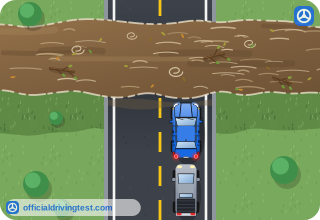
- Turn around and find another route
- Drive through slowly in a low gear
- Follow another vehicle across
- Wait at the water’s edge for it to drain
Show answer
Correct answer: Turn around and find another route
The manual says not to drive through flooded areas and to turn around and find another route.
Source: Alaska Driver Manual (Revised October 2025), page 72 · Open this page in the manual (Manual page 72)
-
Why should you be especially cautious around floodwaters at night?
- Water is deeper at night
- Flash floods only happen at night
- Visibility is limited
- Roads are closed at night
Show answer
Correct answer: Visibility is limited
The manual says to be cautious, especially at night, when the visibility is limited.
Source: Alaska Driver Manual (Revised October 2025), page 72 · Open this page in the manual (Manual page 72)
-
How much water will reach the bottom of most passenger cars, causing loss of control or possible stalling?
- 2 inches
- 6 inches
- 1 foot
- 18 inches
Show answer
Correct answer: 6 inches
Six inches of water will reach the bottom of most passenger cars.
Source: Alaska Driver Manual (Revised October 2025), page 72 · Open this page in the manual (Manual page 72)
-
How much moving water can carry away most vehicles, including sport utility vehicles and pick-up trucks?
- Three inches
- One foot
- Four feet
- Two feet
Show answer
Correct answer: Two feet
Two feet of moving water can carry away most vehicles.
Source: Alaska Driver Manual (Revised October 2025), page 72 · Open this page in the manual (Manual page 72)
-
Why should you not try to cross a flooded road even if the water looks shallow?
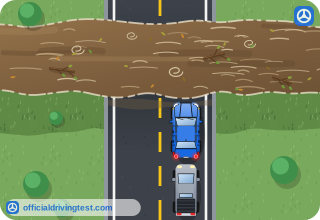
- Water can hide dips or wash away the road surface
- Shallow water always stalls a car’s engine
- Floodwater is always deeper in the middle of the road
- Tires lose all grip once any water covers the road
Show answer
Correct answer: Water can hide dips or wash away the road surface
Water can hide dips, and floodwaters can damage roadways by washing away the underlying road surface.
Source: Alaska Driver Manual (Revised October 2025), page 72 · Open this page in the manual (Manual page 72)
-
What should you do if there is no other route around floodwaters?
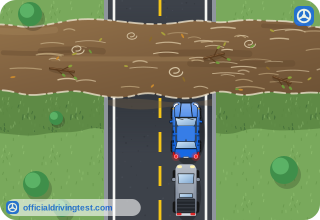
- Drive through in a low gear while watching the depth
- Cross at the shallowest point and drive slowly
- Go to higher ground and wait for the waters to subside
- Park at the edge of the water and stay in the car
Show answer
Correct answer: Go to higher ground and wait for the waters to subside
If there is no other route, proceed to higher ground and wait for the waters to subside.
Source: Alaska Driver Manual (Revised October 2025), page 72 · Open this page in the manual (Manual page 72)
-
How soon after excessive rainfall can flash floods occur?
- Only after several days
- Within a few minutes or hours
- Only after the rain has stopped for a day
- Never in less than a week
Show answer
Correct answer: Within a few minutes or hours
Flash floods can come rapidly and unexpectedly, within a few minutes or hours of excessive rainfall.
Source: Alaska Driver Manual (Revised October 2025), page 72 · Open this page in the manual (Manual page 72)
-
Which of these is named as a cause of flooding?
- A dry spell lasting several weeks
- Strong winds alone
- A drop in river levels
- Run-off from deep snow
Show answer
Correct answer: Run-off from deep snow
Flooding can occur when there is run-off from deep snow, heavy rainfall, or when dams or levees break.
Source: Alaska Driver Manual (Revised October 2025), page 72 · Open this page in the manual (Manual page 72)
-
Where can floodwaters be found?
- On roads, bridges, and low areas
- Only in rural areas
- Only on unpaved roads
- Only on bridges near rivers
Show answer
Correct answer: On roads, bridges, and low areas
Floodwaters can be found on roads, bridges, and low areas.
Source: Alaska Driver Manual (Revised October 2025), page 72 · Open this page in the manual (Manual page 72)