Alaska: Emergencies — Part 3 Practice Test
Questions in this part include: “How many flares does the manual suggest carrying for nighttime emergencies?” · “Which of these is listed as suggested safety equipment?”
Independent educational site · not affiliated with any government agency or DMV
Ready? Test yourself
- Instant feedback with an explanation
- Every answer cites its source in the manual
- Your best score is saved on this device
Questions are original and based on the official manual "Alaska Driver Manual" (Revised October 2025), Alaska Department of Administration, Division of Motor Vehicles (DMV).
All 19 questions in this practice test
Take the test above first, then use this list to study. Tap “Show answer” to see the correct answer and explanation.
Show the questions and answersHide the questions
-
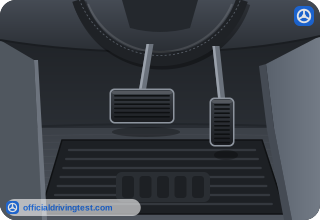
If your accelerator is jammed, which gear should you shift to?
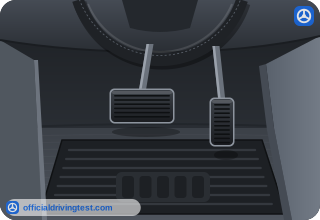
- Reverse
- Park while moving
- Neutral
- A higher gear
Show answer
Correct answer: Neutral
The manual says to shift to neutral when the accelerator is jammed.
Source: Alaska Driver Manual (Revised October 2025), page 66 · Open this page in the manual (Manual page 66)
-
Besides slapping the pedal and shifting to neutral, what else does the manual say to do when the accelerator is jammed?
- Turn the wheel sharply to the left
- Use the brakes and concentrate on steering
- Switch off the lights and then coast
- Sound the horn and keep your speed
Show answer
Correct answer: Use the brakes and concentrate on steering
The manual lists using the brakes and concentrating on steering for a jammed accelerator.
Source: Alaska Driver Manual (Revised October 2025), page 66 · Open this page in the manual (Manual page 66)
-
If your vehicle is disabled, where should you park it if possible?
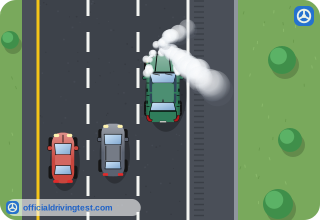
- Two wheels on the shoulder, two on the lane
- Right beside the center line of the road
- On the nearest bridge or overpass ahead
- All four wheels off the traveled highway
Show answer
Correct answer: All four wheels off the traveled highway
The manual says to park all four wheels off the traveled part of the highway if possible.
Source: Alaska Driver Manual (Revised October 2025), page 66 · Open this page in the manual (Manual page 66)
-
What should you turn on at night when your vehicle is disabled?
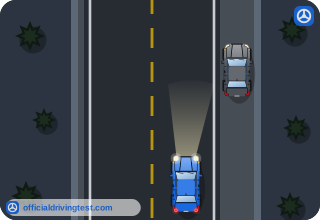
- High beam headlights only
- The windshield wipers
- The interior dome light only
- Parking lights or 4-way flashers
Show answer
Correct answer: Parking lights or 4-way flashers
The manual says to turn on parking lights or 4-way flashers at night.
Source: Alaska Driver Manual (Revised October 2025), page 66 · Open this page in the manual (Manual page 66)
-
What does the manual say to set out, if available, when your vehicle is disabled?
- Tire chains and a snow brush
- Flares or warning triangles
- Spare tires and a jack stand
- Orange traffic barrels or cones
Show answer
Correct answer: Flares or warning triangles
The manual says to set out flares or warning triangles if available.
Source: Alaska Driver Manual (Revised October 2025), page 66 · Open this page in the manual (Manual page 66)
-
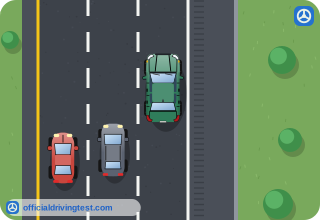
If you cannot move a disabled car off the roadway, what should you do to warn other motorists?
- Open all the doors
- Lower the windows
- Raise the hood
- Turn the wheels toward traffic
Show answer
Correct answer: Raise the hood
The manual says to raise the hood to warn other motorists.
Source: Alaska Driver Manual (Revised October 2025), page 66 · Open this page in the manual (Manual page 66)
-
Which is the first step listed if your brakes fail?
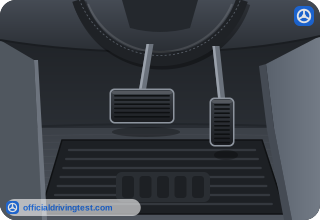
- Use the parking brake
- Turn off the engine at once
- Shift into reverse
- Steer into oncoming traffic
Show answer
Correct answer: Use the parking brake
The manual lists using the parking brake first when brakes fail.
Source: Alaska Driver Manual (Revised October 2025), page 66 · Open this page in the manual (Manual page 66)
-
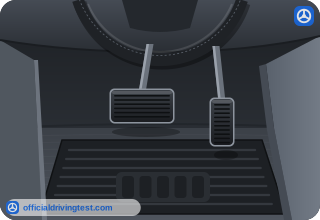
If your brakes fail, which gear should you shift to?
- A higher gear
- A lower gear
- Neutral
- Park
Show answer
Correct answer: A lower gear
The manual says to shift to a lower gear when brakes fail.
Source: Alaska Driver Manual (Revised October 2025), page 66 · Open this page in the manual (Manual page 66)
-
What does the manual say to do with your tires if your brakes fail?
- Spin them on gravel
- Lock them by turning off the engine
- Swerve them across the center line
- Rub them on the curb
Show answer
Correct answer: Rub them on the curb
The manual lists rubbing the tires on the curb as a way to slow down when brakes fail.
Source: Alaska Driver Manual (Revised October 2025), page 66 · Open this page in the manual (Manual page 66)
-
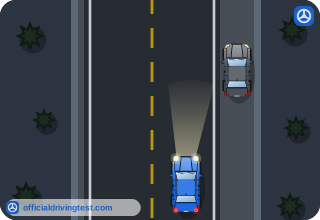
What should you do first when another vehicle is approaching in your lane?
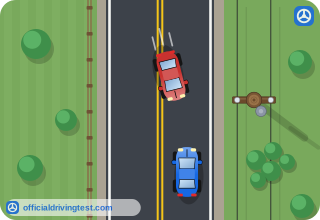
- Sound your horn
- Flash your parking lights only
- Slow down gradually
- Stop in the lane
Show answer
Correct answer: Sound your horn
The manual lists sounding your horn first for a vehicle approaching in your lane.
Source: Alaska Driver Manual (Revised October 2025), page 66 · Open this page in the manual (Manual page 66)
-
When a vehicle is approaching in your lane, how should you brake?
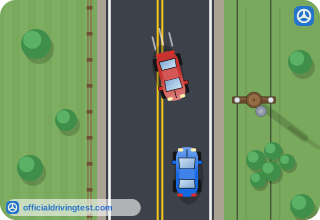
- Softly
- Not at all
- Sharply
- Intermittently and lightly
Show answer
Correct answer: Sharply
The manual says to brake sharply when a vehicle approaches in your lane.
Source: Alaska Driver Manual (Revised October 2025), page 66 · Open this page in the manual (Manual page 66)
-
Where should you steer when a vehicle is approaching in your lane?
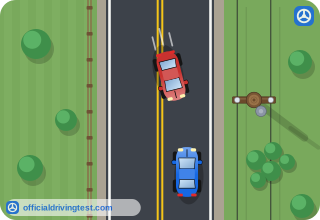
- For the shoulder or ditch
- Into the opposite lane
- Straight toward the vehicle
- Across the center line
Show answer
Correct answer: For the shoulder or ditch
The manual says to steer for the shoulder or ditch.
Source: Alaska Driver Manual (Revised October 2025), page 66 · Open this page in the manual (Manual page 66)
-
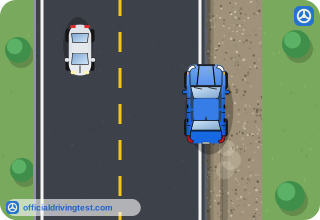
If you have veered off the roadway, what should you do about the gas?
- Press the accelerator harder
- Hold steady speed
- Stop feeding gas
- Tap the accelerator to regain traction
Show answer
Correct answer: Stop feeding gas
The manual lists stopping feeding gas first when a wheel is off the roadway.
Source: Alaska Driver Manual (Revised October 2025), page 67 · Open this page in the manual (Manual page 67)
-
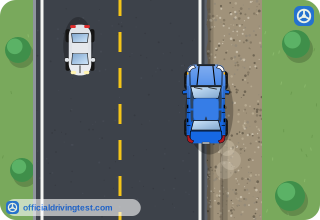
If you have veered off the roadway, how should you hold the steering wheel?
- With one hand only
- With a firm grip
- Loosely, to let the car straighten
- Turning it sharply right away
Show answer
Correct answer: With a firm grip
The manual says to maintain a firm grip on the steering wheel.
Source: Alaska Driver Manual (Revised October 2025), page 67 · Open this page in the manual (Manual page 67)
-
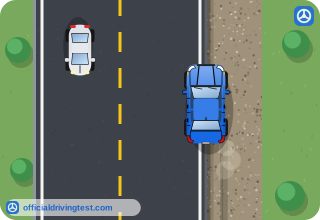
If your wheels are off the roadway, how should you use the brakes?
- Hard and continuously
- Not at all
- Only with the parking brake
- Lightly and intermittently
Show answer
Correct answer: Lightly and intermittently
The manual says to brake lightly and intermittently.
Source: Alaska Driver Manual (Revised October 2025), page 67 · Open this page in the manual (Manual page 67)
-
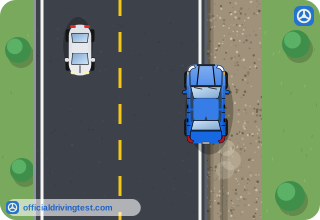
When may you try to return to the pavement after veering off the roadway?
- As soon as you have slowed down a little
- After you have sounded your horn twice
- Once the car behind you has already passed
- When no cars are in your immediate vicinity
Show answer
Correct answer: When no cars are in your immediate vicinity
The manual says not to return to pavement until there are no cars in your immediate vicinity.
Source: Alaska Driver Manual (Revised October 2025), page 67 · Open this page in the manual (Manual page 67)
-
At what speed should you turn back onto the pavement after veering off the roadway?
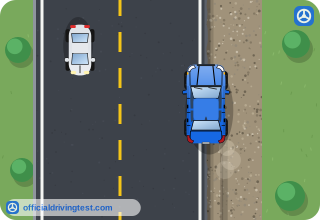
- The speed limit
- A slow speed
- A high speed to get across quickly
- Any speed, if the angle is gentle
Show answer
Correct answer: A slow speed
The manual says to turn back on to the pavement at slow speed.
Source: Alaska Driver Manual (Revised October 2025), page 67 · Open this page in the manual (Manual page 67)
-
How many flares does the manual suggest carrying for nighttime emergencies?
- One
- Two
- Three
- Six
Show answer
Correct answer: Three
The manual lists three flares for nighttime emergencies among its suggested safety equipment.
Source: Alaska Driver Manual (Revised October 2025), page 69 · Open this page in the manual (Manual page 69)
-
Which of these is listed as suggested safety equipment?
- A trailer hitch for towing
- Snow tires or tire chains
- A roof rack for extra cargo
- A fuel additive for the tank
Show answer
Correct answer: Snow tires or tire chains
The manual's list of suggested safety equipment includes snow tires or tire chains, a frost scraper and snow brush, and booted anti-ice wiper blades.
Source: Alaska Driver Manual (Revised October 2025), page 69 · Open this page in the manual (Manual page 69)