Alabama: Right-of-way and turning — Part 4 Practice Test
Questions in this part include: “According to the manual, what causes most head-on and sideswipe collisions on two-lane highways?” · “What does using your turn signal alone give you when you want to pass on the right?”
Independent educational site · not affiliated with any government agency or DMV
Ready? Test yourself
- Instant feedback with an explanation
- Every answer cites its source in the manual
- Your best score is saved on this device
Questions are original and based on the official manual "Alabama Driver Manual" (November 2024), Alabama Law Enforcement Agency (ALEA), Driver License Division.
All 19 questions in this practice test
Take the test above first, then use this list to study. Tap “Show answer” to see the correct answer and explanation.
Show the questions and answersHide the questions
-
What happens if you enter an uncontrolled intersection at an unlawful speed?
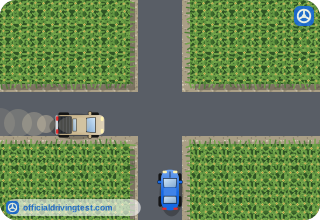
- You lose any right of way you might otherwise have
- You keep the right of way if you arrive first
- You must stop and wait for a police officer
- You gain the right of way over slower vehicles
Show answer
Correct answer: You lose any right of way you might otherwise have
If you enter an uncontrolled intersection at an unlawful speed, you lose any right of way you might otherwise have.
Source: Alabama Driver Manual (November 2024), page 63 · Open this page in the manual (Manual page 63)
-
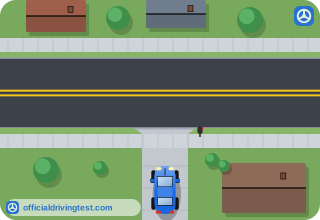
What must cars entering from a private road or driveway do?
- Yield only to cars on their left
- Proceed first if the road is clear on the right
- Yield only when a stop sign is posted
- Stop and yield to cars on a public street or highway
Show answer
Correct answer: Stop and yield to cars on a public street or highway
Cars entering from a private road or driveway must stop and yield to cars on a public street or highway.
Source: Alabama Driver Manual (November 2024), page 63 · Open this page in the manual (Manual page 63)
-
What should you do when entering an intersection where there is a yield sign facing you?
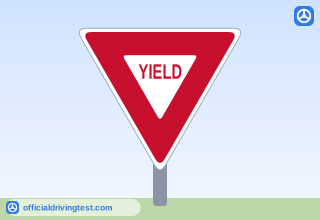
- Slow down and, if necessary, stop to yield to crossing traffic
- Always stop completely and wait for a green light
- Maintain your speed, since you have the right of way
- Stop only if a vehicle is directly beside you
Show answer
Correct answer: Slow down and, if necessary, stop to yield to crossing traffic
At a yield sign you slow down and, if necessary, stop to yield to vehicles and pedestrians legally crossing the roadway.
Source: Alabama Driver Manual (November 2024), page 63 · Open this page in the manual (Manual page 63)
-
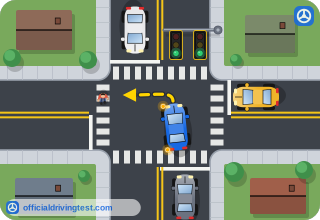
When making a left turn, which vehicles must you yield to?
- Only vehicles that are approaching from behind you in your lane
- Only vehicles that are stopped
- Oncoming vehicles within the intersection or close enough to be a hazard
- No vehicles, since you are already in the intersection
Show answer
Correct answer: Oncoming vehicles within the intersection or close enough to be a hazard
A driver turning left must yield to any vehicle approaching from the opposite direction within the intersection or so close as to constitute an immediate hazard.
Source: Alabama Driver Manual (November 2024), page 63 · Open this page in the manual (Manual page 63)
-
What must vehicles entering an intersection on a green arrow do?
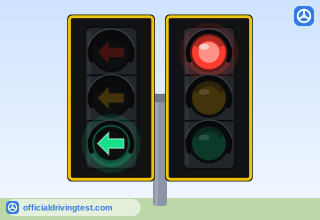
- Proceed first, as the arrow gives absolute right of way
- Yield to other traffic lawfully using the intersection
- Stop and wait for a full green light
- Yield only to pedestrians
Show answer
Correct answer: Yield to other traffic lawfully using the intersection
Vehicles entering on green arrows must yield to other traffic lawfully using the intersection.
Source: Alabama Driver Manual (November 2024), page 63 · Open this page in the manual (Manual page 63)
-
According to the manual, what causes most head-on and sideswipe collisions on two-lane highways?
- Improper or careless passing
- Driving below the posted speed limit
- Using turn signals too early
- Driving with the headlights on in daytime
Show answer
Correct answer: Improper or careless passing
The manual says most of these collisions are caused by improper or careless passing.
Source: Alabama Driver Manual (November 2024), page 64 · Open this page in the manual (Manual page 64)
-
Besides the areas marked no-passing, when must drivers exercise extreme caution in all areas?
- Only when the road ahead is straight and dry
- In darkness, poor visibility, and on slippery roads
- Only on roads with three or more lanes
- Only during the first hour after sunrise
Show answer
Correct answer: In darkness, poor visibility, and on slippery roads
The manual requires extreme caution in all areas during darkness, poor visibility, and slippery road surfaces.
Source: Alabama Driver Manual (November 2024), page 64 · Open this page in the manual (Manual page 64)
-
On a two-lane road with traffic moving in both directions, when may you pass traffic on the left?
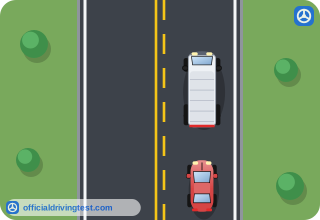
- Whenever the driver ahead is going slower than you
- Only when the driver ahead gives a hand signal to pass
- Only if you speed up to 10 mph over the limit
- When it can be completed safely within the speed limit
Show answer
Correct answer: When it can be completed safely within the speed limit
Passing on the left is allowed only if it can be completed safely without exceeding the speed limit.
Source: Alabama Driver Manual (November 2024), page 64 · Open this page in the manual (Manual page 64)
-
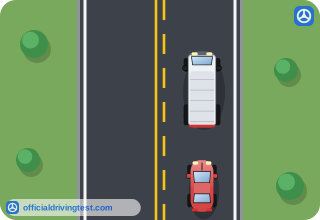
In preparing to pass, what should you check besides the road ahead for sufficient distance?
- The fuel gauge, to be sure you can speed up
- The mirror of the car you are about to pass
- The road behind, for traffic preparing to pass you
- The road to the right, for pedestrians only
Show answer
Correct answer: The road behind, for traffic preparing to pass you
The manual says to check the road ahead for distance and the road behind for traffic that may be preparing to pass you.
Source: Alabama Driver Manual (November 2024), page 64 · Open this page in the manual (Manual page 64)
-
Which is a helpful way to signal your intention to the driver ahead before passing at night?
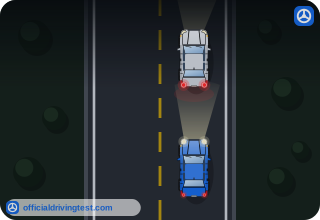
- A flick of your headlights
- Turning on your hazard lights
- A long blast of the horn
- Turning off your headlights briefly
Show answer
Correct answer: A flick of your headlights
The manual says a tap of the horn or a flick of headlights at night is helpful.
Source: Alabama Driver Manual (November 2024), page 64 · Open this page in the manual (Manual page 64)
-
When should you activate your right turn signal when passing another vehicle?
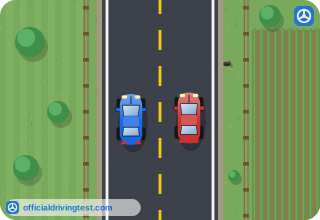
- Before you move into the left lane to pass
- While you are alongside the other vehicle
- Only if the other driver signals first
- After passing, before returning to the right lane
Show answer
Correct answer: After passing, before returning to the right lane
Left turn signals are used before passing and right turn signals after passing and before returning to the right lane.
Source: Alabama Driver Manual (November 2024), page 64 · Open this page in the manual (Manual page 64)
-
After passing a vehicle, when may you return to the right lane?
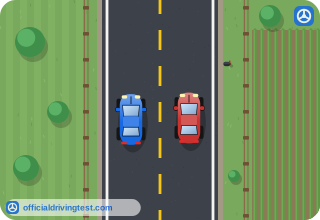
- As soon as your front bumper is even with the passed vehicle
- When you see the whole front of the passed vehicle in your mirror
- After you have driven one full mile past the vehicle
- When the passed vehicle slows to 30 mph or less
Show answer
Correct answer: When you see the whole front of the passed vehicle in your mirror
You must not return to the right lane until you can see the entire front of the vehicle you passed in your interior rear view mirror.
Source: Alabama Driver Manual (November 2024), page 64 · Open this page in the manual (Manual page 64)
-
When another car is trying to pass you, what should you do?
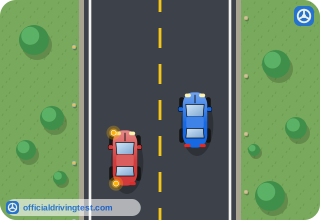
- Stay in your own lane and not increase speed
- Speed up to keep the other car behind you
- Move onto the shoulder to let it by
- Brake hard so the other car can pass quickly
Show answer
Correct answer: Stay in your own lane and not increase speed
The manual says to stay in your own lane and not increase speed when another car is passing you.
Source: Alabama Driver Manual (November 2024), page 64 · Open this page in the manual (Manual page 64)
-
Where is passing on the right permissible?
- On any two-lane road with traffic in both directions
- Only on curves and hills with a clear view
- On one-way roads and roads with two or more lanes in one direction
- Nowhere, because passing on the right is always unlawful
Show answer
Correct answer: On one-way roads and roads with two or more lanes in one direction
Passing on the right is permitted on one-way roadways and on roads marked for two or more lanes moving in the same direction.
Source: Alabama Driver Manual (November 2024), page 64 · Open this page in the manual (Manual page 64)
-
What does using your turn signal alone give you when you want to pass on the right?
- The right of way over the car ahead
- Permission to drive on the shoulder
- The right to pass without checking traffic
- No right to pass
Show answer
Correct answer: No right to pass
The manual states that use of the signal alone does not give you the right to pass.
Source: Alabama Driver Manual (November 2024), page 65 · Open this page in the manual (Manual page 65)
-
Why must you be extremely cautious when passing on the right?
- Because it is unlawful everywhere in the state of Alabama
- Because other drivers always signal first
- It is forbidden in some states, so visitors may not expect it
- Because the shoulder is reserved for wreckers
Show answer
Correct answer: It is forbidden in some states, so visitors may not expect it
The manual notes that passing on the right is forbidden in some states, so out-of-state drivers may not expect it.
Source: Alabama Driver Manual (November 2024), page 65 · Open this page in the manual (Manual page 65)
-
You may not cross the center line to pass on a curve or hill unless you can see a clear passing distance of at least how many feet?
- 500 feet
- 200 feet
- 300 feet
- 1,000 feet
Show answer
Correct answer: 500 feet
The manual prohibits crossing the center line on a curve or hill where you cannot see a clear passing distance of at least 500 feet.
Source: Alabama Driver Manual (November 2024), page 65 · Open this page in the manual (Manual page 65)
-
In which situation may you not cross the center line to pass?
- On a straight road with no oncoming traffic
- When the vehicle ahead is signaling a right turn
- On a one-way street with two lanes
- At a highway intersection
Show answer
Correct answer: At a highway intersection
The manual lists a highway intersection among the places where crossing the center line to pass is prohibited.
Source: Alabama Driver Manual (November 2024), page 65 · Open this page in the manual (Manual page 65)
-
When may you not cross the center line to pass?
- When the vehicle ahead is traveling under the speed limit
- When meeting an oncoming vehicle
- When the road ahead is straight and clear for a long distance
- When you are on a road with no center line painted
Show answer
Correct answer: When meeting an oncoming vehicle
Crossing the center line to pass is prohibited when meeting an oncoming vehicle.
Source: Alabama Driver Manual (November 2024), page 65 · Open this page in the manual (Manual page 65)