Alabama: Right-of-way and turning — Part 1 Practice Test
Questions in this part include: “How long should you continue to give your turn signal?” · “Before you turn, where should you check for cars and pedestrians?”
Independent educational site · not affiliated with any government agency or DMV
Ready? Test yourself
- Instant feedback with an explanation
- Every answer cites its source in the manual
- Your best score is saved on this device
Questions are original and based on the official manual "Alabama Driver Manual" (November 2024), Alabama Law Enforcement Agency (ALEA), Driver License Division.
All 20 questions in this practice test
Take the test above first, then use this list to study. Tap “Show answer” to see the correct answer and explanation.
Show the questions and answersHide the questions
-
How far before making a turn should you signal your intentions?
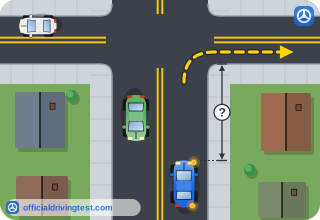
- At least 50 feet
- At least 100 feet
- At least 150 feet
- At least 300 feet
Show answer
Correct answer: At least 100 feet
The manual says to signal at least 100 feet before making the turn.
Source: Alabama Driver Manual (November 2024), page 21 · Open this page in the manual (Manual page 21)
-
How long should you continue to give your turn signal?
- Until you begin to slow down
- Until you are ready to make the actual turn
- Until you reach the intersection
- Until the vehicle behind you has slowed down
Show answer
Correct answer: Until you are ready to make the actual turn
The manual says to continue the signal until you are ready to make the actual turn.
Source: Alabama Driver Manual (November 2024), page 21 · Open this page in the manual (Manual page 21)
-
Who are turn signals given to inform?
- Only drivers behind you
- Only drivers coming toward you
- Only traffic officers
- Both pedestrians and drivers
Show answer
Correct answer: Both pedestrians and drivers
The manual says signals are given to inform both pedestrians and drivers of your intentions.
Source: Alabama Driver Manual (November 2024), page 21 · Open this page in the manual (Manual page 21)
-
Where should your hands be when you are actually making a turn?
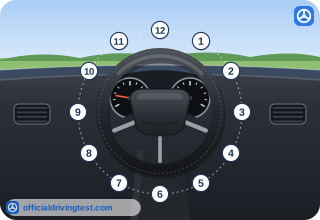
- Both hands on the steering wheel
- One hand on the wheel and one hand signaling
- One hand on the wheel and one hand on the gearshift
- Both hands resting at the bottom of the wheel
Show answer
Correct answer: Both hands on the steering wheel
The manual says both hands should be on the steering wheel when actually turning.
Source: Alabama Driver Manual (November 2024), page 21 · Open this page in the manual (Manual page 21)
-
When should you get into the proper turn lane?
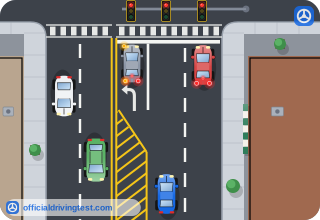
- Well ahead of the turn, once it is safe to change lanes
- Just before you reach the corner where you will turn
- Only after you have started to turn into the street
- As soon as the light changes, even if that lane is full
Show answer
Correct answer: Well ahead of the turn, once it is safe to change lanes
The manual says to get into the proper turn lane well ahead of the turn and be sure the change is safe.
Source: Alabama Driver Manual (November 2024), page 21 · Open this page in the manual (Manual page 21)
-
When should you decide to make a turn?
- As you reach the intersection, once you see the cross street
- At the last moment, after checking for other traffic
- Before you get there, preparing for it in advance
- Only when the car ahead of you has made its turn
Show answer
Correct answer: Before you get there, preparing for it in advance
The manual says to prepare for the turn before you get there and not make the decision at the last moment.
Source: Alabama Driver Manual (November 2024), page 21 · Open this page in the manual (Manual page 21)
-
When should you reduce your speed for a turn?
- In the middle of the turn
- Before making the turn
- After completing the turn
- Only when the road is wet
Show answer
Correct answer: Before making the turn
The manual lists reducing speed before making turns among its rules for turns.
Source: Alabama Driver Manual (November 2024), page 21 · Open this page in the manual (Manual page 21)
-
In which lane should you finish your turn?
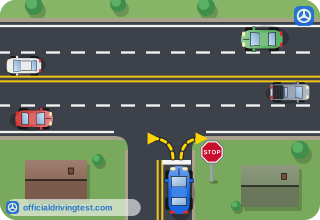
- The lane with the least traffic
- Whichever lane the vehicle ahead of you uses
- Any lane that is open
- The proper lane
Show answer
Correct answer: The proper lane
The manual says to always finish your turn in the proper lane.
Source: Alabama Driver Manual (November 2024), page 21 · Open this page in the manual (Manual page 21)
-
Before you turn, where should you check for cars and pedestrians?
- Only to the front and sides
- Only to the rear
- Only in the street you are leaving
- To the front, rear, and sides
Show answer
Correct answer: To the front, rear, and sides
The manual says to check to the front, rear, and sides for cars and pedestrians before turning.
Source: Alabama Driver Manual (November 2024), page 21 · Open this page in the manual (Manual page 21)
-
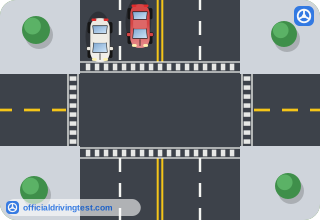
How should you make a right turn from a four-lane or divided highway?
- Move to the center of the road and make a wide swing into the cross street
- Enter the left lane first, then swing right into the lane of the cross street
- Enter the right lane early and make a tight turn into the cross street's right lane
- Turn from the lane nearest the center line into any lane of the cross street
Show answer
Correct answer: Enter the right lane early and make a tight turn into the cross street's right lane
The manual says to enter the right lane well in advance and make a tight turn into the right lane of the cross street.
Source: Alabama Driver Manual (November 2024), page 21 · Open this page in the manual (Manual page 21)
-
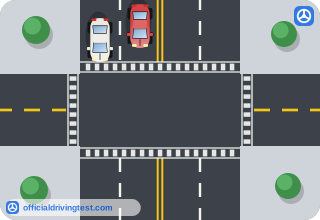
For a left turn from a four-lane or divided highway, which lane should you turn from?
- The lane nearest the center line or traffic divider
- The right lane, using a wide swing into the cross street
- The lane farthest from the center line or traffic divider
- Whichever lane is open when you reach the intersection
Show answer
Correct answer: The lane nearest the center line or traffic divider
The manual says to move to the lane nearest the center line or traffic divider and turn from the inside lane.
Source: Alabama Driver Manual (November 2024), page 21 · Open this page in the manual (Manual page 21)
-
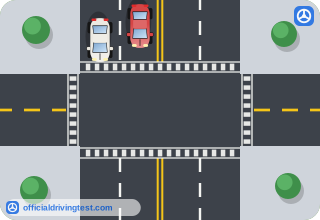
Where should you enter the cross street when making a left turn from a four-lane highway?
- In the lane farthest from the centerline of the cross street
- Across the centerline, into the lane of oncoming traffic
- In the center of the cross street, after a wide swing
- Just to the right of the centerline, avoiding a wide swing
Show answer
Correct answer: Just to the right of the centerline, avoiding a wide swing
The manual says to avoid a wide swing and enter the cross street just to the right of the centerline.
Source: Alabama Driver Manual (November 2024), page 21 · Open this page in the manual (Manual page 21)
-
When may you turn from more than one lane at an intersection?
- At any intersection that has four or more lanes
- When signs or pavement markings there permit it
- Whenever the traffic behind you is waiting
- Only at intersections that have traffic signals
Show answer
Correct answer: When signs or pavement markings there permit it
The manual says some intersections are marked to permit turns from more than one lane, as indicated by signs or markings.
Source: Alabama Driver Manual (November 2024), page 21 · Open this page in the manual (Manual page 21)
-
Which of these is one of the manual's proper turning rules?
- Always turn from the lane nearest the right curb
- Adjust your speed to the flow of traffic
- Stop in the intersection to look for traffic before turning
- Turn only after sounding your horn
Show answer
Correct answer: Adjust your speed to the flow of traffic
The manual lists adjusting speed to the flow of traffic as part of the proper turning rules.
Source: Alabama Driver Manual (November 2024), page 22 · Open this page in the manual (Manual page 22)
-
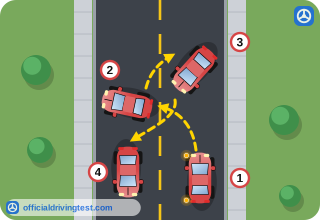
What must be true when you make a three-point turn?
- It must be made only at a stop sign
- It must be signaled with a horn blast
- It must be completed in under ten seconds
- It must be made without endangering other traffic
Show answer
Correct answer: It must be made without endangering other traffic
The manual says a three-point turn must be made without endangering other traffic.
Source: Alabama Driver Manual (November 2024), page 23 · Open this page in the manual (Manual page 23)
-
Where are three-point turns normally permitted?
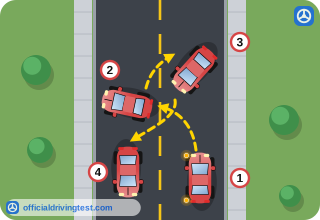
- Where you can be seen for a great distance and the turn is not a hazard
- Only on interstate freeways when the traffic is light enough
- Only near the top of a hill, where traffic is generally slower
- Anywhere that a sign does not forbid it, even on a sharp curve
Show answer
Correct answer: Where you can be seen for a great distance and the turn is not a hazard
The manual says they are normally permitted where the vehicle can be seen for a great distance and the turn would not be a hazard.
Source: Alabama Driver Manual (November 2024), page 23 · Open this page in the manual (Manual page 23)
-
Where are three-point turns NOT permitted?
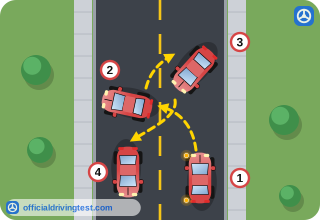
- On two-lane roads and in residential areas
- On one-way streets and in parking lots
- On interstate freeways, curves, or near the top of hills
- On roads with a posted speed limit under 45 mph
Show answer
Correct answer: On interstate freeways, curves, or near the top of hills
The manual says three-point turns are not permitted on interstate freeways, on curves, or near the top of hills.
Source: Alabama Driver Manual (November 2024), page 23 · Open this page in the manual (Manual page 23)
-
Near the top of a hill, a three-point turn is not permitted if you cannot be seen by drivers approaching from either direction within how many feet?
- 500 feet
- 200 feet
- 300 feet
- 1,000 feet
Show answer
Correct answer: 500 feet
The manual says three-point turns are not permitted near hilltops where you cannot be seen within 500 feet.
Source: Alabama Driver Manual (November 2024), page 23 · Open this page in the manual (Manual page 23)
-
Are signs always posted to warn you where a three-point turn is not allowed?
- Yes, a sign is required at every place where they are not allowed
- Yes, but only on interstate freeways and on divided highways
- No, they are governed by local ordinances and there may be no signs
- No, because they are governed only by state law on all roads
Show answer
Correct answer: No, they are governed by local ordinances and there may be no signs
The manual says they are governed by local ordinances and there may be no signs, though prohibitory signs are usually posted at hazardous locations.
Source: Alabama Driver Manual (November 2024), page 23 · Open this page in the manual (Manual page 23)
-
At a 4-way stop intersection with other vehicles stopped or moving, in what order should the vehicles leave the stop signs?
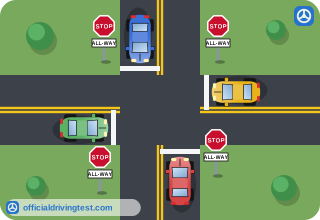
- The largest vehicle leaves first
- The vehicle on the left leaves first
- Vehicles going straight leave before turning vehicles
- In the same order in which they arrived
Show answer
Correct answer: In the same order in which they arrived
The manual says vehicles should leave the stop signs in the same order in which they arrived.
Source: Alabama Driver Manual (November 2024), page 42 · Open this page in the manual (Manual page 42)